At Vedhas Technology, we’ve seen brilliant ideas stall because founders try to build everything at once. In 2026, over-engineering is the fastest way to burn your capital. The key to survival isn’t a full-scale app on day one—it’s mastering the MVP development cost to preserve your runway for growth. In the race to launch a perfect product, many entrepreneurs exhaust their capital before their app even touches the market.
In today’s competitive landscape, the key to survival isn’t building a full-scale application on day one—it’s mastering the MVP development cost. A Minimum Viable Product (MVP) allows you to launch with the essential features needed to solve a core problem, validate your business model, and preserve your runway for future growth.
However, “how much does it cost to build an app?” is a question with a moving target. Without a clear software development cost estimator, you are essentially flying blind. Understanding your initial investment is the singular difference between a strategic market entry and a premature exit.
Before you dive into the strategy, get a realistic baseline for your vision. Use our interactive software development cost estimator to see how your industry and feature list impact your 2026 budget.
The MVP Development Lifecycle: More Than Just a Prototype
An MVP isn’t a prototype; it’s a functional product designed to survive the real world. At Vedhas, our app development lifecycle focuses on getting you to market in 8 to 16 weeks. We don’t just build; we validate your custom software pricing against actual market needs.
Understanding these stages ensures that your startup software budget is allocated to the areas that drive the most growth.
The 4 Stages of the MVP Journey
- Ideation & Market Validation: Before writing a single line of code, you must validate that a market exists. This phase involves competitor analysis and user research to ensure your custom software pricing reflects a product people actually need.
- Prototyping (UI/UX Design): Here, we create wireframes and click-through mockups. This allows you to visualize the user flow and refine the experience before the more expensive coding phase begins.
- The MVP Build: This is the core of your investment. It involves the actual engineering—frontend development, backend architecture, and database setup. This is where the majority of your project budget estimator results are focused.
- Launch & Feedback Loop: Once the MVP is live, the focus shifts to data. You collect user feedback to decide what to build, what to fix, and what to scrap in the next version.
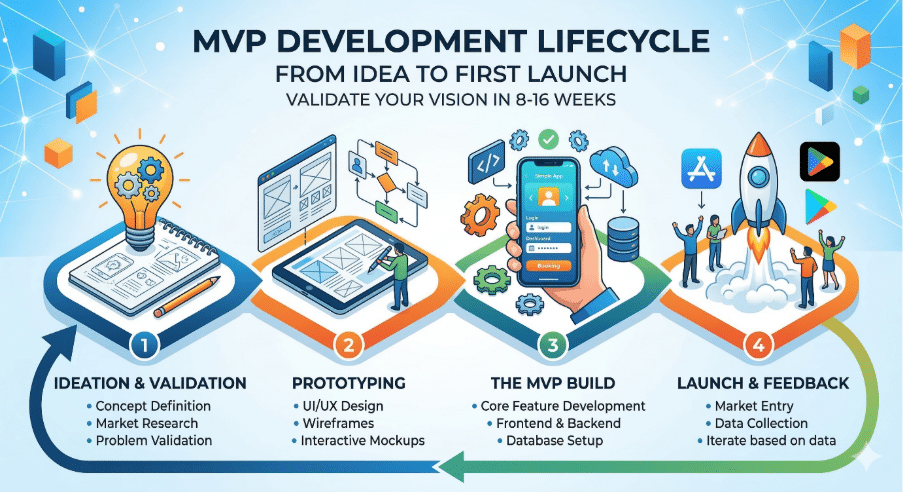
SEO Alt Text: Modern MVP development lifecycle infographic showing stages from ideation to launch for startup budgeting.
By treating the build as a structured lifecycle rather than a one-time event, you gain control over your app development cost calculator inputs. This phased approach prevents “scope creep,” ensuring that your initial launch remains lean and financially viable.
Feature Auditing: The “Must-Have” vs. “Nice-to-Have” Framework
Our product consultants apply a ‘Ruthless Audit’ to your feature wishlist. Using the 80/20 rule, we identify the 20% of features that will drive 100% of your initial user engagement. This strategic narrowing is how we keep your MVP development cost lean without sacrificing quality rather than “nice-to-have” fluff that complicates the user experience.
The MVP Feature Audit: What to Keep vs. What to Cut
To keep your app development cost calculator results within a manageable range, use the following framework to prioritize your build:
| Keep (The Core MVP) | Cut (Post-Launch Roadmap) |
| Primary Value Proposition: The one feature that solves the user’s pain point. | Advanced AI/ML: Predictive models or complex automation (unless it is the core product). |
| Essential User Access: Single-method login (e.g., Email or Google) to minimize friction. | Social Overload: Integrating every social platform (FB, X, LinkedIn, Apple) at once. |
| Functional UI: A clean, intuitive interface that prioritizes usability over “wow” factor. | Custom Animations: Heavy transitions and micro-interactions that delay the launch. |
| One Core Integration: A single payment gateway (Stripe) or one primary data API. | Advanced Analytics: Granular heatmaps and complex data reporting dashboards. |
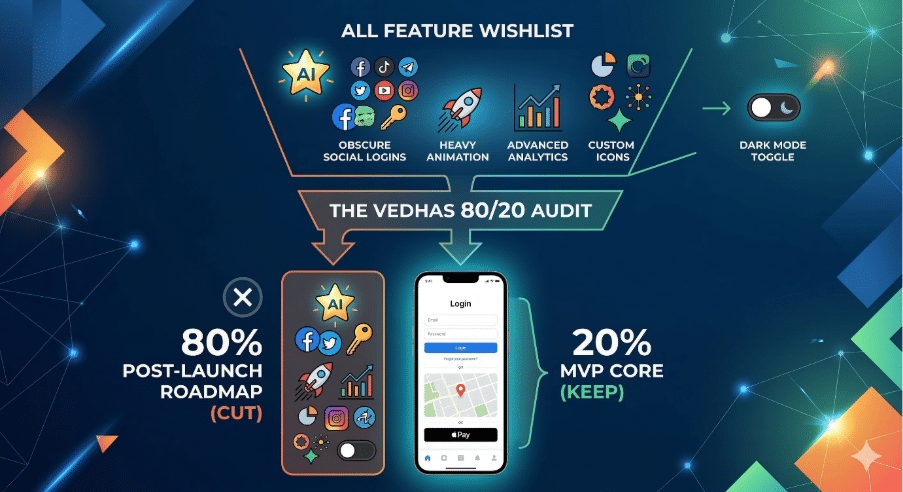
SEO Alt Text: Infographic showing the 80/20 rule application for MVP feature auditing, prioritizing core functions over nice-to-have features for startup budgeting.
The Goal: Strategic Narrowing
The objective of this framework is not to build a “cheap” product, but a focused one. By narrowing your focus to the “Must-Haves,” you significantly reduce the complexity of the backend architecture. This not only lowers the initial MVP development cost but also allows for a faster launch, giving you the agility to pivot based on real-world user data.
The Cost Spectrum: Basic MVP vs. Polished MVP
Not all MVPs are created equal. Depending on your industry and your audience, the level of “finish” required for a successful launch can vary significantly. At Vedhas Technology, we help founders navigate this by categorizing builds into two distinct tiers. Understanding where your idea sits on this spectrum is vital for an accurate software development cost estimate.
The “Basic” MVP: Speed & Utility
A Basic MVP is designed for high-speed market validation. It utilizes standard UI components and established frameworks to get your product live as quickly as possible.
- Technical Focus: Robust backend logic, standard security protocols, and a clean, functional interface.
- Best For: Internal business tools, B2B SaaS platforms, or “Blue Ocean” ideas where there is no direct competition and users prioritize utility over aesthetics.
The “Polished” MVP: Investor-Ready & Competitive
A Polished MVP is built to impress. In crowded markets, “good enough” often isn’t enough to capture user attention or secure venture capital.
- Technical Focus: Bespoke UI/UX design, custom branding, high-performance transitions, and advanced front-end architecture.
- Best For: Consumer-facing apps (B2C), high-stakes investor pitches, or entering competitive industries like Fintech or Wellness where the “experience” is a key part of the value proposition.
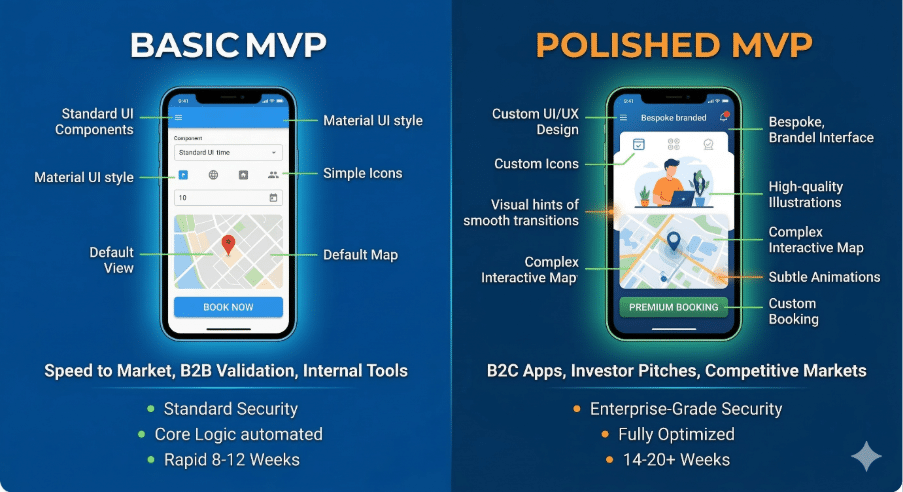
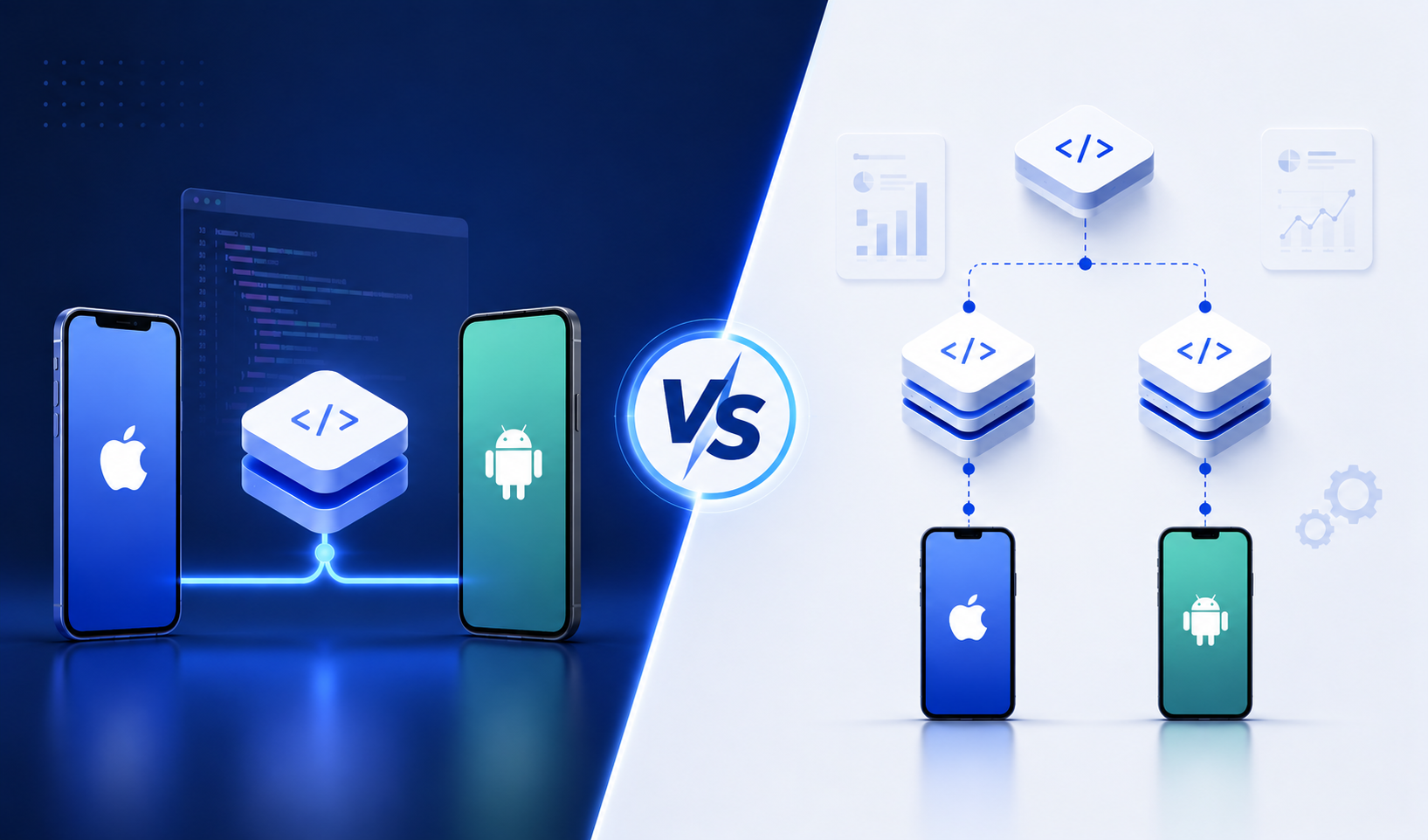
SEO Alt Text: Side-by-side comparison infographic of a basic MVP versus a polished MVP mobile app interface for software project budgeting.
Comparison Table: Aligning Your Budget with Your Vision
Use this table to determine which path aligns with your startup software budget. This comparison mirrors the “Level of Application” selection in our project budget estimator.
| Feature Category | Basic MVP | Polished MVP |
| Visual Design | Functional & standard (Material/Bootstrap) | Bespoke UI, Custom Icons, Branded Experience |
| User Experience | Straightforward & effective | Fluid transitions & high-fidelity interactions |
| Tech Architecture | Standard Scalability (React/Node.js) | Enterprise-ready, high-performance optimization |
| Average Timeline | 8 to 12 weeks | 14 to 20+ weeks |
| Best For… | B2B Validation & Internal Tools | B2C Apps & High-Stakes Fundraising |
| Next Step | Estimate Basic Project | Estimate Polished Project |
Hidden Budget Drivers: What Most Calculators Miss
When founders search for a software development cost estimate, they often find generic numbers that don’t account for the “invisible” factors of engineering. An app isn’t just a collection of buttons; it is an ecosystem. To ensure your startup software budget remains accurate, you must account for the specific technical drivers that can shift the final price.
1. Industry-Specific Complexity
Not every “app” is built on the same foundation. The industry you choose directly impacts the MVP development cost due to regulatory and technical requirements.
- Healthcare: Requires HIPAA compliance and advanced data encryption.
- Fintech: Demands PCI-DSS compliance and high-frequency security audits.
- Logistics: Needs complex API integrations for real-time GPS and routing. A standard retail app is fundamentally different from a medical portal, which is why our project budget estimator includes an industry-specific selector.
2. Platform Selection: Web vs. Mobile
Where your users live dictates your development spend.
- Web Applications: Often the most cost-effective entry point. They are easier to deploy and update, making them ideal for B2B validation.
- Cross-Platform Mobile (Flutter/React Native): This allows you to target both iOS and Android with a single codebase. It is more expensive than a web app but significantly cheaper than building two separate native applications.
3. Third-Party API & Integration Costs
Your app likely doesn’t live in a vacuum. Integrating external services like Stripe for payments, Twilio for SMS, or AWS for cloud storage adds layers of development time. While these services save you from building features from scratch, the engineering time required to “pipe” them into your system is a major software project cost driver.
By identifying these drivers early, you move away from “guesstimates” and toward a professional, data-backed budget.
Post-Launch Budgeting: The “Other” 20%
A common misconception among first-time founders is that the MVP development cost ends the day the app hits the store. In reality, “Launch Day” is just the beginning of the product’s lifecycle. To maintain a healthy startup software budget, you must plan for the “Other 20%”—the capital required to keep the lights on and the software evolving after the initial build.
Transparency is core to our philosophy at Vedhas Technology. When you use an app development cost calculator, you are typically seeing the price for the Build & Launch phase. However, professional software project budget planning should always include a reserve for the following post-launch realities:
1. Infrastructure & Maintenance
Even if you don’t add a single new feature, your software requires ongoing care. This includes:
- Cloud Hosting: Monthly fees for AWS, Azure, or Google Cloud.
- Security Patches: Routine updates to protect against new vulnerabilities.
- OS Updates: Ensuring your app remains compatible with the latest iOS and Android releases.
2. The Feedback Pivot
The primary goal of an MVP is to learn. Once real users start interacting with your product, they will inevitably discover bugs or request features you hadn’t anticipated. Reserving a portion of your custom software pricing budget for these “Day 2” iterations allows you to pivot quickly. If you spend 100% of your capital on the initial build, you lose the ability to act on the very data the MVP was designed to collect.
3. Scaling for Growth
As your user base grows from 10 to 10,000, your backend architecture may need optimization to handle the increased load. By acknowledging these software maintenance costs early, you ensure that your business remains operational and scalable without the need for emergency fundraising.
Conclusion: Start Small, Validate Fast, and Scale with Confidence
Building a successful startup in 2026 isn’t about who has the most features; it’s about who uses their capital most effectively. By focusing on a lean MVP development cost, you give your idea the best chance to breathe, adapt, and grow. Whether you choose a Basic MVP to prove your concept or a Polished MVP to capture a competitive market, the goal remains the same: validate your vision with real users before committing to enterprise-scale spending.
Don’t let the uncertainty of custom software pricing stall your progress. Strategic software project budget planning starts with data, not guesswork. By narrowing your focus, auditing your features, and accounting for industry drivers, you can preserve your runway and build a product that the market actually wants.
Ready to see where your idea fits?
Don’t gamble with your runway. Use the Vedhas Project Estimator to get a data-backed software development cost estimate tailored to your specific industry and platform today.