
The Midnight Migration Crisis of 2026
Imagine a Friday evening in late 2026. A lead architect at a major U.S. healthcare provider receives an urgent notification. The latest compliance audit has flagged their core patient data exchange—running on a legacy Windows Communication Foundation (WCF) service—as a “high-risk” violation of the new HIPAA Security Rule. The issue is not just about functionality; it is about the inability of the aging SOAP protocol to support mandatory end-to-end encryption and multi-factor authentication (MFA) at the service level without crippling performance. This is the “Legacy Tax” in its most aggressive form: a hidden cost that suddenly demands a multi-million dollar architectural overhaul just to keep the lights on.

The debate of WCF vs gRPC has moved out of the realm of “developer preference” and into the center of board-level risk management. For enterprises still tethered to.NET Framework 4.8, the clock has run out. The infrastructure is too slow, the security is insufficient, and the talent pool of developers willing to maintain XML-heavy SOAP services has evaporated. For many enterprises, the WCF vs gRPC decision has become a business survival issue rather than a technology upgrade.
Replacing WCF vs gRPC in 2026 is critical for enterprises migrating to.NET 10/11 to achieve 3–5x performance gains and meet new HIPAA/SOC2 compliance mandates for mandatory encryption. By adopting gRPC with Native AOT and skipping directly to Angular’s zoneless architecture, organizations can reduce Azure infrastructure costs by 40% and eliminate the “Legacy Tax” of maintaining outdated, Windows-locked services.
The Agitation: The True Cost of Inaction
The real-world impact of the WCF vs gRPC transition is no longer theoretical for enterprise teams. Remaining on WCF in 2026 is a recipe for operational paralysis. The risks are not merely technical; they are financial and legal. As the software market converges on.NET 10 (LTS) and the upcoming.NET 11, the gap between “stable legacy” and “modern efficient” has widened into a chasm.
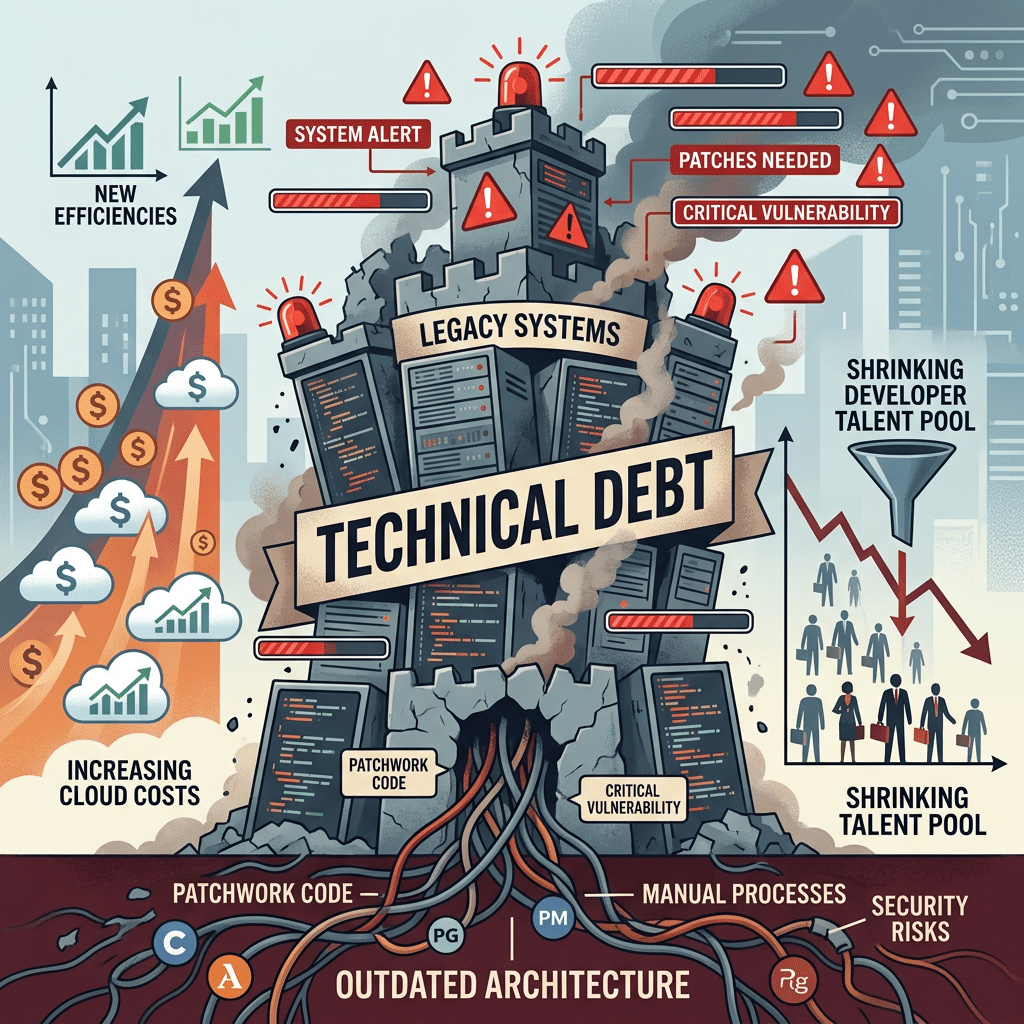
First, consider the Technical Debt. WCF services remain locked to the.NET Framework and Windows-based hosting. This prevents teams from utilizing Linux containers, which are the industry standard for cost-efficient, scalable microservices on platforms like Kubernetes. In a world of WCF vs gRPC, gRPC allows for cross-platform hosting on Kestrel, providing the flexibility that WCF could never deliver.
Second, the Talent Gap is reaching a breaking point. Senior developers are increasingly unwilling to work on legacy stacks, preferring the modern tooling and performance of gRPC and Angular Signals. Organizations that fail to modernize their architecture find themselves dependent on a shrinking pool of expensive consultants just to maintain basic services.
Finally, the Total Cost of Ownership (TCO) of legacy systems is ballooning. Because WCF is less efficient at serializing data and requires more memory to process SOAP envelopes, companies are over-provisioning their Azure or AWS instances to compensate for the bloat. In a direct WCF vs gRPC performance comparison, gRPC services using.NET 10 Native AOT show a ~60% reduction in execution time and memory footprint, allowing for massive consolidation of cloud resources.
Deep Dive: WCF vs gRPC for Enterprise Applications
To understand why the industry has moved toward replacing WCF with gRPC, one must look at the underlying mechanics of how these systems communicate. WCF was designed in an era of monolithic applications and stable, high-bandwidth local area networks. gRPC was born in the cloud-native era, where low latency, high throughput, and efficient resource utilization are the primary goals.
WCF vs gRPC Serialization Efficiency: XML vs Protobuf
The core of the WCF vs gRPC comparison is the difference between XML and Protocol Buffers (Protobuf). XML is a text-based format that is easy for humans to read but incredibly taxing for computers to parse. Every message sent over WCF includes verbose tags that consume bandwidth and CPU cycles. gRPC uses Protobuf, a binary serialization format. This is one of the biggest architectural advantages in the modern WCF vs gRPC comparison. This means the data is smaller, faster to transmit, and requires significantly less power to deserialize at the receiving end.
Comparision Table: WCF (XML) vs gRPC (Protobuf)
This table highlights the core architectural differences in the WCF vs gRPC performance model.
| Serialization Metric | WCF (XML) | gRPC (Protobuf) | Performance Advantage |
|---|---|---|---|
| Data Format | Text/Verbose | Binary/Compact | Up to 80% bandwidth reduction |
| CPU Parsing Overhead | High (String handling) | Low (Direct binary) | 3-5x faster processing |
| Schema Enforcement | Weak (WSDL config) | Strong (.protocontracts) | Fewer runtime errors |
WCF vs gRPC Transport Comparison: HTTP/1.1 vs HTTP/2
Another critical factor in the WCF vs gRPC debate is the transport protocol. WCF typically uses HTTP/1.1, which suffers from “Head-of-Line” (HOL) blocking. If one request in the queue is slow, all subsequent requests must wait. gRPC leverages HTTP/2, which supports multiplexing and allows multiple requests and responses over a single connection simultaneously. This allows multiple requests and responses to be sent over a single connection simultaneously without blocking each other. In large-scale systems, this gives the WCF vs gRPC architecture transition a major scalability advantage.
For a healthcare platform processing thousands of patient data points per second, this multiplexing capability is the difference between a responsive system and one that crashes under peak load.
The Solution: Vedhas’s Edge in Modernization
Modernizing a legacy stack is not just about changing code; it is about transforming a business. Vedhas Technology Solutions (Vedhas) has established itself as a premier partner for this transition, specifically for organizations in the U.S. healthcare, e-commerce, and enterprise sectors.
A Technical Roadmap for WCF to gRPC Migration
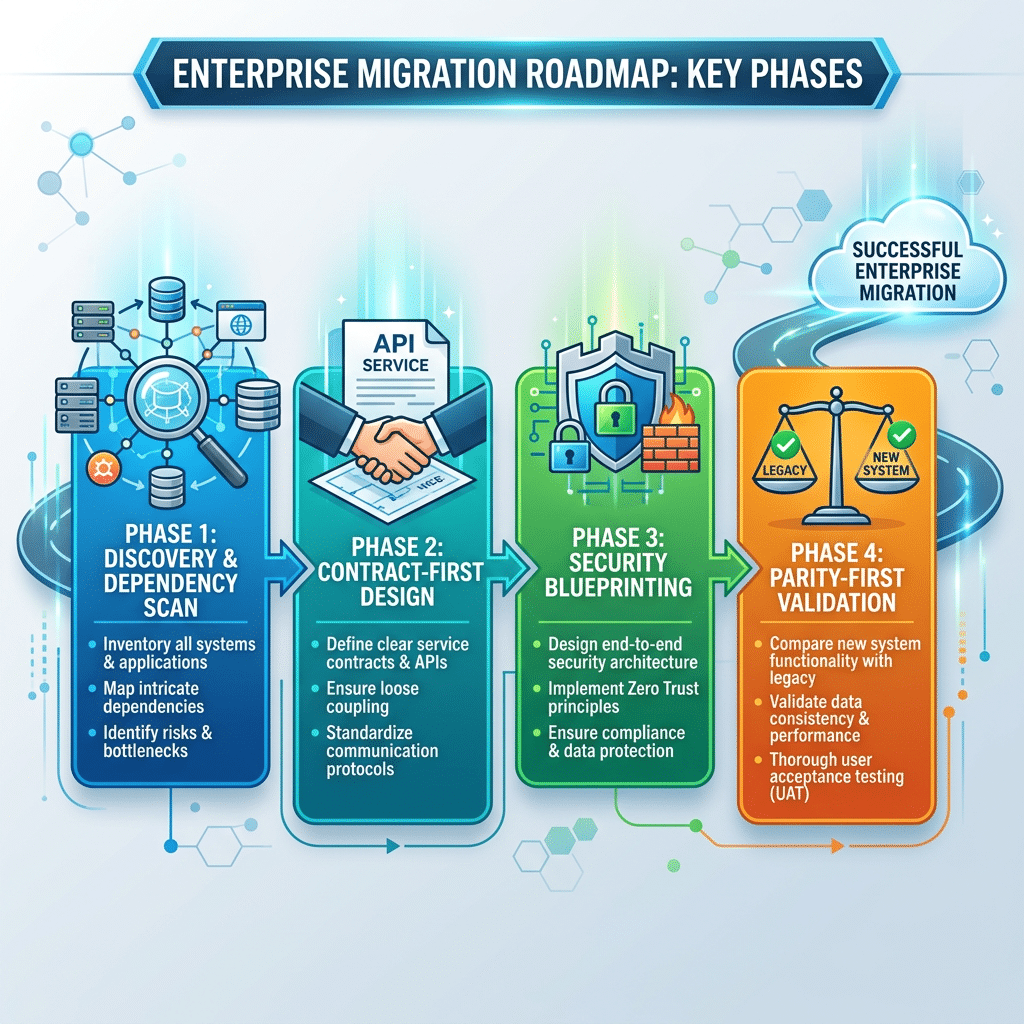
The Vedhas approach to a WCF to gRPC migration strategy is defined by precision and transparency. The consultancy follows an “Infrastructure Readiness Assessment” (IRA) methodology to ensure that the move to.NET 10 is seamless.
- Discovery & Dependency Scan: Vedhas utilizes automated agents to scan legacy WCF contracts, bindings, and behaviors. This identifies “hidden” dependencies on Windows-specific libraries that must be replaced before the migration.
- Contract-First Design: The team defines the modern service interface using .proto files, ensuring that the new gRPC architecture is strictly enforced and platform-independent.
- Security Blueprinting: Vedhas maps legacy security models (like Kerberos or WS-Security) to modern Zero Trust standards including OAuth2, OIDC, and mutual TLS (mTLS), meeting the 2026 compliance landscape requirements.
- Parity-First Validation: Before cutting over to the new system, Vedhas captures “Golden Requests” from the legacy WCF service and replays them against the gRPC service. This ensures that the new system behaves exactly like the old one, but at much higher speeds.
The Performance Frontier:.NET 10 and Native AOT
The year 2026 marks the maturity of Native AOT (Ahead-of-Time compilation) in.NET 10. For tech leads evaluating WCF vs gRPC, Native AOT is the ultimate performance unlock. Traditional.NET apps use Just-In-Time (JIT) compilation, which compiles code at runtime. This causes “cold start” delays and consumes significant memory.

Native AOT compiles the application into machine code during the publish phase. This results in:
- Instant Startup: Crucial for serverless functions and auto-scaling container clusters.
- Smaller Footprint: Apps are optimized for massive clusters where every megabyte of memory saved translates to lower Azure bills.
- Enhanced Security: By removing the JIT compiler from the production environment, the attack surface is significantly reduced.
WCF vs gRPC: Code Snippet Comparison
Architects need to see the difference in implementation. Below is a conceptual look at how a legacy WCF service contract is transformed into a modern gRPC service definition.
Legacy WCF (C# Interface):
using System.Runtime.Serialization;
using System.ServiceModel;

[ServiceContract(Namespace = "http://example.com/patient")]
public interface IPatientService
{
    [OperationContract]
    PatientResponse GetPatientData(PatientRequest request);
}

[DataContract(Namespace = "http://example.com/patient")]
public class PatientRequest
{
    [DataMember(Order = 1, IsRequired = true)]
    public string PatientId { get; set; } = string.Empty;
}

[DataContract(Namespace = "http://example.com/patient")]
public class PatientResponse
{
    [DataMember(Order = 1)]
    public string Id { get; set; } = string.Empty;

    [DataMember(Order = 2)]
    public string Name { get; set; } = string.Empty;

    [DataMember(Order = 3)]
    public int Age { get; set; }
}

This is one reason the WCF vs gRPC transition is accelerating across enterprise .NET teams in 2026.
Modern gRPC (Protobuf):
syntax = "proto3";

package patient;

option java_package = "com.example.patient";
option java_outer_classname = "PatientProto";

service PatientService {
  rpc GetPatientData (PatientRequest) returns (PatientResponse);
}

message PatientRequest {
  string id = 1;
}

message PatientResponse {
  string id = 1;
  string name = 2;
  int32 age = 3;
}
This shift to a contract-first model in the WCF vs gRPC transition ensures that the service can be consumed by any modern language, from Python-based AI agents to mobile apps written in Flutter or Swift.
The Frontend Pivot: Why Skip Angular 20 and Go Zoneless
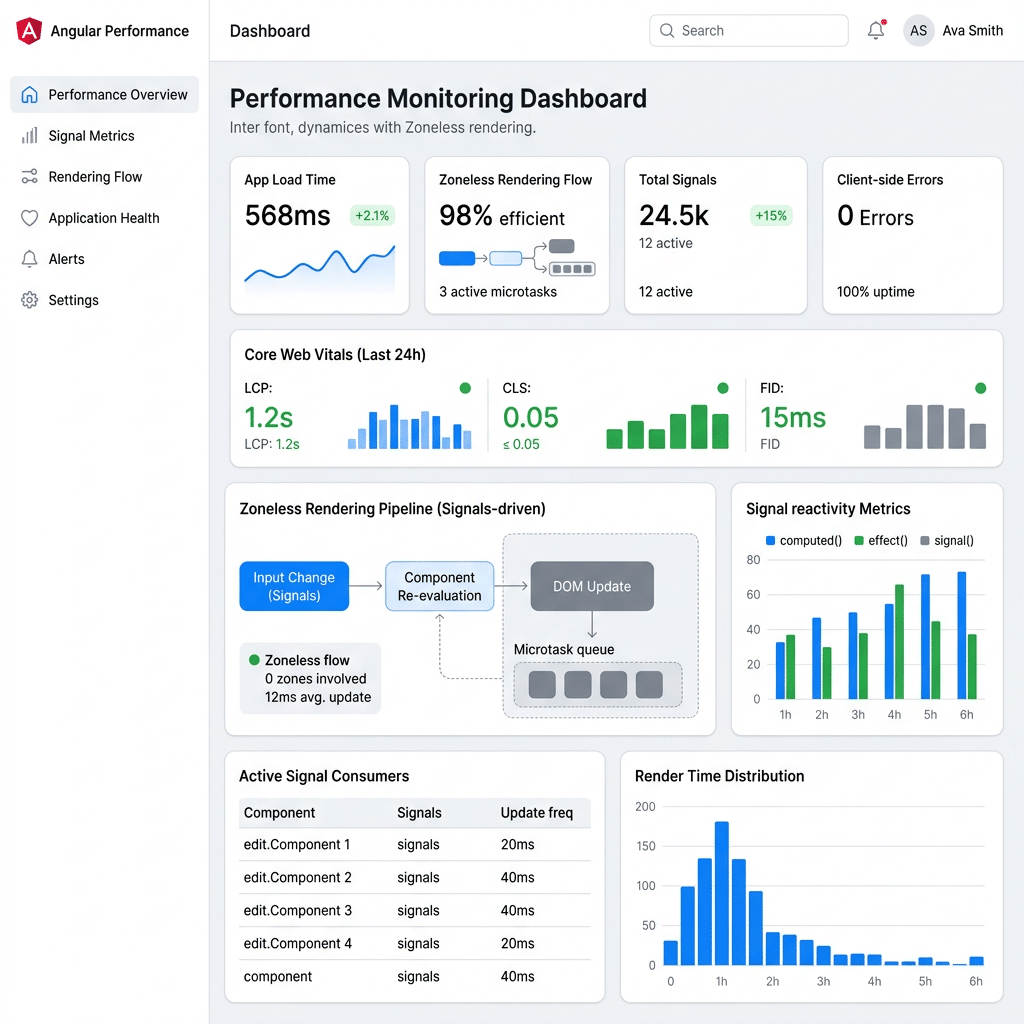
While the WCF vs gRPC transition fixes the back-end architecture, the modern enterprise must also address front-end performance. In 2026, the guidance for Angular developers is clear: skip the standard configurations of version 20 and migrate directly to a zoneless architecture.
The Problem with Zone.js
For years, Angular relied on Zone.js to detect when data changed and update the UI. However, Zone.js works by “guessing” and checking the entire application tree whenever any asynchronous event happens (like an HTTP request or a button click). This leads to high CPU usage and sluggish user interfaces in complex applications.
The Zoneless Advantage
By removing Zone.js and utilizing Angular Signals, applications move to a targeted change detection model. Only the components that actually need an update are refreshed.
| Performance Metric | Angular with Zone.js | Angular Zoneless (Signals) |
|---|---|---|
| CPU Usage | 70% – 100% under high load | 30% – 40% under high load |
| Bundle Size | Includes Zone.js library | Smaller, library-free bundle |
| Reactivity | Global/Predictive | Local/Explicit |
| LCP (Largest Contentful Paint) | Slower due to JIT overhead | 80% reduction in payload size |
For a U.S. e-commerce retailer, this performance leap directly impacts the bottom line. Faster rendering times lead to higher Google Core Web Vitals scores, better SEO rankings, and ultimately, higher conversion rates.
Regulatory Enforcement: The 2026 Compliance Landscape
A critical driver for replacing WCF with gRPC in 2026 is the shifting regulatory environment. U.S. companies in the healthcare and financial sectors are facing unprecedented scrutiny.
The compliance impact of the WCF vs gRPC transition is especially visible in healthcare modernization projects.
HIPAA 2026 Security Rule Changes
The Department of Health and Human Services (HHS) has eliminated the “addressable” status for many security safeguards. What used to be “recommended” is now “required”.
- Mandatory Encryption at Rest and In Transit: WCF’s legacy bindings often struggle with modern TLS 1.3 implementation. gRPC uses HTTP/2 and TLS natively, ensuring that every data packet is encrypted by default.
- Mandatory Multi-Factor Authentication (MFA): Access to any system containing electronic Patient Health Information (ePHI) now requires MFA. Modernizing to.NET 10 allows for easier integration of identity providers like Microsoft Entra ID or Okta.
- Network Segmentation: HIPAA now mandates that patient data systems be isolated. Legacy monolithic WCF services often make this impossible. Transitioning to gRPC-based microservices allows for clean segmentation and a reduced blast radius in the event of a breach.
SOC 2 Type II: Continuous Evidence
The era of once-a-year SOC 2 audits is ending. In 2026, enterprise clients demand continuous evidence that security controls are functioning. Modern architectures using gRPC and.NET 10 provide standardized observability through OpenTelemetry, allowing Vedhas to build dashboards that provide real-time compliance data to auditors and stakeholders.
ROI Logic: How We Slash Azure Bills by 40%
When a U.S. enterprise modernizes from WCF vs gRPC, the financial impact is immediate. The consolidation of resources is made possible by the efficiency of .NET 10.This is where the financial ROI of the WCF vs gRPC migration becomes measurable.
- Memory Savings: By utilizing <PublishAot>true</PublishAot> and <PublishTrimmed>true</PublishTrimmed> in the .csproj file, the memory footprint of each service instance drops by up to 60%.
- CPU Optimization: gRPC’s binary format requires fewer CPU cycles to parse than WCF’s XML, allowing for more requests to be handled by the same processor.
- License Reduction: Moving from Windows-based WCF hosting to Linux-based gRPC containers on Azure Kubernetes Service (AKS) eliminates Windows Server licensing costs.
Many agencies will try to sell a “full migration” immediately. Vedhas knows that enterprise transformation requires a phased approach.
Is Your Stack a 2026 Liability?
Don’t wait for an audit failure or a system crash to discover the cracks in your architecture.
- What you get: A complete dependency inventory, a 2026 compliance gap analysis, and a technical roadmap to.NET 10 Native AOT.
- No Quote Required: This is a high-value technical assessment, not a sales call.
The Architecture of 2026: Why Replacing WCF is Mandatory
The software industry in 2026 has reached a point of no return. The legacy Windows Communication Foundation (WCF) stack, while revolutionary in its time, has become the primary bottleneck for U.S. enterprises seeking to scale. In the debate of WCF vs gRPC, the latter wins on every critical business metric: performance, security, cost, and developer productivity.
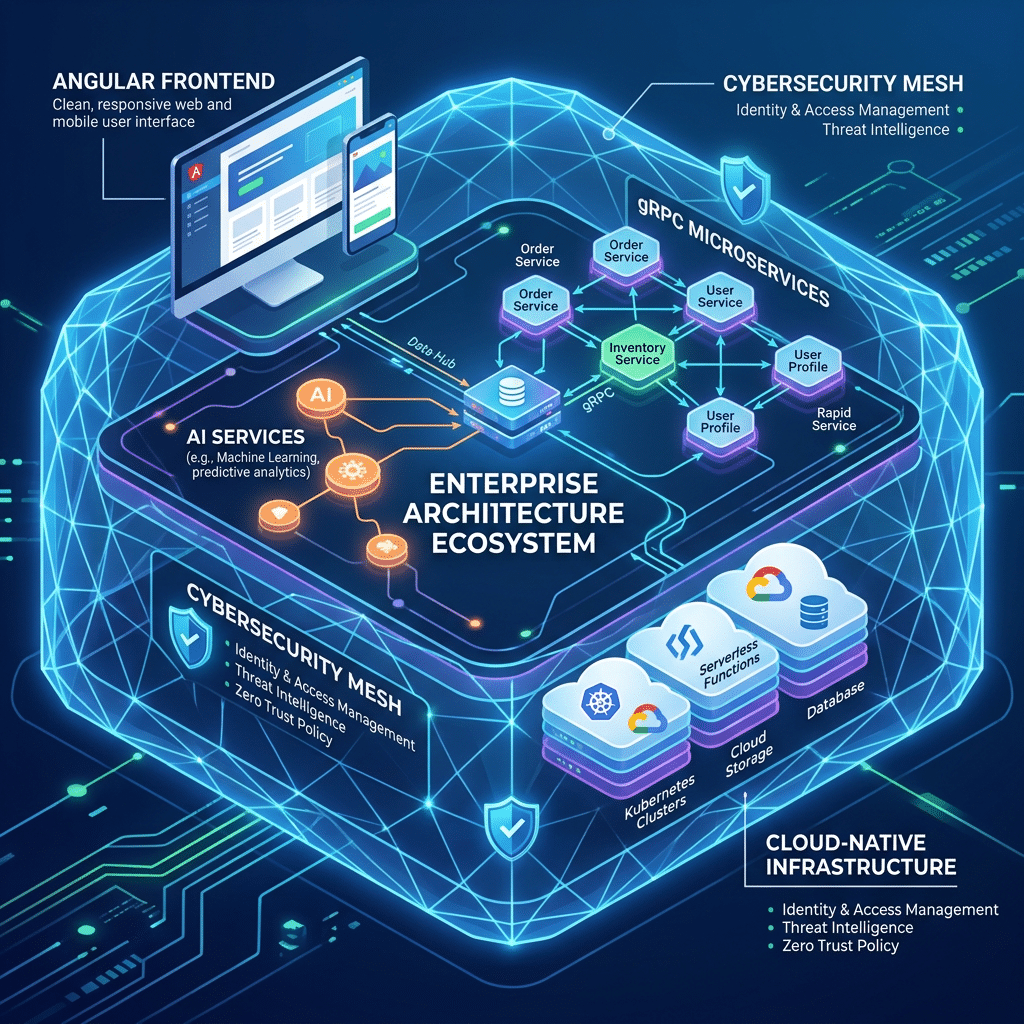
By integrating gRPC with the power of.NET 10 Native AOT and the front-end reactivity of zoneless Angular, organizations can finally shed their technical debt. Vedhas Technology Solutions provides the bridge between legacy vision and modern reality, ensuring that your enterprise is not just compliant, but competitive in the marketplace of 2026 and beyond.Through a combination of deep industry expertise in healthcare and e-commerce, transparent cost estimation, and proactive project management, Vedhas ensures that your modernization project is delivered “right the first time”. Whether you are a startup needing a scalable foundation or a large enterprise modernizing a mission-critical platform, the time to move from WCF vs gRPC is now.
Detailed Technical Analysis: Navigating the 2026 Software Landscape
The following sections provide an exhaustive technical breakdown for Architects and Tech Leads who require a deeper understanding of the mechanisms behind the WCF vs gRPC transition and the move to zoneless Angular.
Protocol Comparison: The Physics of High-Performance Communication
In 2026, the demand for high-throughput systems has increased exponentially, driven largely by the integration of real-time AI and the proliferation of IoT devices in healthcare and manufacturing. The WCF vs gRPC comparison is essentially a comparison between two different philosophies of network communication.
WCF: The XML-SOAP Philosophy
In the broader WCF vs gRPC discussion, one of the biggest limitations of WCF was its dependence on SOAP and configuration-heavy architectures.
WCF was built around the idea of “abstraction through configuration.” The goal was to make remote procedure calls (RPC) look like local method calls, regardless of the transport protocol (HTTP, TCP, or Named Pipes). However, this flexibility came at the cost of extreme complexity in the Web.config and the heavy overhead of SOAP. SOAP (Simple Object Access Protocol) is an envelope-based protocol that requires parsing multiple layers of XML before reaching the actual data payload. This creates a “serialization floor” that limits how fast a WCF service can ever be, regardless of how much hardware you throw at it.
gRPC: The Binary-Protobuf Philosophy
gRPC, developed by Google and now part of the Cloud Native Computing Foundation (CNCF), takes the opposite approach. It prioritizes speed and efficiency. By using Protobuf (Protocol Buffers), gRPC defines the structure of data in a compact binary format.
The mathematical efficiency of Protobuf compared to XML can be modeled as follows:
If L payload is the length of the actual data, the total length L total of an XML message often includes a constant factor for tags C tags and namespaces C ns, such that: L total = L payload + C tags + C ns In Protobuf, the overhead is minimal, as it uses tag-length-value (TLV) encoding. The total length is roughly: L total = L payload + C minimal_header This leads to a bandwidth saving of 60-80% in high-data-volume scenarios, which is critical for mobile devices on bandwidth-restricted networks.The.NET 10 Advantage: Native AOT and the Future of Backend Efficiency
With the release of.NET 10, Microsoft has shifted the performance floor of the entire ecosystem. For teams considering replacing WCF with gRPC, the introduction of Native AOT is the deciding factor.
JIT vs. Native AOT in 2026
Traditional.NET execution relies on the Common Intermediate Language (CIL). When an app launches, the Just-In-Time (JIT) compiler translates that CIL into machine code for the specific processor. In a world of dynamic cloud scaling, this JIT step is a liability. Every time a new container instance spins up to handle a traffic spike, the JIT compiler consumes CPU cycles and increases the “time-to-first-request”.
Native AOT removes the JIT compiler from the equation. The code is compiled directly to machine-specific binary at build time. This means:
- Immediate Execution: No “warm-up” period for the service.
- Reduced Working Set: The memory footprint is dramatically smaller because the JIT compiler and its metadata are not loaded into RAM.
- Binary Trimming: The compiler can perform “tree shaking” to remove every piece of the.NET runtime that the application doesn’t actually use, leading to binaries that are a fraction of the size of traditional deployments.
Benchmarking the Shift
In a direct comparison of a service-to-service call using gRPC on.NET 10, the Native AOT implementation shows a stark improvement.
| Runtime Strategy | Total Execution Time (ms) | Memory Usage (MB) |
|---|---|---|
| Traditional.NET 10 (JIT) | 170 ms | 150 MB |
| Modern.NET 10 (Native AOT) | 69 ms | 45 MB |
This performance gain of approximately 60% allows a company to run more services on the same hardware, which is a key component of Vedhas’s ROI logic for its enterprise clients.
Frontend Modernization: The Angular 20 Zoneless Revolution
Modernizing the backend with gRPC is only half the battle. If the frontend remains bloated and unresponsive, the user experience will suffer. This is why Vedhas recommends that U.S. software teams skip the standard Angular 20 release and move directly to a zoneless architecture.
The End of Zone.js
For over a decade, Zone.js was the heart of Angular. It intercepted every asynchronous task and told Angular when to check for changes. While this “magic” made development easier, it was highly inefficient for large-scale applications.12 In a zoneless Angular application, Zone.js is removed entirely.
Transitioning to Signals and OnPush
The new reactive engine in Angular 20.2+ uses Signals. Signals provide a way to explicitly track when data changes. Instead of the framework “guessing” where an update is needed, it knows exactly which component must be re-rendered.
The performance benefits of zoneless Angular include:
- CPU Optimization: By eliminating the global change detection cycle, CPU usage drops from 90% peaks to a steady 30-40% even under heavy UI interaction.
- Improved Web Vitals: Smaller bundle sizes (by removing Zone.js) and faster rendering lead to significant improvements in Largest Contentful Paint (LCP) and First Input Delay (FID).For healthcare platforms where clinicians are managing dozens of real-time data streams, this UI responsiveness is not a luxury—it is essential for patient safety and operational efficiency.
Regulatory Compliance: Navigating the 2026 Mandates
The decision to modernize from WCF vs gRPC is increasingly driven by the legal department. In 2026, the U.S. government significantly increased the penalties for non-compliance with data protection standards.
The 2026 HIPAA Security Rule Update
The most impactful change for healthcare organizations is the elimination of “addressable” implementation specifications. In the past, if a team felt that encrypting data at rest was “not reasonable and appropriate,” they could document their reasoning and move on. Under the 2026 rule, this is no longer an option. All safeguards are now mandatory.
| 2026 HIPAA Mandate | Legacy WCF Status | gRPC /.NET 10 Status |
|---|---|---|
| Mandatory Encryption (At rest/transit) | Difficult to implement with legacy bindings | Native support via HTTP/2 and TLS 1.3 |
| Universal MFA | Requires complex workarounds | Seamless OIDC/OAuth2 integration |
| Network Segmentation | Monoliths are difficult to segment | Microservices are naturally isolated |
| 72-Hour Incident Recovery | Recovery of legacy systems is slow/manual | Automated CI/CD and AOT-speed recovery |
SOC 2 Type II in the AI Era
SOC 2 audits in 2026 now place a greater emphasis on Supply-Chain Risk and AI Governance. Organizations must prove they are monitoring their vendors continuously. Vedhas utilizes gRPC’s native observability features to build “compliance-aware” architectures that automatically flag security anomalies in real-time, satisfying the new SOC 2 criteria.
Roadmap to Success: The Vedhas Engagement Model
Vedhas Technology Solutions does not believe in a one-size-fits-all approach. For a WCF vs gRPC migration, the consultancy offers a structured four-phase engagement model designed to maximize value and minimize disruption.
Phase 1: Strategy & Technology Due Diligence
Vedhas begins with a deep dive into the business goals. Is the primary driver cost reduction, performance improvement, or compliance? The team conducts an “Infrastructure Readiness Assessment” to determine if the existing stack can support a move to.NET 10.
Phase 2: Design & Development (The Iterative Sprint)
Instead of a “big bang” release, Vedhas uses the Strangler Fig Pattern. A gRPC bridge is built alongside the legacy WCF service, and individual operations are migrated one by one. This ensures that the system remains operational throughout the entire process.
Phase 3: Independent Validation & Testing
The Vedhas QA team performs independent testing to ensure functional parity. By using automated regression suites that compare the output of WCF vs gRPC services, they guarantee that no business logic is lost during the transition.
Phase 4: Post-Deployment Monitoring & Optimization
Once the migration is complete, Vedhas doesn’t disappear. The team provides ongoing 360° monitoring and regular analytical reports to show the client exactly how much they are saving on Azure costs and how much the system performance has improved.
For enterprise teams planning long-term modernization, the WCF vs gRPC debate is no longer optional.
Conclusion: The Modernization Imperative
The debate between WCF vs gRPC for 2026 has been settled by the realities of the market. Enterprises that continue to cling to legacy.NET Framework stacks are facing a “triple threat”: spiraling technical debt, an inability to meet federal security mandates, and a complete loss of developer interest.
Modernizing to gRPC and.NET 10 is the only viable path forward. It provides the performance, security, and scalability required to compete in the marketplace of the future. With the help of Vedhas Technology Solutions, organizations can navigate this complex transition with confidence, turning their legacy liability into a modern strategic tool. For organizations planning long-term .NET modernization, the WCF vs gRPC decision now impacts performance, deployment flexibility, and future cloud adoption.
By successfully completing a WCF vs gRPC modernization and adopting a zoneless Angular architecture on the frontend and gRPC on the backend, you are not just upgrading your software—you are future-proofing your entire business. The “Legacy Tax” is optional. High performance and compliance are mandatory. Choose the partner that gets it right the first time.