Every business today wants the same outcome: reach users everywhere, move fast, and keep development costs under control. But maintaining separate apps for iOS, Android, and desktop often creates the opposite effect—higher budgets, slower releases, and more complexity than many teams can justify.
Progressive Web Apps offer a different path. A progressive web app for business is a strong option for organizations that want broad device reach, strong mobile usability, and better search visibility without committing to multiple native codebases. That makes them especially relevant for startups, SaaS products, content platforms, eCommerce brands, and internal business tools.
At the same time, PWAs are not the right choice for every product. Apps that depend on deep hardware access, advanced background processing, or highly specialized native features may still need a native or hybrid approach. For decision-makers, the real question is not whether PWAs are modern, but whether they match the product’s business goals, user needs, and technical constraints.
The Quick Answer: Should You Build a Progressive Web App in 2026?
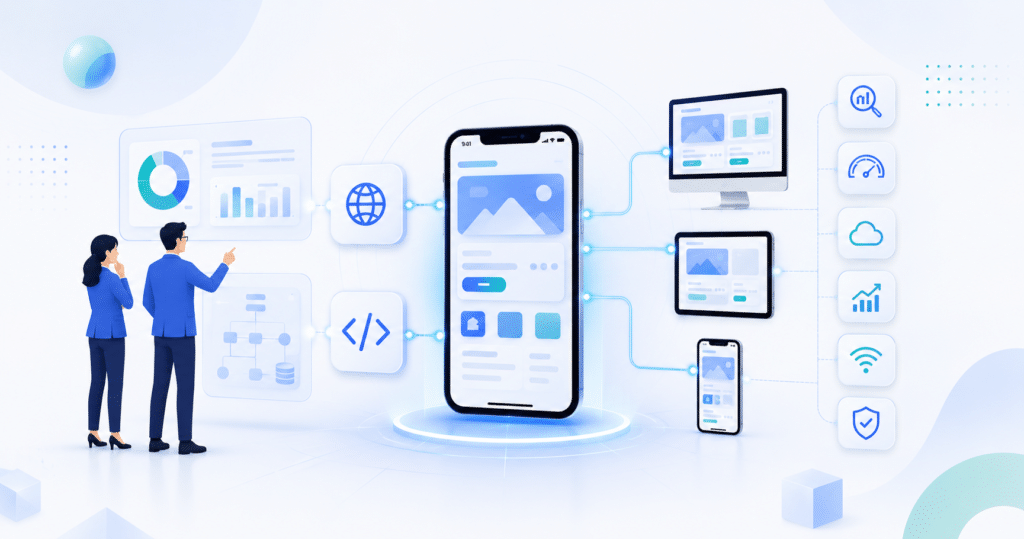
In 2026, Progressive Web Apps (PWAs) are an excellent choice for businesses that want to reduce development costs, launch faster, improve SEO, and deliver a consistent cross-device experience from a single codebase. They are particularly well-suited for eCommerce, SaaS platforms, customer portals, content-driven websites, booking systems, and startup MVPs. However, if your application depends on advanced hardware features such as Bluetooth, NFC, biometrics, intensive background processing, or high-performance graphics, a native or hybrid application is often the better investment. Ultimately, the right choice depends on your business goals, user expectations, technical requirements, and long-term growth strategy—not simply on the technology itself.
Why the Wrong App Strategy Costs More Than You Think
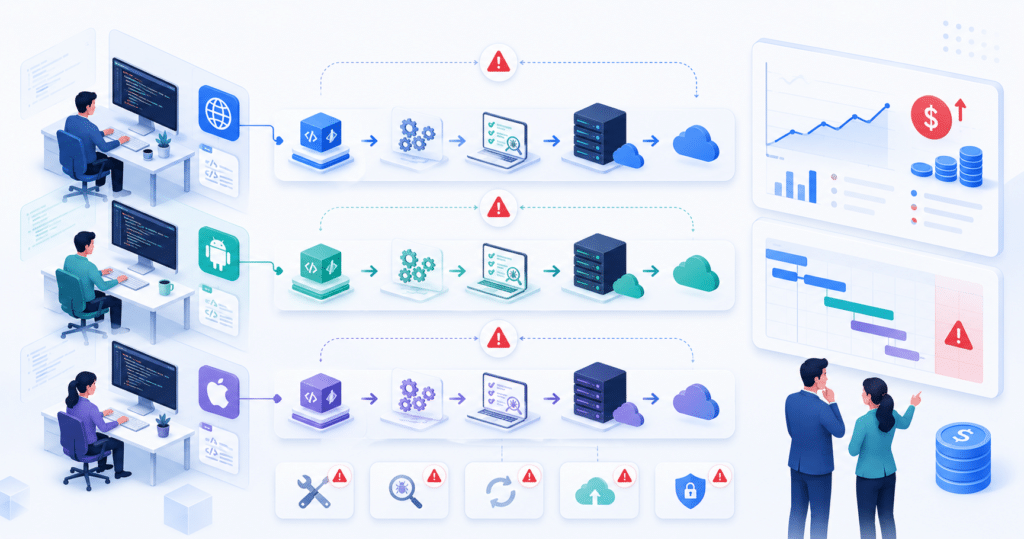
Choosing the wrong application approach creates real business friction. Building separate native apps for iOS and Android increases development effort, stretches timelines, and raises long-term maintenance costs. For many businesses, the bigger issue is not just upfront budget, but the ongoing complexity of supporting multiple codebases, release cycles, and platform requirements.
Native apps also add friction to distribution and updates through app store review processes, which can slow down launches and delay critical changes. For startups and growing businesses, that can mean slower market validation, higher customer acquisition drop-off, and a weaker return on investment.
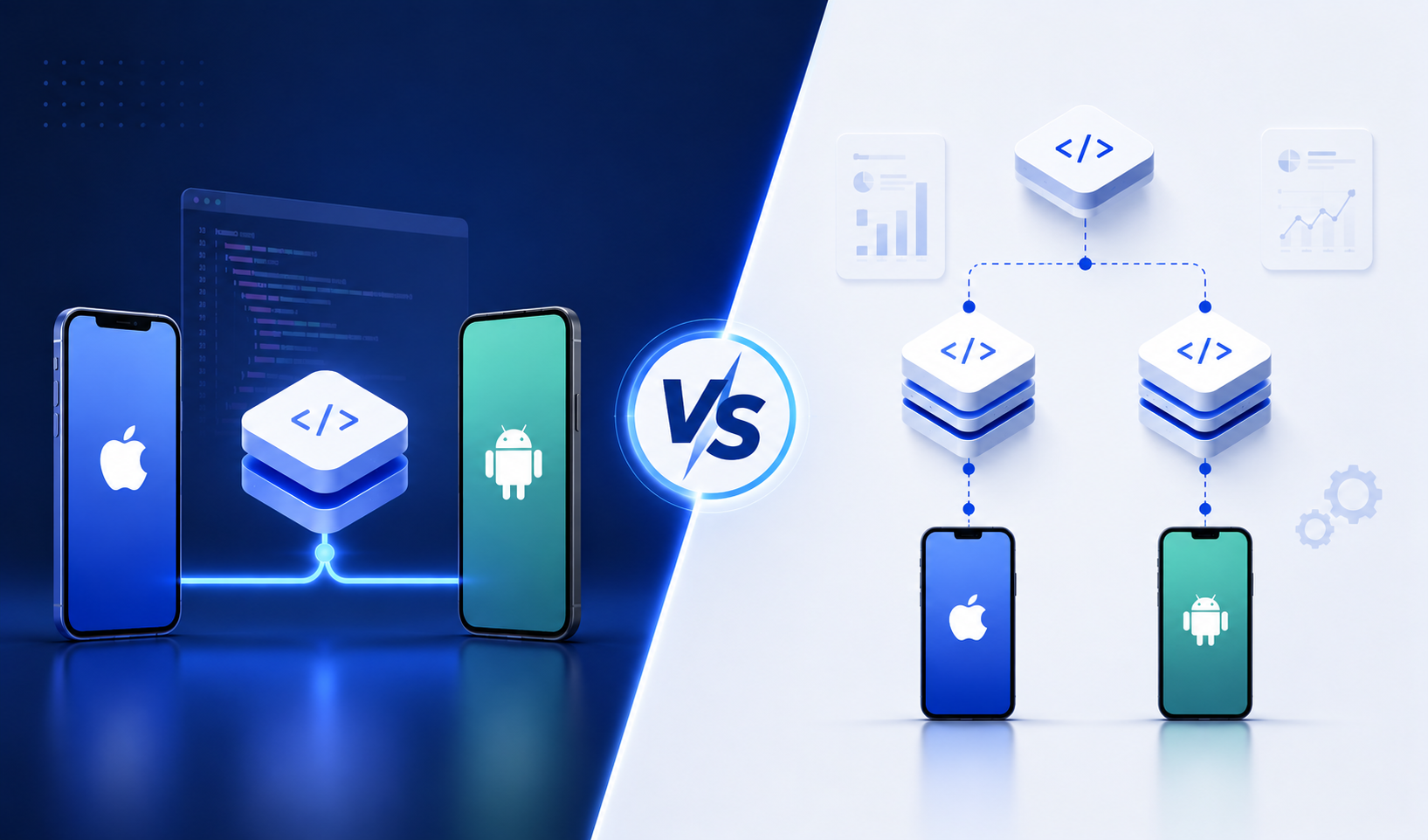
Traditional web experiences have their own limitations. If a product needs offline access, smooth mobile behavior, and better retention, a standard website may not be enough. That is why the decision between PWA, native, and hybrid development should be based on business goals, user needs, and product complexity—not habit or trend.
What’s Changed for Progressive Web Apps in 2026?
Progressive Web Apps have become more capable in 2026, especially for businesses that want a single codebase with strong mobile reach. Browser support has improved, installation experiences are smoother, and core features such as offline access, push notifications, and home-screen installation are more practical than they were a few years ago.
That said, PWAs still have important limitations. Platform behavior is not fully consistent across browsers and operating systems, and some native-level capabilities remain out of reach. For example, hardware-heavy features, advanced background processing, and deeper operating system integration are still areas where native or hybrid applications often perform better.
For business leaders, the key takeaway is simple: PWAs are no longer a compromise technology, but they are still not universal. In 2026, they are a strong fit for products that prioritize reach, speed, SEO, and lower development cost—but not for applications that depend on deep device access or highly specialized native performance.
How a Progressive Web App Is Built
Although users interact with a Progressive Web App like a mobile application, it is built using modern web technologies that combine the accessibility of a website with many of the capabilities of a native app. Several core components work together to deliver a fast, reliable, and engaging user experience.
- Service Worker: A Service Worker acts as the engine behind a PWA’s offline capabilities. It stores important application resources locally, enabling users to continue accessing key features even when network connectivity is slow or temporarily unavailable.
- Web App Manifest: The Web App Manifest defines how the application appears and behaves once installed on a user’s device. It includes details such as the app name, icons, theme colors, display mode, and launch behavior, allowing the PWA to provide an app-like experience directly from the home screen.
- Secure HTTPS Connection: PWAs are delivered over secure HTTPS connections, ensuring encrypted communication between users and the application. This provides a trusted environment for handling user authentication, transactions, and other sensitive data.
- Responsive User Interface: A responsive interface ensures the application delivers a consistent experience across desktops, tablets, and smartphones, allowing businesses to serve users on multiple devices without maintaining separate codebases.
Together, these technologies enable organizations to deliver applications that are faster to deploy, easier to maintain, and capable of providing many of the features users expect from modern mobile experiences.
PWA vs Native/Hybrid: Capability Comparison
| Business Requirement | Progressive Web App | Native / Hybrid App |
|---|---|---|
| Installation | Easy to access through the browser and add to home screen | Installed from an app store |
| Push Notifications | Supported, with some platform differences | Fully supported |
| Offline Access | Good for cached content and essential workflows | Stronger for large-scale offline use |
| Device Hardware Access | Limited | Full or near-full access |
| Background Processing | Limited | Better for continuous background activity |
| Storage Capacity | Suitable for many business use cases, but not unlimited | Better for heavy local storage needs |
| SEO Visibility | Strong | Weak or indirect |
| Development Cost | Lower | Higher |
| Time to Launch | Faster | Slower |
| Best Fit | Content platforms, SaaS, eCommerce, MVPs, customer portals | Apps needing deep hardware access, advanced performance, or complex native features |
This comparison helps decision-makers evaluate the right architecture based on business priorities rather than technology preference alone. PWAs are often the better choice when speed, cost, SEO, and cross-device reach matter most. Native or hybrid apps are better when the product depends on deep hardware integration, advanced performance, or heavy background processing.
When Is a Progressive Web App for Business the Right Choice?
A Progressive Web App is a strong choice when your business needs faster launch times, lower development costs, broad device reach, and strong visibility in search engines. It works especially well when your users come through organic search, when the product needs to be accessible across devices, and when you want to avoid the cost of maintaining separate mobile codebases.
PWAs are particularly effective for eCommerce stores, SaaS platforms, booking systems, customer portals, content-driven websites, news and media platforms, and online learning products. These businesses benefit from the combination of mobile-friendly performance, installability, offline support for core actions, and better user retention without the friction of app store downloads.
For startups and growing businesses, PWAs are also useful for MVP development because they allow teams to validate the product faster and at a lower cost. If your goal is to test demand, improve conversion, and reach users quickly, a PWA can be a practical first choice.
Should You Build a Progressive Web App?
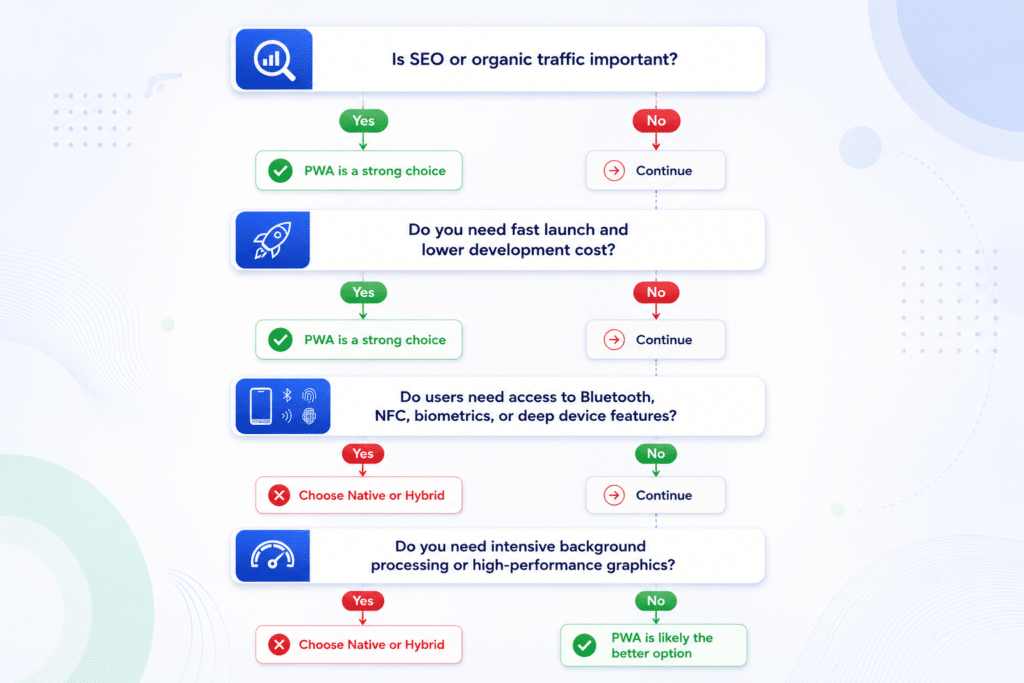
Best fit for PWA:
- eCommerce
- SaaS
- Customer Portals
- Booking Systems
- Content Platforms
- MVPs
Use this framework to evaluate the right application strategy based on business value, not just technology preference. PWAs are best when speed, cost, SEO, and cross-device reach matter most. Native or hybrid apps become the better choice when the product needs deep device integration, intensive performance, or more advanced mobile capabilities.
When a Progressive Web App Isn’t the Right Choice
While Progressive Web Apps offer significant advantages in cost, speed, and accessibility, they are not the ideal solution for every business. Choosing a PWA for the wrong type of application can lead to performance limitations, reduced user satisfaction, and higher long-term costs if the product eventually requires capabilities that browsers cannot fully support.
If your application relies heavily on advanced device hardware—such as Bluetooth, NFC, biometric authentication, GPS tracking, camera-intensive workflows, or IoT connectivity—a native or hybrid app is generally the better choice. These platforms provide deeper integration with the operating system, enabling a smoother and more reliable user experience.
Similarly, products that require high-performance graphics or continuous background processing are better suited to native development. Mobile games, augmented reality (AR) applications, video editing tools, fitness tracking apps, navigation platforms, and real-time communication systems demand levels of performance and device access that Progressive Web Apps cannot consistently deliver.
Businesses with strict regulatory, security, or offline requirements should also evaluate PWAs carefully. Industries such as healthcare, banking, insurance, and government often require advanced security controls, extensive offline data storage, or seamless hardware integration that may be easier to achieve with native or hybrid applications.
In these situations, investing in a native or hybrid solution can provide greater flexibility, stronger performance, and a better long-term user experience. While the initial development cost may be higher, the investment is often justified by the application’s functional requirements and future scalability.
Common Business Scenarios Where a PWA May Not Be the Best Fit
| Business Scenario | Recommended Approach | Why? |
|---|---|---|
| Mobile banking applications | Native / Hybrid | Strong security, biometrics, and reliable performance |
| Healthcare apps connected to medical devices | Native | Bluetooth and hardware integration are essential |
| Ride-sharing and delivery platforms | Native / Hybrid | Continuous GPS tracking and background location updates |
| Fitness and health tracking apps | Native | Sensor access and real-time background monitoring |
| Navigation and mapping applications | Native | High-performance GPS and offline maps |
| AR/VR applications | Native | Intensive graphics processing and device capabilities |
| Mobile games | Native | Better graphics performance and lower latency |
| Professional video or photo editing apps | Native | High processing power and hardware acceleration |
| Industrial or IoT applications | Native / Hybrid | Reliable communication with connected devices |
A Progressive Web App is an excellent solution for many business applications, but it should not be viewed as a one-size-fits-all approach. If your product’s success depends on advanced device capabilities, high-performance computing, or complex native integrations, a native or hybrid application will usually deliver greater long-term value despite the higher development investment.
Compliance Considerations for Regulated Industries
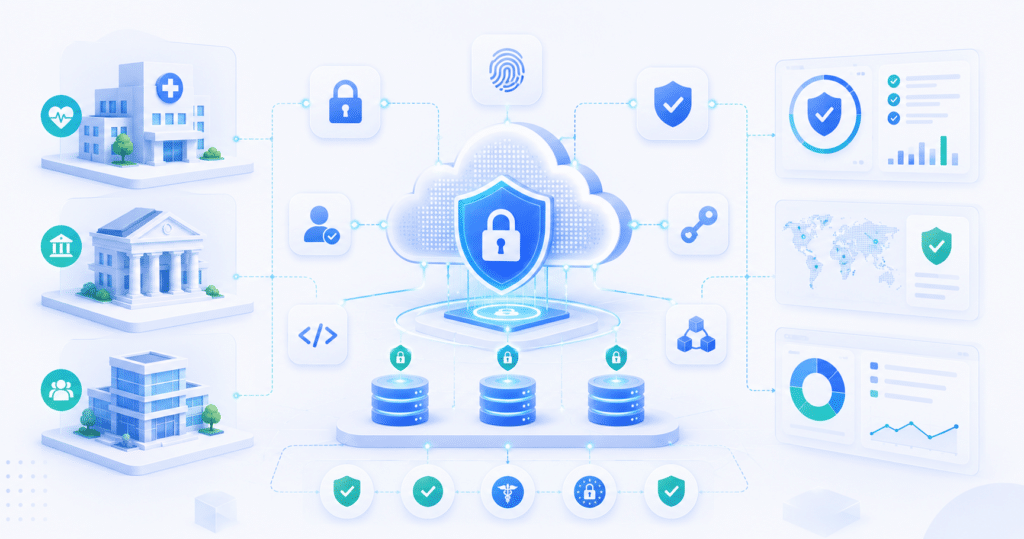
While Progressive Web Apps are suitable for many business applications, organizations operating in healthcare, banking, insurance, finance, and government should evaluate compliance requirements before deciding on their application architecture. In these industries, security, privacy, and regulatory obligations are often just as important as development cost or time to market.
Modern PWAs can support enterprise-grade security, but because they run inside web browsers, they require additional planning to meet strict compliance standards. Secure authentication, encrypted data transmission, secure storage practices, Content Security Policies (CSP), and regular security testing become essential components of a compliant implementation.
The table below highlights some of the key security requirements that organizations handling sensitive data should consider.
| Compliance Requirement | Why It Matters |
|---|---|
| Multi-Factor Authentication (MFA) | Protects sensitive accounts by requiring an additional verification step beyond passwords. |
| End-to-End Encryption | Ensures data remains protected while stored and transmitted across networks. |
| Regular Security Testing | Identifies vulnerabilities before they can be exploited. |
| Secure Data Storage | Helps safeguard confidential information and reduce the risk of unauthorized access. |
| Disaster Recovery & Backup | Ensures business continuity and faster recovery after security incidents or system failures. |
Although standards such as HIPAA, SOC 2, PCI DSS, and GDPR apply differently across industries, they share a common objective: protecting sensitive data and reducing operational risk. Organizations should evaluate these requirements early in the planning phase to ensure the chosen application architecture supports both business goals and compliance obligations.
For many regulated businesses, a PWA can still be the right solution when designed with appropriate security controls. However, if the application depends on advanced hardware integration, extensive offline storage, or platform-specific security capabilities, a native or hybrid application may provide greater flexibility for meeting regulatory requirements.
Compliance should be viewed as a business requirement—not a limitation of Progressive Web Apps. Before selecting a PWA, native, or hybrid architecture, organizations should assess their industry regulations, security obligations, and long-term operational needs to ensure the chosen solution supports both compliance and business growth.
How Vedhas Helps You Choose the Right App Strategy
Choosing between a Progressive Web App, a native application, or a hybrid solution is a strategic business decision that influences development costs, time to market, user experience, long-term maintenance, and scalability. At Vedhas Technology Solutions, we’ve helped startups, SMEs, and enterprises make informed technology decisions since 2017 by modernizing legacy systems and building scalable digital products. Through our structured Infrastructure Readiness Assessment (IRA) and technology discovery process, we evaluate your business goals, technical requirements, compliance needs, existing infrastructure, and budget to recommend the application architecture that best supports your long-term growth.
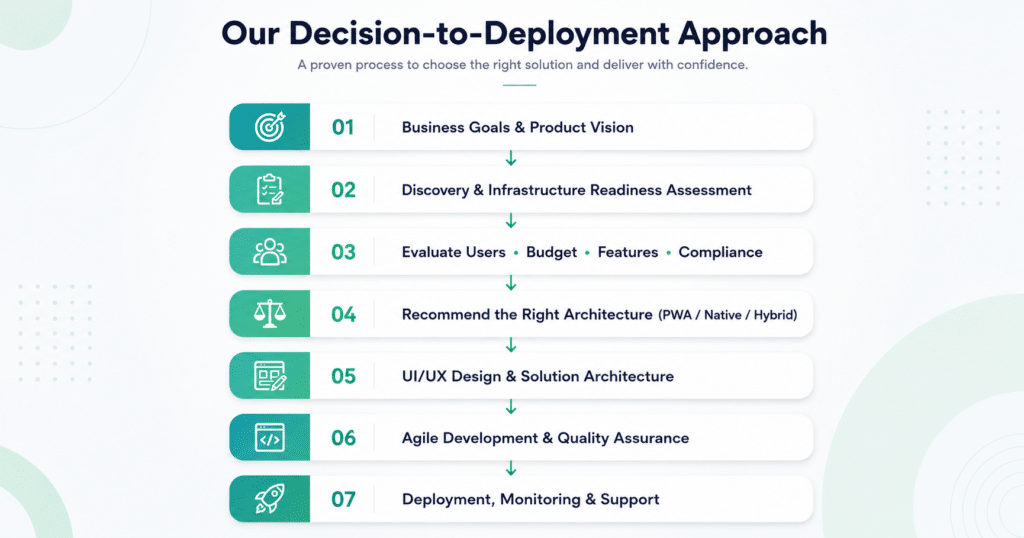
Every successful application begins with choosing the right architecture—not the most popular one. Our structured approach ensures technology decisions are based on measurable business outcomes, helping organizations reduce risk, optimize investment, and build applications that can scale with future growth.
Why Businesses Choose Vedhas
Our approach combines strategic consulting with end-to-end technology delivery, enabling organizations to move from idea to implementation with a single technology partner. Our core strengths include:
Industry-Focused Expertise
We have experience delivering technology solutions across healthcare, eCommerce, education, B2B SaaS, professional services, and enterprise digital transformation, allowing us to recommend architectures that fit each industry’s operational and compliance needs.
Transparent Planning & Cost Estimation
Every project begins with a clear scope, realistic timelines, and transparent pricing so businesses understand the investment required before development starts.
Proactive Project Management
We follow an iterative delivery model with regular progress reviews, weekly communication, and continuous monitoring to keep projects aligned with business goals throughout development.
End-to-End Digital Transformation
From business consulting and product strategy to UI/UX design, application development, cloud infrastructure, CRM implementation, digital marketing, and long-term support, we provide integrated services under one roof.
What Building a PWA Looks Like
Developing a successful Progressive Web App involves much more than writing code. It begins with understanding business objectives, selecting the right architecture, and delivering a solution that supports long-term growth and scalability.
Typical PWA Development Lifecycle
| Phase | Business Focus |
| 1. Discovery & Strategy | Understand business objectives, user needs, technical requirements, and define the right application architecture. |
| 2. Planning & UI/UX Design | Create user journeys, wireframes, system architecture, and implementation roadmap. |
| 3. Development | Build the application using modern technologies while integrating APIs, security measures, and business logic. |
| 4. Testing & Quality Assurance | Validate functionality, performance, security, usability, and cross-device compatibility before launch. |
| 5. Deployment & Ongoing Support | Launch the application, monitor performance, release updates, and continuously optimize based on user feedback and business growth. |
A well-planned development process reduces project risks, improves product quality, and ensures the final application aligns with both business goals and user expectations. Whether building a Progressive Web App, a native application, or a hybrid solution, investing time in strategy, design, testing, and post-launch optimization is essential for long-term success.
Progressive Web Apps are no longer just an alternative to native apps—they’re a strategic choice for businesses that prioritize speed, cost efficiency, and cross-platform reach. However, they aren’t the right solution for every product. Understanding your users, technical requirements, and long-term business goals is essential to selecting the architecture that delivers lasting value.
Ready to Build the Right App?
Choosing between a Progressive Web App, a native application, or a hybrid solution is a strategic business decision that affects cost, scalability, user experience, and time to market. At Vedhas Technology Solutions, we help businesses evaluate their product goals, technical requirements, infrastructure, and compliance needs to recommend the architecture that delivers the best long-term value. If you’re planning a new application or modernizing an existing one, schedule a
to receive a tailored technology roadmap and transparent project estimate.