The saas product development process runs through seven stages: discovery, UX/UI design, architecture planning, agile sprints, QA, beta testing, and post-launch iteration.
Every stage has a direct role in reaching your first 100 paying users — discovery defines who will pay; design determines whether they activate; architecture determines whether they stay.
Cost and timeline are shaped primarily by decisions made in discovery and architecture — not during the coding phase.
The most common reason SaaS products stall before 100 users: stages are compressed under budget pressure, then rebuilt at far higher cost after launch.
The saas product development process is the structured sequence of decisions that takes a product from an idea to a platform people will pay for. This article treats it as an executive roadmap — not a technical manual — keeping a clear line from each stage to the outcome that actually matters: your first 100 paying customers.
Budget and Timeline: What Executives Want to Know First
Before mapping the stages, here is the practical snapshot that shapes every conversation with a development partner:
Question
Indicative Answer
Time from idea to launch?
6–9 months for a mid-complexity B2B SaaS product
Time to first 100 paying users?
3–6 months post-launch, depending on onboarding quality and go-to-market execution
Cost of a focused SaaS MVP?
$50,000–$150,000, depending on scope and team model
Cost of a full-featured B2B SaaS platform?
$150,000–$500,000 or more
Biggest driver of cost overruns?
Undefined scope at discovery and unplanned architecture changes mid-development
These are indicative ranges drawn from TechVedhas’ own client project history — actual costs vary with scope, tech stack, and team model. For a stage-by-stage breakdown tied to your specific product, see our SaaS Platform Development Cost Guide.
SaaS Development Lifecycle: 7 Stages at a Glance
Stage
What Happens
Typical Duration
1. Discovery & Validation
Workshops, user research, problem definition, PRD
2–4 weeks
2. UX/UI Wireframing & Design
User flows, wireframes, high-fidelity prototypes
3–5 weeks
3. Architecture Planning
Tech stack, infrastructure design, security model
1–2 weeks
4. Agile Development Sprints
Feature-by-feature build in 2-week sprint cycles
12–20 weeks
5. QA & Pre-Launch Testing
Functional, performance, and security testing
2–4 weeks
6. Beta Testing & Iteration
Closed beta, user interviews, onboarding refinement
4–8 weeks
7. Launch & Revenue Activation
Go-to-market execution, onboarding, first paying users
Ongoing
Timelines are indicative for a mid-complexity B2B SaaS platform. Simpler tools may compress to 16 weeks total; enterprise platforms may span 12+ months.
Stage 1: Discovery Workshops — Defining Who Your First 100 Users Will Be
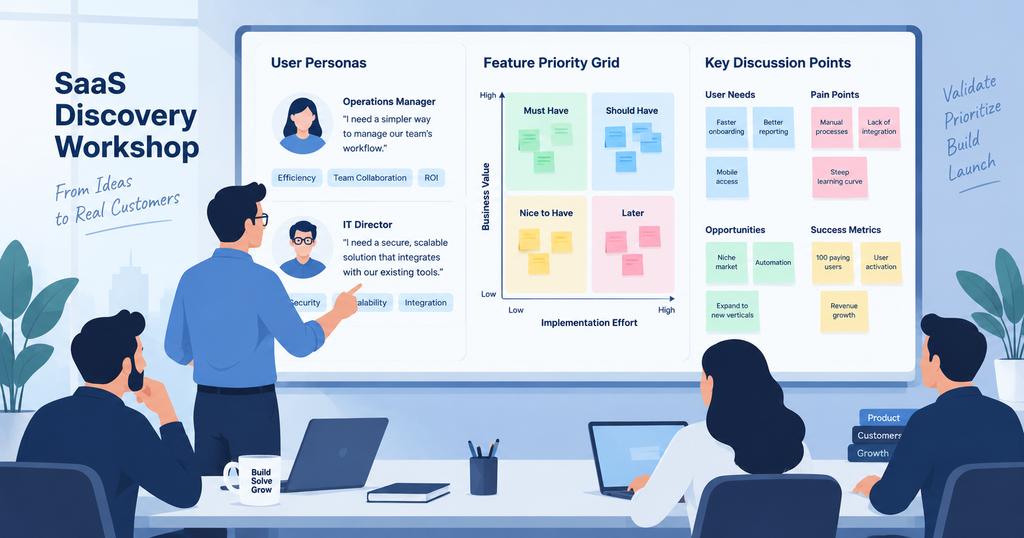
The discovery stage is where most SaaS projects either earn their path to revenue or guarantee a costly pivot. Structured discovery workshops — typically two to three sessions over two to four weeks — serve a specific purpose: force stakeholders to answer the questions they have been assuming away.
A well-run discovery workshop covers four areas. Problem definition: who specifically experiences this problem, how do they currently solve it, and what is the measurable cost of not solving it? Vague answers here produce vague products that serve no one well enough to pay.
Competitive landscape mapping: what tools does the target buyer already use, and where do those tools fall short? This shapes feature prioritization and pricing positioning before a single screen is designed.
User persona development: SaaS platforms fail when built for a fictional user rather than a specific, researched one. Discovery workshops should produce at least two validated personas with job titles, workflows, and decision triggers — not generic demographic profiles.
Success metric alignment: what does “working” mean at month 3, 6, and 12? Aligning the technical team and the business on concrete metrics early prevents the scope creep that kills timelines and erodes budgets.
The output is a Product Requirements Document (PRD) and a prioritized feature backlog — the shared contract between the business and the development team for everything that follows.
→ Path to 100 users: Discovery defines who your first 100 paying users are, what they need, and what price point they will accept. Skipping it means building for a persona that turns out not to pay — and spending post-launch months rebuilding rather than selling.
Stage 2: UX/UI Wireframing — Where Activation Gets Decided
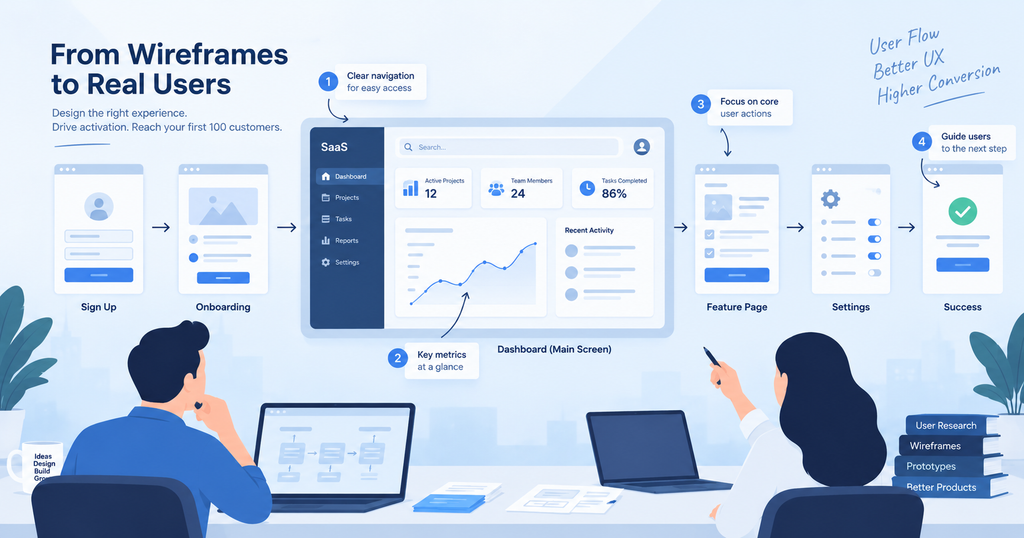
UX/UI design in the saas product development process is not cosmetic — it is structural. The way a new user first experiences your product: the onboarding flow, the dashboard layout, the moment they encounter your core feature, directly determines whether they activate, return, and eventually pay.
The design phase moves through three layers. User flows map the journey before any screen is designed: how does a new user arrive, what is the first action they take, how do they reach value? This mapping consistently surfaces navigation assumptions that do not match how real users think about the product.
Wireframes establish layout, content hierarchy, and interaction logic in low-fidelity form — before color, typography, or polish enter the picture. Wireframes approved by stakeholders before the team moves to high-fidelity design are a high-leverage investment: changes at wireframe stage cost hours; equivalent changes in development cost weeks.
High-fidelity prototypes produce clickable screens that can be tested with real target users before production code is written. Nielsen Norman Group’s widely cited research — “Why You Only Need to Test with 5 Users” — demonstrates that a small number of test participants can surface the majority of critical usability issues in a prototype, making pre-development testing disproportionately cost-effective.
The most valuable output of this stage is not the final design files. It is the validated user flow: confirmation that real users can navigate from registration to value without confusion or abandonment.
→ Path to 100 users: Onboarding completion rate — the percentage of signups who reach core value in their first session — is one of the strongest early predictors of conversion to paid. That rate is set during UX/UI design, not adjusted after launch.
Stage 3: Architecture Planning — What Non-Technical Founders Actually Need to Know
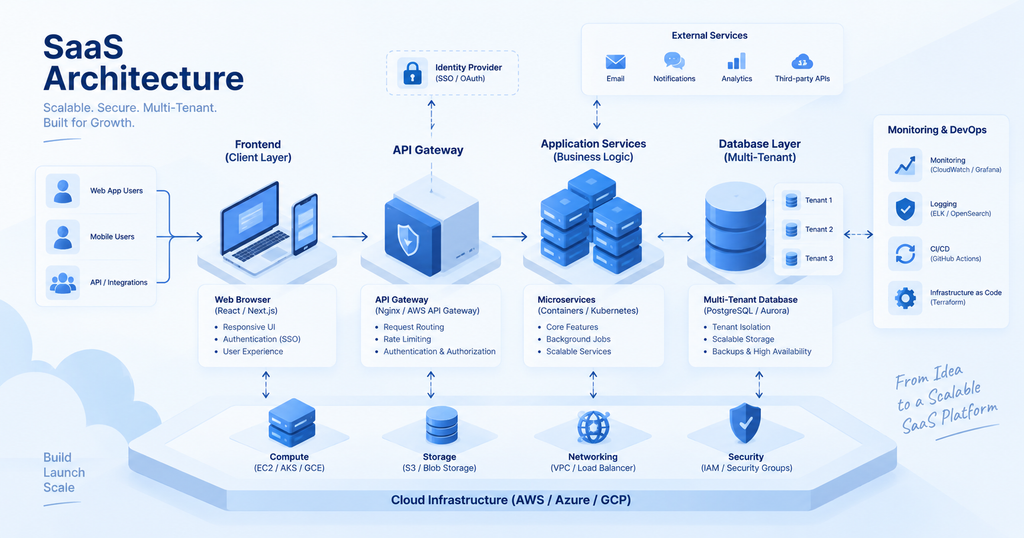
Architecture planning is consistently the most underestimated stage in the saas product development process — and the one with the most expensive mistakes. The technical decisions made here do not just affect scalability. They affect budget exposure, vendor dependency, compliance readiness, and whether enterprise buyers will sign a contract with you.
Here are the decisions that matter — framed for what they mean to a founder or executive, not just an engineer:
Multi-tenancy model. This determines how the platform separates each customer’s data. Choosing the wrong model at the start can force a six-to-twelve month rebuild when an enterprise buyer demands full data isolation — or when a compliance audit finds shared data where there should be none. It also directly determines your per-customer infrastructure cost, which affects gross margin at scale.
SSO and authentication readiness. Enterprise SaaS buyers routinely evaluate Single Sign-On support in their first vendor conversation. A platform without SSO architecture built in faces expensive retrofitting precisely at the moment it should be closing its largest contracts. Building it in from the start costs a fraction of what it costs to add later.
Cloud infrastructure selection. AWS, Azure, or GCP — the choice matters less than the reasoning. What executives need to know: which services in your chosen platform are fully managed (lower maintenance burden, more predictable cost) versus self-hosted (your engineering team’s ongoing responsibility). That distinction determines your operational cost at 1,000 users versus 100,000.
API-first design. A backend built as clean, versioned APIs from day one means enterprise buyers can connect your platform to their existing tools without a custom integration project. Without this, every enterprise deal that requires integration becomes a professional services negotiation — and a reason for the deal to stall.
Security and compliance baseline. Retrofitting encryption standards, role-based access controls, or audit trails after launch is not just expensive — it directly delays contracts with buyers in regulated industries who will not sign until those controls are in place. The cost to design them in is a fraction of the cost to add them retroactively.
The output of architecture planning: a system design document, a cloud infrastructure cost projection, and a stack recommendation — all approved before development begins, not revised during it.
→ Path to 100 users: Architecture decisions determine which buyers you can sell to from day one. A platform without SSO, audit logs, or proper data isolation cannot close enterprise accounts — which are often the fastest path to paying users in B2B SaaS. Correct architecture means your first 100 users do not hit a technical ceiling before you can add user 101.
Stage 4: Agile Development Sprints — Building in Measurable Increments
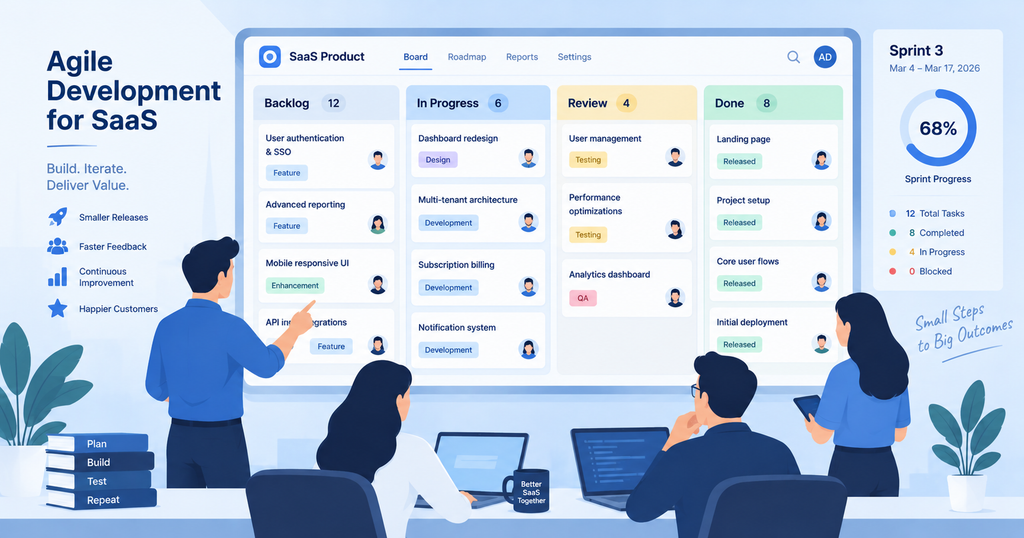
Agile development is how modern SaaS products get built — but agile means something specific, not just “we work fast and improvise.” In a well-run agile engagement, each two-week sprint starts with a planning session, the team commits to a deliverable increment, and the sprint closes with a stakeholder demo of working functionality.
This cadence creates three important forcing functions.
Regular visibility: every two weeks, the business sees and interacts with what has been built. Misalignments between specification and execution get caught at sprint two, not at launch.
Scope discipline: when stakeholders see working software delivered every two weeks, scope-addition requests become concrete. “Can we add X?” becomes “Adding X means removing Y from this sprint — do you want that trade?” That conversation is far healthier than discovering at month six that the team has been building features nobody prioritized.
Quality control at pace: agile sprints without embedded QA accumulate quality debt that gets paid — with interest — in the final weeks before launch. Embedding QA engineers from sprint one eliminates the late-stage crunch that consistently derails SaaS timelines and produces the validated codebase that Stage 5 pre-launch testing is then built on.
For most mid-complexity B2B SaaS platforms, the development phase spans 12 to 20 weeks of active sprints, delivering a fully functional, QA-validated MVP by the end.
→ Path to 100 users: Regular sprint demos mean the product has already been course-corrected based on real business input before development ends. A clean, QA-validated MVP is what makes beta testing meaningful and launch credible to your first target accounts.
Stage 5: QA & Pre-Launch Testing — What “Done” Actually Means
Pre-launch QA is not a repeat of sprint-level testing. Sprint QA validates individual features in isolation. The dedicated 2–4 week pre-launch phase validates the integrated product — how every feature works together under conditions that approximate real user load and behaviour before any public exposure.
Three testing types define this phase. Functional testing confirms every feature performs as specified across supported browsers, devices, and user roles — including error states, edge cases, and multi-step flows that sprint demos rarely surface in full. Performance testing establishes how the system behaves under concurrent user load and peak traffic; the benchmarks set here become the baseline for every post-launch scaling decision. Security testing reviews authentication flows, access controls, and known vulnerability patterns before the application is publicly accessible. For SaaS products targeting business buyers, a pre-launch security review is increasingly a prerequisite for enterprise procurement conversations — not a nice-to-have.
“Done” in pre-launch QA means zero critical defects open, performance benchmarks met at target load, and a documented test results report. That report has value beyond internal assurance: enterprise prospects routinely ask for evidence of quality process before signing. Our quality assurance services are structured to produce exactly that deliverable at the close of this phase.
→ Path to 100 users: Enterprise buyers — often the fastest path to paying users in B2B SaaS — increasingly request quality process documentation before committing. A documented pre-launch QA sign-off makes that conversation possible and removes a common procurement blocker before launch day.
From Beta to First 100 Paying Users: A Three-Phase Funnel
The journey from a completed MVP to 100 paying users runs through three distinct phases — each with a different objective, a different set of metrics, and a different kind of work. Treating them as one undifferentiated “launch” phase is one of the most common reasons the number stalls.
A closed beta with 20 to 50 users recruited from the actual target persona — not the founder’s network — surfaces more actionable insight in four weeks than months of internal review. The objective is not to collect compliments. It is to identify activation failures (users who sign up but never complete setup), retention gaps (users who activate but do not return), and confusion points (features users skip or misuse).
Collect beta feedback through three channels: in-app analytics showing what users do, structured interviews exploring why they do it, and passive in-app surveys placed at key friction points. Where behavioral data and qualitative reasoning overlap is where the most actionable product decisions live.
Define beta readiness criteria before the cohort begins: what activation rate, retention signal, and willingness-to-pay confirmation constitute a launch-ready product? Without those criteria set upfront, beta ends when the team feels good — which is not a validation method.
Phase 2 — Post-Launch Loop: The First 60–90 Days
The 60 to 90 days following public availability are when the saas product development process becomes a structured iteration cycle. Track cohort metrics — activation rate, week-1 and week-4 retention — by the week users joined. Improving cohort performance week over week confirms onboarding is getting better. Flat or declining cohorts signal a product-level problem that more marketing spend will not fix.
Monitor support ticket categories as a proxy for product clarity: high “how do I do X?” volume means onboarding gaps; high “X is broken” volume means QA gaps. Both are actionable when tracked from day one rather than discovered at the first investor update.
Quarterly roadmap reviews should be driven by user behavior data, not feature intuition. Features users are not engaging with should be simplified or removed before new ones are added.
Phase 3 — What Drives the Number from Zero to 100
Why 100 specifically? In B2B SaaS, 100 paying users is the threshold at which usage patterns become statistically reliable, pricing defensibility is demonstrable to investors and acquirers, and the acquisition playbook can be confirmed rather than guessed — below it, results are too small to distinguish signal from noise; above it, the work shifts from finding what works to scaling it.
The first 100 paying users in B2B SaaS rarely come from paid advertising or SEO alone. They come from direct outreach to the persona validated in discovery, referrals from satisfied beta users, and active presence in the communities where that persona already spends time — Slack groups, LinkedIn, industry events, and niche forums.
Pricing model affects how quickly trial converts to revenue. The SaaS Benchmarks report — historically published by OpenView Partners and from 2024 continued by High Alpha — has consistently documented that pricing model selection, whether usage-based, seat-based, or flat-fee, meaningfully affects early adoption curves. The right model depends on your product’s natural unit of value and your buyer’s procurement process. The point is to decide it deliberately before launch based on buyer research from discovery, not to adjust it under pressure after launch.
At sub-100 users, high-touch customer success is fully cost-justified. Manual onboarding — 1:1 setup calls, proactive check-ins, video walkthroughs — produces retention rates that automated sequences alone will not match. The economics improve with scale; the relationships it builds do not depreciate.
Questions to Ask Before Hiring a SaaS Dev Partner
If you are evaluating development partners, the seven stages above give you a practical framework for the conversation. These questions separate credible partners from those who will compress the process under budget pressure:
How do you run discovery, and what do you deliver at the end of it? A credible partner delivers a PRD and prioritized backlog — not just a kickoff call and an invoice.
Is QA embedded in sprints or run as a phase at the end? End-of-project QA is a structural red flag. Embedded QA is standard in modern SaaS development.
What multi-tenancy model do you recommend for a product at our stage, and why? If they cannot explain the trade-offs in plain language, they have not thought through architecture at the decision-making level.
How do you define “beta ready” before the cohort starts? If there are no measurable pass/fail criteria, the beta will drift without producing a clear launch decision.
What does post-launch support look like in the first 90 days? A partner who disappears at launch leaves you without expert support during the highest-learning period of your product’s life.
Common Mistakes in the SaaS Product Development Process
Mistake
Direct Consequence
Estimated Cost Impact
Skipping or compressing discovery
Building for a persona that does not convert; scope defined by assumption rather than research
Months of post-launch rework; often triggers a partial product rebuild
Frequently Asked Questions About the SaaS Product Development Process
What is the saas product development process?
The saas product development process is the structured sequence of stages used to take a software product from initial concept to a paying user base. It includes discovery and validation, UX/UI design, architecture planning, agile development sprints, beta testing, launch, and post-launch iteration — each with a defined purpose and a defined output.
How long does it take to build a SaaS product?
A mid-complexity B2B SaaS product typically takes 6 to 9 months from discovery to launch. Adding the 3 to 6 months of post-launch beta testing and revenue activation shown in the budget table above, the full journey from discovery to first paying users runs 9 to 15 months — the lower bound when scope is tight and execution is clean, the upper bound for more complex builds with longer go-to-market ramp. Timeline is primarily shaped by scope decisions made in discovery and architecture planning.
What is a discovery workshop and what does it produce?
A discovery workshop is a structured session — or series of sessions — in which the product team and business stakeholders define the user persona, core problem, competitive landscape, and success metrics before development begins. The output is a Product Requirements Document (PRD) and a prioritized feature backlog, which serve as the foundation for every subsequent stage.
What is the difference between a SaaS MVP and a beta?
An MVP (Minimum Viable Product) is the smallest technically functional version of the product that demonstrates core value. A beta is the phase in which that MVP is deployed to a select group of real target users to validate activation, retention, and willingness to pay before a full public launch.
How do I evaluate a SaaS development partner before committing?
Ask how they run discovery (expect a PRD as a deliverable), whether QA engineers are embedded in sprints (they should be), how they explain architecture trade-offs to non-technical stakeholders (plainly), and how they define beta readiness before the cohort starts (with measurable criteria, not subjective judgment).
What metrics matter most in the first 90 days after a SaaS launch?
The most important post-launch metrics are activation rate (percentage of signups who reach the product’s core value in their first session), week-1 and week-4 retention rates, support ticket volume by category, and monthly recurring revenue (MRR) growth. Total signups are a secondary signal.
When should a SaaS product start charging users?
Monetization should begin as soon as the product delivers consistent, repeatable value to a defined user segment — typically during or immediately following beta. Delaying it to add more features consistently produces a larger free-user base that is harder to convert and a roadmap shaped by assumption rather than paying customers’ actual priorities.
Build Your SaaS the Right Way From Day One
The saas product development process is the operational sequence that determines whether a product reaches its first 100 paying users within months of launch — or spends those months rebuilding decisions that should have been made in the first four weeks.
Every stage has a defined purpose and a defined output. Discovery tells you who will pay. Design determines whether they activate. Architecture determines whether they stay and whether enterprise buyers can close. Sprints deliver the product. Beta validates it. The post-launch loop refines it. The path to 100 users runs through all of it — not just the section labeled “growth.”
If you are evaluating the cost, timeline, or partner fit for a SaaS product, start with a
with the TechVedhas team. We map your concept through each stage of the lifecycle, identify where your current plan carries the most risk, and provide a realistic estimate before development begins. You can also get a detailed project estimate if you already have a defined scope.
A seasoned Senior Solutions Architect with extensive experience in designing and delivering scalable, secure, and high-performance technology solutions. Adept at translating complex business requirements into robust technical architectures, they specialize in system integration, cloud infrastructure, and enterprise application design.