
Key Takeaways
- Definition: AI code slop refers to superficially competent, AI-generated code that satisfies an immediate prompt but lacks architectural foresight, context awareness, defensiveness, and long-term maintainability.
- The “Looks Fine” Trap: Unlike traditional broken code, AI code slop compiles, formats nicely, and passes happy-path tests, allowing it to slip past rushed code reviews into production.
- The Compounding Risks: Unchecked AI slop creates silent security vulnerabilities, code duplication, hallucinated dependencies (“slopsquatting“), and crippling technical debt.
- The Solution: Solving AI slop does not mean banning AI tools. It requires deterministic CI/CD quality gates, strict human code ownership, risk-tiered AI policies, and explicit architectural conventions.

Your engineering team adopted AI coding assistants six months ago. Initial adoption metrics looked stellar: pull request velocity rose, boilerplate generation took seconds, and tickets moved across the sprint board at record speed. Syntactically, the generated code compiled without complaints. Unit tests ran green. Features went live.
Now, six months down the line, a subtle friction has infected the development lifecycle.
Code reviews that once took twenty minutes now drag into multi-day debates. A straightforward payment reconciliation tweak—estimated at two days of work—has stalled in its second week because untangling the surrounding modules feels like navigating a hall of mirrors. A security scan flagged critical vulnerabilities in middleware that no engineer remembers deliberately architecting. Meanwhile, senior developers spend half their sprints triaging bizarre regressions rather than delivering roadmap priorities.
You are not imagining this friction. You are dealing with AI code slop—and your engineering organization is far from alone.
What Is AI Code Slop?
AI code slop refers to low-quality, poorly contextualized, or architecturally incoherent code generated by AI coding assistants that compiles and passes surface-level tests, but degrades the maintainability, security, and structural integrity of an application over time.
The term extends the wider cultural concept of “AI slop”—unvetted, mass-produced generative content filling the web—into software engineering. In the codebase, it represents automated mediocrity: code that satisfies the letter of a developer’s prompt while ignoring the systemic constraints, edge cases, and architectural principles required for production durability.
The Critical Difference: “Looks Fine” vs. “Actually Fine”
To diagnose AI code slop, engineers must first unlearn how they traditionally recognize bad code.
Historically, low-quality code was noisy. It broke builds, threw immediate runtime exceptions, failed linting passes, or was written with atrocious formatting that immediately triggered alarms in code review. Senior engineers could spot junior mistakes by scanning syntax and structure.
AI code slop behaves inversely. It passes the visual “eye test” with flying colors:
- Plausible syntax: It is formatted cleanly according to language conventions.
- Confident naming: Variables and functions carry articulate, expressive names.
- Green happy-path tests: The accompanying tests verify that valid inputs return expected outputs.
- Superficial structure: It often includes standard design patterns like factories, adapters, and handlers.
Yet, underneath that polished veneer lies code that has no actual comprehension of system invariants, database locks, thread safety, downstream rate limits, or error propagation. Because it appears harmless at a glance, reviewers approve it under time pressure. Once merged, it accumulates silently until scale, traffic, or future modifications expose the void where engineering judgment was supposed to reside.
Why Does AI Generate Slop? The Four Root Causes
AI coding tools are not defective; they are generative statistical pattern-matchers operating within specific algorithmic boundaries. When developers understand why models produce slop, they can anticipate and counteract its failure modes.
1. Training Data Inherits the Flaws of Public Repositories
Large language models are trained on millions of open-source repositories. While those datasets contain brilliant engineering, they also house millions of abandoned hobby projects, rushed student assignments, outdated stack patterns, and deprecated API conventions.
An LLM does not possess an internal compass for “architectural beauty” or “enterprise durability.” It predicts the most statistically probable token completion. If thousands of public GitHub repositories handled exceptions with an empty except Exception: pass block or concatenated SQL strings directly into queries, the model treats those anti-patterns as standard industry practice.
2. Context Window Isolation (Zero System-Level Vision)
An AI coding assistant in your IDE typically inspects only a localized slice of your codebase—the active file, a few open tabs, or fragments indexed via retrieval-augmented generation (RAG).
The AI is completely blind to:
- The broader architectural contract across microservices or internal domain boundaries.
- Pre-existing utility libraries and helper methods tucked into other internal modules.
- Team-specific security policies, data masking rules, and audit logging standards.
- Production performance constraints, like database indexing strategies or memory allocations.
Lacking this systemic awareness, the AI solves every problem from scratch in complete isolation. It creates redundant helpers, introduces conflicting serialization libraries, and ignores established team standards.
3. Optimization for Immediate Surface Correctness
AI tools are tuned through reinforcement learning to deliver quick, agreeable, and apparently functional answers. When an engineer prompts: “Write a helper function to charge customer cards via Stripe,” the model aims for the shortest path to an affirmative user experience.
It generates the charge API call. What it routinely omits:
- Idempotency key handling to prevent double charges on network dropouts.
- Graceful degradation when the third-party gateway responds with an HTTP 504.
- Cryptographic payload verification for asynchronous webhook responses.
- Structured telemetry logging that integrates with your team’s Datadog or Prometheus stack.
The code is “correct” for the text prompt, but completely unqualified for real-world financial transactions.
4. Generation Speed Outpaces Verification Capacity
Human engineers, once you account for design, testing, documentation, and verification, produce a fraction of the raw line count that AI can generate — industry estimates commonly put sustainable output in the tens of lines per hour, not hundreds. An AI assistant can emit hundreds of lines of syntactically valid code in seconds.
This creates a severe cognitive bottleneck. Reviewing code requires reconstructing the original author’s mental model, verifying assumptions, tracing edge cases, and anticipating failure states. When a developer submits an 800-line pull request that took twenty minutes to prompt into existence, peer reviewers face an impossible task. Reading and truly validating that code takes significantly longer than it took to generate. Under release deadlines, review rigor degrades into skimming—and slop flows unimpeded into production.
What AI Code Slop Actually Looks Like (With Code Examples)
To prevent AI code slop from entering your repository, you need to recognize its signature fingerprints in pull requests. Here are five concrete patterns observed across production engineering teams:
1. Silent Failure and Swallowed Exceptions
AI models notoriously despise crashing. When instructed to build robust code, an assistant will often wrap delicate calls in broad catch blocks that silence errors completely rather than bubbling them up to an observability layer.
// python

// TYPICAL AI CODE SLOP PATTERN

def process_subscription_rebill(user_id, billing_payload):
    try:
        response = payment_client.charge_recurring (
            customer=user_id,
            amount=billing_payload["amount"]
     )

        return {"status": "success", "charge_id": response.id}

    except Exception:

// Silently catches network timeouts, authentication rejections, and syntax bugs. Returns None or falls through.

// pass
The Disaster: The call fails because an internal token expired. The exception is swallowed. The calling service evaluates the response, assumes no exception equals a successful queue processing, and marks the user’s invoice as settled without collecting revenue.
// python

// PRODUCTION-GRADE HUMAN-ENGINEERED PATTERN

def process_subscription_rebill(user_id: str, billing_payload: BillingPayload) -> ChargeResult:

    try:
        response = payment_client.charge_recurring(
            customer=user_id,
            amount=billing_payload.amount,
            idempotency_key=f"rebill_{user_id}_{billing_payload.cycle_id}"
     )

        return ChargeResult(status=ChargeStatus.SUCCESS, charge_id=response.id)

    except PaymentGatewayTimeoutError as exc:

        logger.warning(
         "Payment gateway timeout during rebill attempt",
            extra={"user_id": user_id, "cycle_id": billing_payload.cycle_id, "error": str(exc)}
     )

        raise TransientPaymentException("Gateway unavailable; schedule for exponential retry") from exc

    except PaymentDeclinedError as exc:

        logger.error(
         "Card declined for recurring subscription",
            extra={"user_id": user_id, "decline_code": exc.code}
     )

        raise NonRetryablePaymentException(f"Decline code: {exc.code}") from exc
2. Proliferation of Duplicated Utility Helpers
Because the assistant lacks a complete map of your project, it generates brand-new internal helpers every time a prompt requests parsing or formatting.
// javascript

// In newly generated file: src/features/invoices/dateUtils.js

export function formatIsoDate(dateString) {
  const d = new Date(dateString);
 return `${d.getFullYear()}-${String(d.getMonth() + 1).padStart(2, '0')}-${String(d.getDate()).padStart(2, '0')}`;
}
Meanwhile, elsewhere in your codebase:
- src/shared/utils/date.ts already contains formatUtcDate().
- src/lib/formatting/datetime.js already exports formatToStandardIso().
The AI creates a third variant with slight behavioral nuances (e.g., handling UTC vs. local timezone offsets differently). Three months later, a bug fix applied to the shared utility leaves the AI’s duplicate unpatched, causing subtle data discrepancies in client reports.
3. Narrative, Redundant “Noise” Comments
AI models are trained to be chatty and polite. In code, this manifests as comments that merely narrate the obvious syntax rather than explaining architectural motivation or edge constraints.
// Typescript

// AI SLOP: Narrating syntax without substance

// Set user count to zero

let activeUserCount: number = 0;

// Loop over all users in the array

for (const user of userList) {

  // Check if user is active

  if (user.isActive === true) {

// Increment activeUserCount by 1

    activeUserCount++;

  }
}
This clutter inflates file length, burns reviewer cognitive energy, and inevitably falls out of sync as the code evolves. Meaningful engineering comments document why, what invariants apply, or which external constraints dictate the design:
// Typescript

// PROFESSIONAL: Explaining the business rule and constraint

// We count only active users with verified billing status to prevent

// seat-allocation overflows under the v2 multi-tenant licensing limits.

const billableSeatCount = userList.filter(u => u.isActive && u.billingStatus === 'CONFIRMED').length;
4. “Green” But Semantically Hollow Test Suites
AI assistants can generate 100% test coverage in minutes, but the resulting tests often assert implementation trivia rather than verifying business logic boundaries.
// python

// AI SLOP TEST: Asserts virtually nothing of value

def test_calculate_annual_discount():
    calculator = DiscountCalculator()
    result = calculator.apply(amount=1000, plan="ENTERPRISE")

 // Passes whether the discount is 10%, 90%, or totally incorrect

 // assert result is not None

    assert isInstance(result, float)
The test turns green in CI/CD. The developer merges with confidence. In reality, the calculator returned a negative balance or miscalculated tax liabilities, but because the test only validated type existence, the regression made it straight to production.
5. Hallucinated Dependencies and “Slopsquatting”
When prompted for non-standard utility functions, LLMs have a documented tendency to fabricate package names that sound plausible based on linguistic naming conventions.
// json

// AI suggested adding to package.json

"dependencies": {
  "express-rate-limit-redis-cluster": "^2.1.4"
}
If a developer blindly runs npm install without checking the npm registry, one of two things occurs:
- The build breaks because the package does not exist.
- An attacker has recognized this common LLM hallucination, registered the fake package name on the public registry, and injected a credential-harvesting payload—a supply chain attack vector known as slopsquatting.
The Three Risk Categories of AI Slop
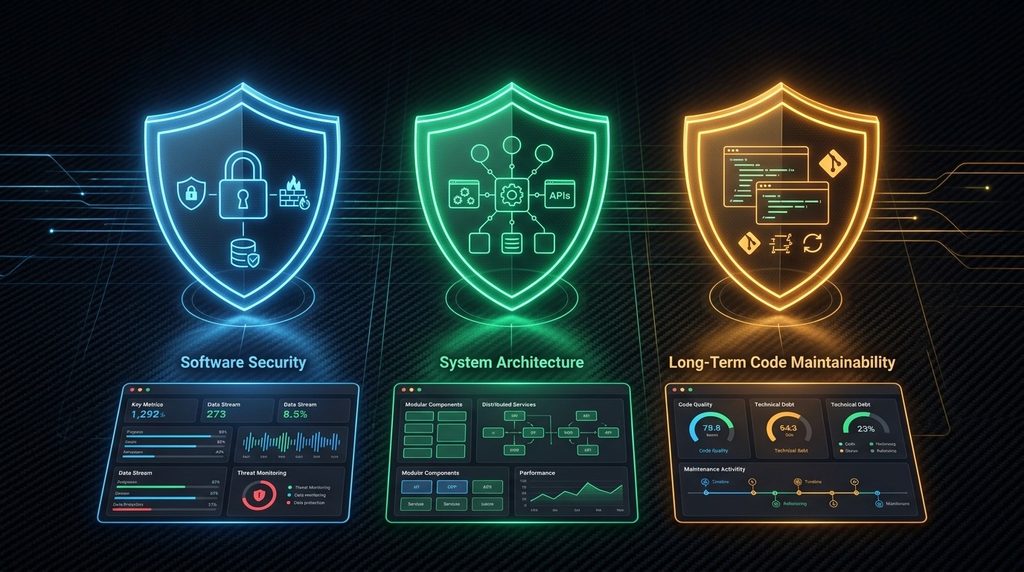
Not all bad code carries identical consequences. In our work reviewing modern codebases at TechVedhas, we classify AI code slop into three distinct risk tiers:
| Risk Category | How It Manifests | Blast Radius | Business Consequence |
|---|---|---|---|
| 1. Security Slop | Missing input sanitization, insecure deserialization, swallowed auth errors, hardcoded defaults. | Immediate & Critical | Regulatory fines, data exfiltration, reputational collapse, compliance audit failures. |
| 2. Architectural Slop | Redundant layers, monolithic helpers, bypass of central middleware, conflicting data models. | Compounding & Medium-Term | Exploding technical debt, developer paralysis, inability to ship complex roadmap features. |
| 3. Maintenance Slop | Brittle happy-path tests, noise comments, dead utilities, inconsistent formatting. | Chronic & Daily Drag | Reviewer burnout, high employee turnover, elevated defect density in standard releases. |
The Business Impact No One Talks About
Engineering leaders frequently evaluate AI coding assistants purely through the lens of initial speed: “Our engineers generate 30% more code per sprint.”
However, in software engineering, lines of code produced are a liability, not an asset. Every line written must be compiled, reviewed, secured, maintained, and adapted over a five-to-ten-year lifecycle.
The Productivity Paradox & The “Great Toil Shift”
While individual developers report feeling more productive during the drafting phase, that velocity is frequently erased downstream. AI has not eradicated engineering toil; it has shifted it.
Engineers spend less time typing boilerplate and significantly more time:
- Deciphering cryptic logic generated by someone else’s prompt.
- Investigating bizarre edge-case production anomalies.
- Refactoring near-duplicate functions that broke third-party integrations.
- Fixing architectural drift that prevents major version upgrades.
When review times double and production regressions rise, the net organizational velocity drops below where it was prior to AI adoption.
The Year-Two Maintenance Wall
Organizations that embraced unguided AI coding practices in 2024 and 2025 are now hitting a severe “Year-Two Maintenance Wall.”
In Year One, building an MVP or adding greenfield features feels intoxicatingly fast. The code passes tests and ships.
In Year Two, the system must scale. New hires join the team. Integrations expand. Suddenly, engineers discover that nobody on the team deeply understands how core modules operate because no human conceived their overarching design. Modifying a single workflow requires touching twenty files with contradictory patterns.
Feature delivery slows to a crawl, and executive leadership faces an unwelcome reality: paying twice for the same software—first to generate it, and then to rewrite it.
Beyond Subscription Fees: The True Total Cost of Ownership (TCO)
The true cost of unmanaged AI adoption extends far beyond a per-seat monthly license. It encompasses:
- Rework and Refactoring Sprints: Sprints diverted from commercial features to untangle technical debt.
- Elevated Incident Response Overhead: On-call engineers triaging silent failure cascades at 2:00 AM.
- Talent Attrition & Burnout: Senior engineers are leaving because their roles have deteriorated from building elegant systems into reviewing endless mountains of machine-generated slop.
- Security Remediation: Emergency penetration tests and zero-day patch deployments caused by overlooked injection flaws.
How to Detect AI Code Slop in Your Codebase
You cannot remediate what you cannot identify. Detecting AI code slop requires a combination of behavioral review heuristics, engineering metrics, and deterministic automated tooling.
1. Code Review Heuristics (What Humans Should Look For)
During PR reviews, train your team to watch for these red flags:
- Missing Negative Test Cases: The PR includes 15 unit tests, but every test feeds valid inputs. There are zero tests verifying how the system reacts to null pointers, expired tokens, or network disconnects.
- Novel Helper Implementations: The PR introduces a utility method for something common (e.g., currency conversion, phone number validation) without reusing existing repository modules.
- Generic Catch-All Blocks: Widespread use of broad catch clauses without explicit telemetry or re-raising.
- Unused Abstraction Bloat: Generic repository interfaces, mediator patterns, or dynamic factories wrapping single-table operations that will never change.
- Absence of Intent Documentation: PR descriptions that copy-paste the AI prompt rather than explaining the architectural rationale and business trade-offs.
2. Engineering Metrics That Signal AI Debt
Watch your engineering dashboard for these statistical warning signs:
- Code Churn Spikes: A high percentage of lines added to the codebase are deleted or rewritten within 30 to 90 days.
- Expanding PR Sizes: PR volume growing from an average of 150 lines to 600+ lines without a corresponding increase in delivery impact.
- Lengthening PR Cycle Time: Pull requests sitting open in review states for days because peer reviewers find them cognitively overwhelming.
- Growing Ratio of Maintenance vs. Feature PRs: Your sprint burndown shifting from 75% feature work to 60% bug fixing and regression stabilization.
3. Automated Tooling to Catch Slop at the Merge Gate
Manual review alone cannot catch high-velocity slop. Engineering teams must deploy automated guardrails in their CI/CD pipelines:
- Static Application Security Testing (SAST): Tools like Semgrep, Snyk, or SonarQube are configured with strict rules to flag missing input validation, unparameterized queries, and swallowed exceptions before PRs can merge.
- Code Duplication Detectors: Automated linters (e.g., CPD, SonarQube) set to fail builds when duplicated logic exceeds strict thresholds.
- Software Composition Analysis (SCA): Automated dependency verifiers that cross-reference new packages against public registries to block hallucinated dependencies or unvetted libraries.
- Complexity Analyzers: Tools that measure cyclomatic complexity and flag deeply nested, over-engineered functions.
How to Clean It Up: Refactor or Rewrite?
When teams inherit a repository burdened by AI slop, the immediate emotional impulse is often: “Throw it away and start over.”
However, full-scale rewrites are notoriously perilous. Standish Group data on large-scale IT projects found only 6.4% were fully successful, while 41.4% failed outright — abandoned or restarted from scratch — because the legacy code, no matter how sloppy, contains subtle, hard-won edge cases and domain logic that a rewrite forgets to preserve.
— Source: The Standish Group, CHAOS Report (project data spanning 2003–2012)
Use this decision matrix to determine your remediation path:
| Scenario / Symptom | Recommended Action | Strategic Rationale |
|---|---|---|
| Localized Messiness: Duplicated helpers, verbose comments, poor naming, but isolated to specific leaf components. | Targeted Refactoring | Low risk. Preserves business logic while consolidating helpers and cleaning up formatting in small, verifiable PRs. |
| Flawed Test Suites: Tests pass, but lack assertion depth or negative coverage. | Test-First Fortification | High impact. Write comprehensive end-to-end and integration characterization tests before altering code. |
| Fundamental Architectural Rot: Conflicting state ownership, lack of boundary enforcement, cross-module tight coupling. | Incremental Rewrite (Strangler Fig) | Balances stability and progress. Never do a big-bang rewrite; carve out bounded contexts one service at a time. |
| Hallucinated or Plausible-but-Wrong Logic: Code that produces subtle numerical or algorithmic inaccuracies. | Revert & Hand-Craft | Do not try to polish hallucinated logic. Strip the function out and write it manually with explicit unit tests. |
The Strangler Fig Approach for Large Slop Modules
If an entire service or module has degraded under AI slop, do not stop roadmap development for three months to rebuild it from scratch. Apply the Strangler Fig Pattern:
- Place a facade or proxy interface in front of the existing sloppy module.
- Build the new, rigorously architected implementation alongside the old one.
- Write end-to-end integration tests that route identical production-like payloads through both systems, comparing outputs.
- Gradually shift traffic (e.g., 5%, 25%, 100%) to the clean implementation.
- Decommission the old module once all edge cases are verified.
How to Prevent AI Code Slop: Individual Best Practices
Preventing slop begins with the mindset of the engineer holding the keyboard. Adopt these core disciplines:
- Treat AI Output as an Unvetted Intern’s First Draft: Never view an AI-generated suggestion as finished code. Treat it as if an eager, highly confident intern with zero company context wrote it. Your job is not to copy-paste; your job is to edit, verify, stress-test, and refine.
- The Rule of Complete Comprehension: “Own What You Merge”: If an AI assistant writes a 50-line regular expression, an intricate SQL query, or a multi-threaded worker, you are strictly forbidden from committing it until you can explain every single character and token to a colleague. If a bug breaks production, *”the AI suggested it”* is never an acceptable defense. You are the author of every line you merge.
- Context-Engineered, Security-Aware Prompting: Vague prompts yield sloppy code. Stop prompting: “Write an auth middleware for Express.”
Instead, provide strict, defense-in-depth architectural boundaries in your prompt:
Write an Express TypeScript authentication middleware using our existing JWT verification utility at src/shared/auth/jwt.ts. Do not import third-party libraries. Return an HTTP 401 with a structured JSON error response if the Bearer token is missing or expired. Log authentication failures using the Pino logger imported from src/shared/logger.ts including the client IP and correlation ID. Explicitly handle and catch all token parsing exceptions.
How Engineering Teams Can Use AI Responsibly (Team Governance)
Individual discipline must be anchored by organizational governance. At Vedhas Technology Solutions, we recommend engineering leaders implement a clear, three-part operational policy:
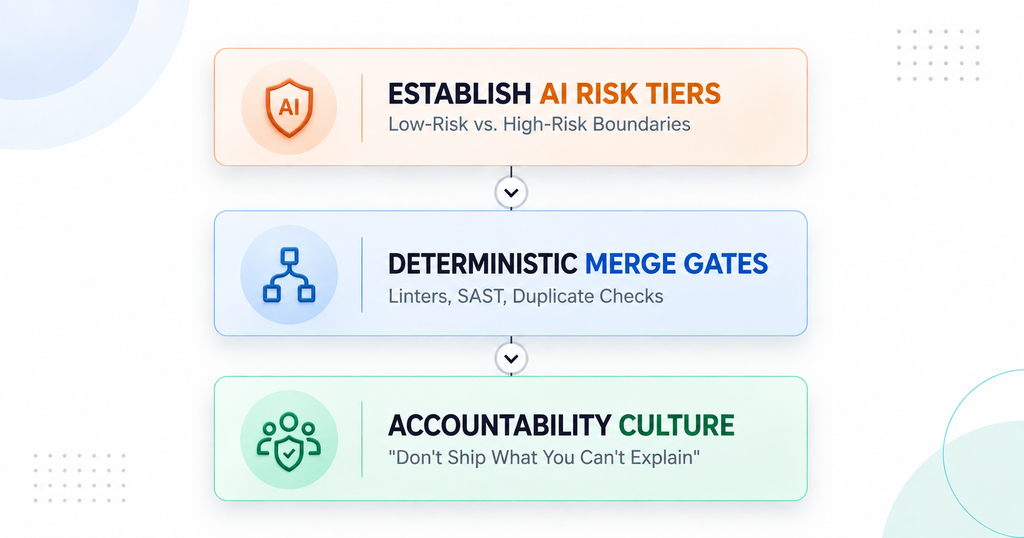
1. Classify Work into Clear AI Risk Tiers
Establish unambiguous organizational boundaries regarding where AI tools may and may not be deployed:
- Tier 1: High Freedom (Green Zone): Generating test data, crafting standard regex patterns, writing documentation, drafting boilerplate types, scaffolding mundane UI forms.
- Tier 2: Supervised Assistance (Yellow Zone): Business logic workflows, database migration scripts, API client adapters. Requires line-by-line review by a senior engineer and 90%+ unit test coverage.
- Tier 3: Strictly Human-Engineered (Red Zone): Cryptographic implementations, authentication and session management, financial transaction processing, data governance boundaries, core distributed system consensus. AI suggestions should be disabled or explicitly disallowed.
2. Enforce the Detection Tooling as Non-Negotiable Policy
The automated guardrails covered earlier — SAST, duplication detectors, SCA, and complexity analyzers — aren’t optional tooling suggestions; they need to be mandatory merge gates with no override path for individual engineers.
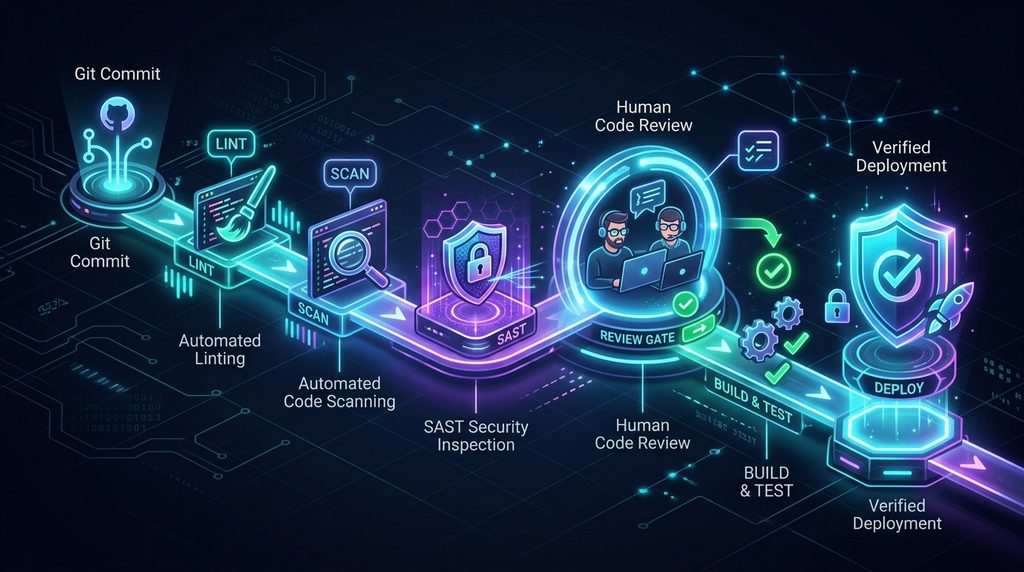
3. Shift Code Review from Syntax to Systems
With automated linters handling whitespace, formatting, and syntax, human reviewers must focus exclusively on system-level questions:
- Does this PR adhere to our domain boundary model?
- What happens when downstream dependencies fail?
- Does this create unneeded complexity or duplicate existing abstractions?
The AI Code Review Checklist (For Modern Engineering Teams)
Copy this checklist into your GitHub or GitLab pull request templates as a fast pass — it covers the checks above that automated linters and the heuristics list don’t already catch:
- Security Validation: Are all external inputs sanitized, validated, and type-checked against a strict schema (e.g., Zod, Pydantic)?
- Dependency Provenance: If new dependencies are added, have they been verified on official public registries to prevent slopsquatting attacks?
- Author Comprehension: Can the submitting author clearly explain the rationale and trade-offs of every line included in the changeset?
Frequently Asked Questions
-
What is the difference between technical debt and AI code slop?
Traditional technical debt is usually a conscious, deliberate engineering trade-off—a team knowingly takes a shortcut to meet a critical product launch deadline, intending to refactor it later. AI code slop, by contrast, is unconscious, accidental debt. It enters the codebase silently because the code appears polished, passes happy-path tests, and satisfies the prompt, despite being architecturally thoughtless and unmaintainable.
-
Does using AI coding tools always lead to lower code quality?
No. AI coding tools are exceptionally capable when wielded by experienced engineers who understand system design, supply strict prompt constraints, and treat AI output as an unvetted rough draft. Quality degrades only when organizations use AI as a replacement for engineering judgment, prioritizing sheer lines-of-code velocity over code review rigor and architectural standards.
-
How can small startups move fast with AI without accumulating slop?
Startups can harness AI velocity safely by establishing automated CI/CD guardrails from day one. Enforce strict linting, integrate automated static security scanners (SAST), forbid the use of AI on core authentication and billing pathways, and establish a non-negotiable culture where no engineer merges code they cannot thoroughly explain. Moving fast does not require abandoning defensive programming.
-
What is “slopsquatting” and how dangerous is it?
Slopsquatting is a software supply-chain threat where attackers monitor common package hallucinations generated by AI models and publish malicious packages under those exact fabricated names on registries like npm or PyPI. If a developer runs an installation command recommended by an AI assistant without verifying its provenance, they risk executing malicious code directly within their application.
-
When should a team consider rewriting AI-generated code rather than refactoring it?
Refactoring is best when problems are localized (e.g., duplicated helpers or messy syntax within an isolated function). A rewrite—preferably executed incrementally using the Strangler Fig pattern—is warranted when AI slop has compromised the architectural foundation: conflicting state management, circular module dependencies, or systemic security flaws where ongoing maintenance costs consistently outstrip the cost of a clean rebuild.
Conclusion: Balancing AI Velocity with Engineering Discipline
Artificial intelligence has fundamentally transformed software development. It has democratized coding, eliminated repetitive scaffolding, and allowed small teams to build ambitious applications at unprecedented speed.
However, the defining competitive advantage in modern software engineering is not how fast your team can generate code. It is how reliably your team can verify, secure, and maintain the code that gets shipped.
AI code slop is not an indictment of AI tools; it is a wake-up call for engineering discipline. Teams that scale cleanly over the coming decade will be those that pair the speed of generative AI with rigorous architectural governance, automated quality gates, and an unshakeable culture of human code ownership.
Need Help Elevating Your Codebase and Quality Standards?
If your team is balancing the pressure for rapid feature delivery with the necessity of architectural durability, partner with experts who understand both.
At Vedhas Technology Solutions, our QA Services and Quality Engineering teams help organizations audit codebases, implement automated CI/CD testing guardrails, and eliminate compounding technical debt before it halts your product roadmap. Whether you need strategic quality engineering, specialized AI Services, or Staff Augmentation to strengthen your core development teams, we ensure your technology scales cleanly and securely.
to discuss an engineering quality audit or explore how our solutions can safeguard your software growth.