Navigating the 2026 Legacy Tax Crisis
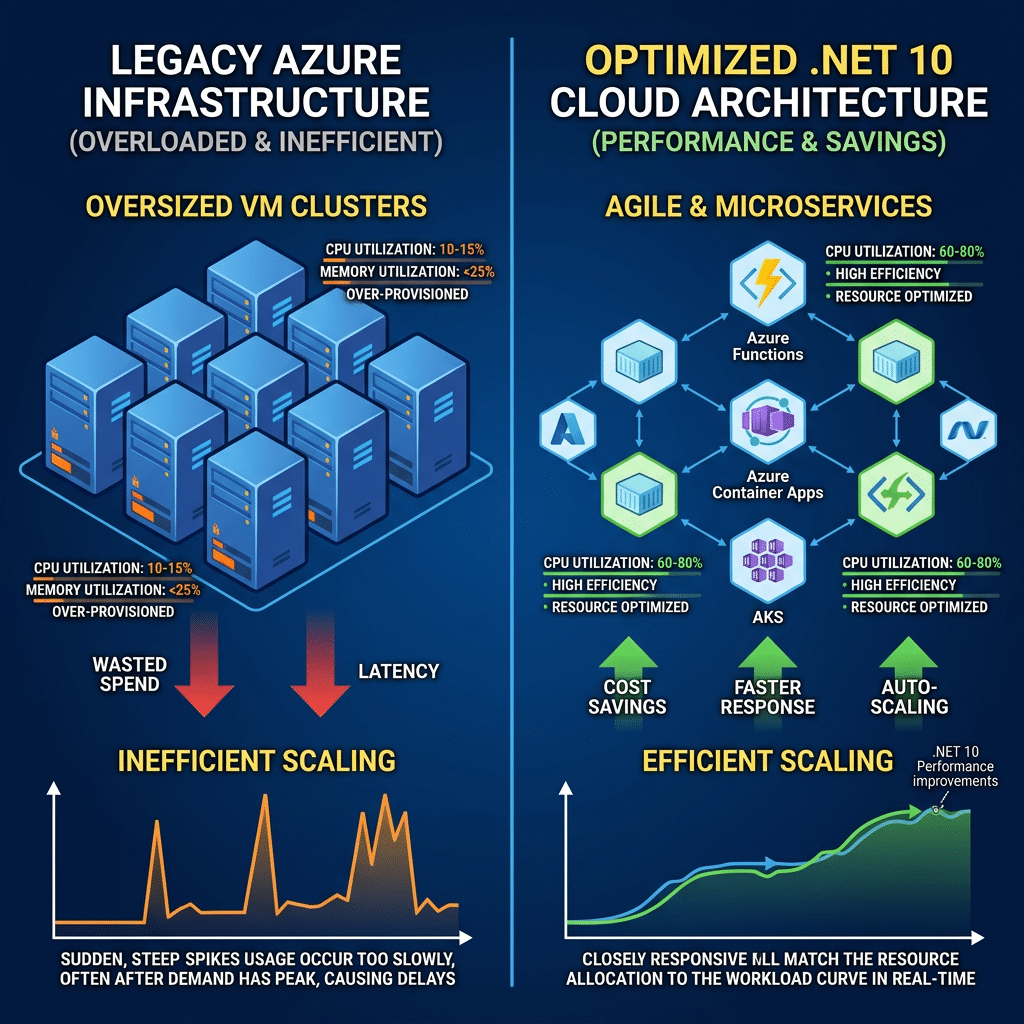
The year 2026 has arrived with a stark ultimatum for SaaS founders and CFOs: modernize or succumb to the “Legacy Tax.” This tax is not a government levy but a structural drain on profitability caused by two-decade-old codebases that lack the elasticity required for the modern cloud. Organizations are currently wasting an estimated $200 billion annually on underutilized cloud infrastructure—a staggering 32% of total cloud budgets. The primary culprit is the persistence of monolithic .NET Framework applications that were never intended to run in containerized, high-density environments like Azure Kubernetes Service.
For a mid-sized B2B SaaS platform, this inefficiency manifests as a silent bleed of $13,500 per month for a single 50-node cluster running at only 12% CPU utilization. When scaled across global regions, the “Legacy Tax” becomes a multi-million dollar liability that prevents the reallocation of capital toward growth drivers like generative AI and market expansion. The solution lies in the strategic deployment of.NET 10 Azure Cost Optimization, a framework that moves beyond surface-level “lift and shift” to fundamental architectural efficiency.
The 2026 Azure Efficiency Mandate: .NET 10 Azure Cost Optimization is the strategic practice of reducing infrastructure overhead by 18-28% through the adoption of the .NET 10 LTS framework, leveraging Native AOT for 40% faster cold starts and JIT improvements that allow 30-45% higher throughput on existing Azure compute tiers.
The Agitation: The High Stakes of Architectural Stagnation
The risks of inaction in 2026 extend far beyond a high Azure bill. Technical debt has reached a tipping point where it directly impacts company valuation and investor perception. CFOs who ignore the “Legacy Tax” are finding themselves trapped in a cycle of reactive firefighting, where 60-80% of the IT budget is consumed by maintenance activities that add zero business value. This stagnation creates a talent vacuum; modern engineering talent gravitates toward AI-native, cloud-native stacks, leaving legacy-bound companies reliant on a shrinking, increasingly expensive pool of specialized contractors.
Furthermore, the regulatory landscape has turned hostile for unoptimized systems. The finalized 2026 HIPAA Security Rule updates have eliminated the “addressable” loophole, making multi-factor authentication (MFA), encryption at rest/transit, and automated asset inventory mandatory for all healthcare-adjacent entities. Organizations that fail to implement .NET 10 Azure Cost Optimization while modernizing their compliance posture face fines of up to $1.9 million per violation category per year. The disconnect between the teams building the cloud and the teams paying for it has created a “visibility-accountability gap” that 40% of practitioners cite as their primary challenge.
The Mechanics of .NET 10 Azure Cost Optimization
The release of .NET 10 in November 2025 provided the technical catalyst required to resolve the cloud waste crisis. As a Long-Term Support (LTS) release, it offers stability until late 2028, making it the ideal target for enterprise modernization efforts. The framework introduces measurable, production-ready performance gains that translate directly into lower hosting costs through three primary mechanisms: Native AOT, JIT compiler optimizations, and advanced memory management.
Benchmarking the Leap: .NET 8 vs. .NET 10
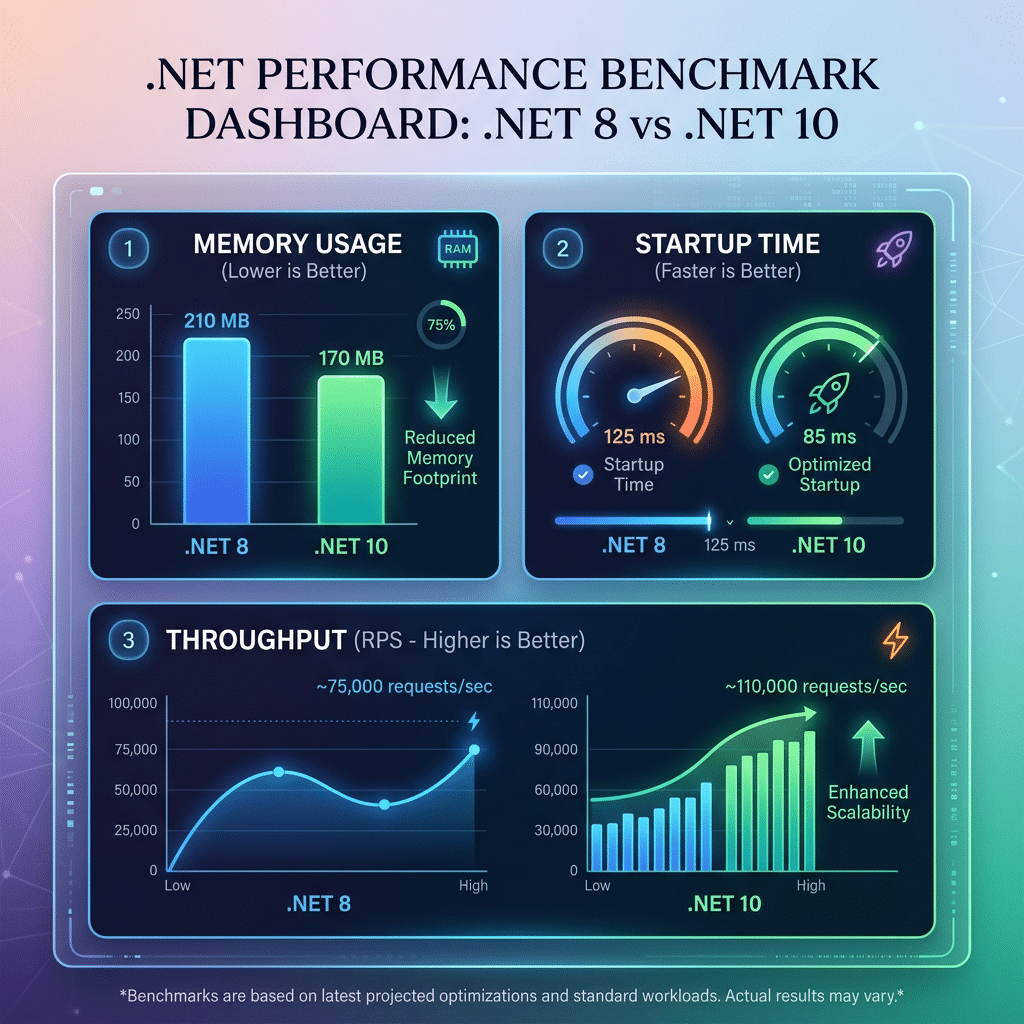
The following benchmarks demonstrate why the migration to.NET 10 is a financial imperative for 2026.
| Performance Metric | .NET 8 (Previous LTS) | .NET 10 (2026 Benchmark) | Delta / Efficiency Gain |
| Requests per Second (Throughput) | ~428,000 | ~542,000 | +26.6% |
| Cold Start Time (Native AOT) | 85 ms | 51 ms | -40.0% |
| Memory Resident Set Size (RSS) | 245 MB | 172 MB | -29.8% |
| JSON Serialization Speed | Baseline | Baseline + 34% | +34.0% |
| Average Monthly Azure Savings | N/A | 18-28% | -23.0% (Average) |
The latest .NET 10 SDK enhancements further improve application performance, build optimization, and cloud deployment efficiency for enterprise workloads.
These gains allow for significantly higher resource density on Azure App Service and AKS. When memory residency drops by nearly 30%, a single VM node that previously hosted 10 container instances can now comfortably host 14, effectively reducing the required node count for a cluster by 28.5% without any degradation in service.
How .NET 10 Azure Cost Optimization Reduces Azure VM and AKS Costs
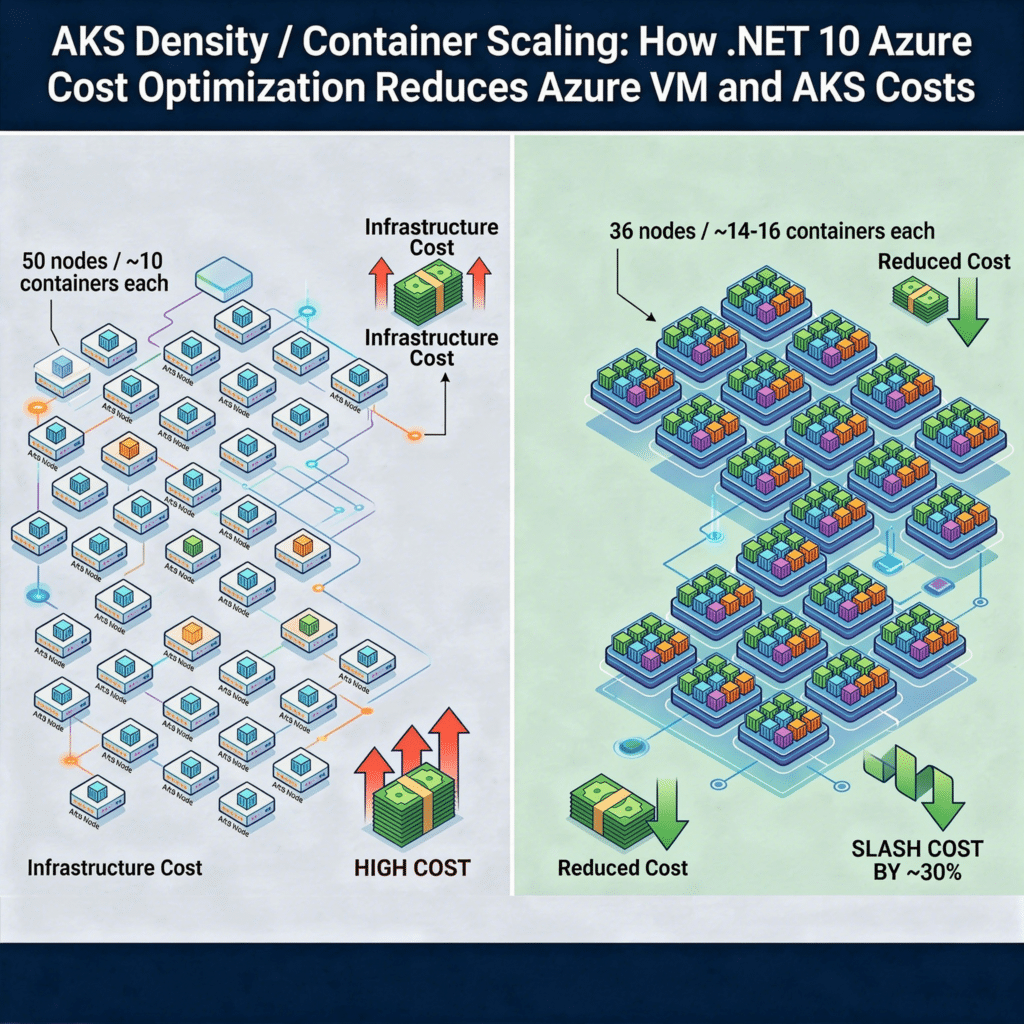
One of the biggest advantages of .NET 10 Azure Cost Optimization is the ability to increase workload density without increasing infrastructure spend. Traditional .NET Framework applications often consume excessive memory and CPU resources, forcing organizations to provision oversized Azure Virtual Machines and Kubernetes clusters just to maintain stable performance.
With .NET 10 Native AOT, improved garbage collection, and optimized runtime execution, organizations can run significantly more workloads on the same infrastructure footprint.
For example:
- A Kubernetes node previously hosting 10 microservices can now support 14–16 optimized .NET 10 containers.
- Azure App Service instances can process more concurrent requests without scaling horizontally.
- Lower memory residency enables migration from premium VM tiers to cost-efficient B-series or D-series instances.
This is where .NET 10 Azure Cost Optimization directly impacts monthly Azure billing:
| Infrastructure Area | Legacy Environment | Optimized .NET 10 Environment |
| AKS Node Count | 50 Nodes | 36–40 Nodes |
| Average Memory Usage | 245 MB/container | 172 MB/container |
| Cold Start Delays | High | Minimal |
| Compute Overprovisioning | Common | Reduced |
| Azure Monthly Spend | High | 18–30% Lower |
By improving compute efficiency at the runtime level, .NET 10 Azure Cost Optimization allows organizations to scale applications without scaling cloud waste.
The Native AOT Advantage in Microservices
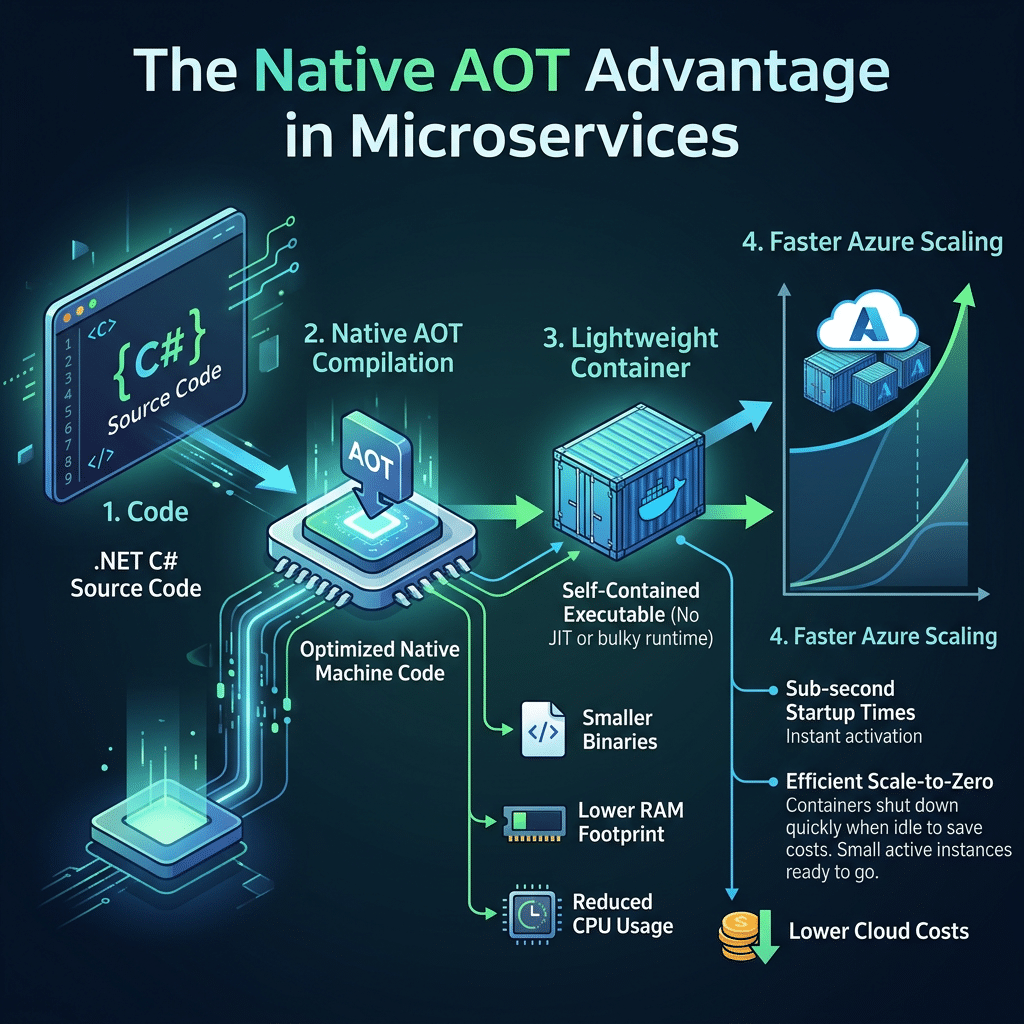
Native AOT (Ahead-of-Time) compilation is the cornerstone of.NET 10 Azure Cost Optimization for cloud-native architectures. Unlike traditional.NET applications that rely on a Just-In-Time (JIT) compiler—which compiles code at runtime and consumes significant CPU and RAM during the “warm-up” phase—Native AOT produces a fully pre-compiled, platform-optimized binary. Microsoft’s Native AOT deployment documentation explains how ahead-of-time compilation improves startup performance, reduces runtime dependencies, and lowers memory consumption in containerized cloud environments.
The implications for Azure billing are substantial:
- Smaller Binaries: A minimal API published with Native AOT often produces a 3-10 MB binary, drastically reducing container pull times and Azure Container Registry storage costs.
- Lower Memory Footprint: By removing the JIT compiler and unused library code at runtime, memory usage drops, making AOT-optimized apps ideal for the low-resource environments of edge devices and cost-efficient Azure B-series VMs.
- Instant Scaling: Native AOT apps start in microseconds (5-40ms), allowing for “scale-to-zero” architectures in Azure Container Apps where you only pay for compute during active request processing.
Real-World Azure Billing Impact of .NET 10 Azure Cost Optimization
For many SaaS companies, Azure costs increase faster than revenue growth because infrastructure scaling is tied directly to inefficient application performance. .NET 10 Azure Cost Optimization changes this equation by reducing the infrastructure required to support the same transaction volume.
A modernized .NET 10 workload improves Azure billing efficiency across multiple services:
- Reduced AKS node consumption
- Lower Azure App Service scaling events
- Faster Azure Container Apps startup times
- Reduced Azure bandwidth overhead
- Lower Azure Monitor ingestion costs due to optimized telemetry handling
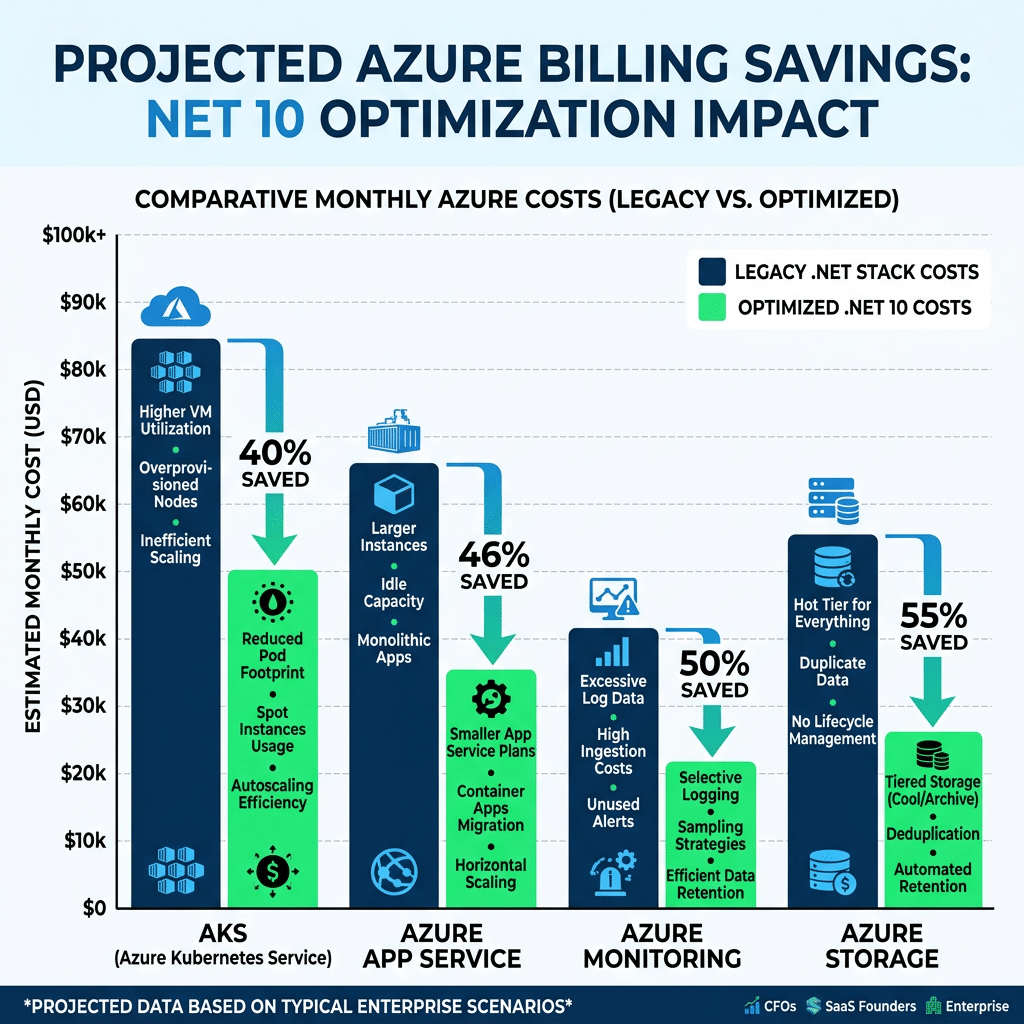
Example monthly savings for a mid-sized SaaS platform:
| Azure Service | Legacy Monthly Cost | Optimized Monthly Cost |
| Azure Kubernetes Service | $18,000 | $12,800 |
| Azure App Service | $6,500 | $4,700 |
| Azure Storage & Networking | $4,200 | $3,600 |
| Monitoring & Logging | $2,800 | $1,900 |
Total estimated reduction using .NET 10 Azure Cost Optimization: approximately 30% lower infrastructure spend annually.
This cost reduction creates additional budget capacity for AI adoption, product innovation, and market expansion initiatives.
JIT Compiler and Garbage Collection Enhancements
For applications that cannot yet transition to Native AOT, the .NET 10 JIT compiler offers “graph-based loop recognition” and improved “escape analysis”. The compiler can now prove if an object escapes its method scope; if it does not, the object is allocated on the stack rather than the heap. This stack allocation involves only pointer bumping and automatic freeing upon method exit, which is significantly cheaper than heap allocation and subsequent garbage collection.
Real-world benchmarks show that simple operations that took 19.5 nanoseconds in .NET 9 now complete in just 6.6 nanoseconds in .NET 10, a 66% improvement in raw execution speed for localized logic. These efficiencies mean that CPU-bound workloads—such as those found in financial services or data analytics—require fewer Azure vCores to maintain the same throughput, enabling .NET 10 Azure Cost Optimization through vertical rightsizing of VM instances.
Strategic Implementation: The Vedhas Technology Solutions Edge
Modernizing an enterprise application stack is a high-stakes endeavor that requires more than just technical code changes. It requires a partner that understands the intersection of technology, business transformation, and regulatory compliance. Vedhas Technology Solutions, an established provider since 2017 with a dual presence in the U.S. and India, offers a specialized approach to .NET 10 Azure Cost Optimization that prioritizes “getting it right the first time”.
Specialized Industry Expertise
Vedhas brings deep market expertise across mission-critical sectors where downtime and compliance failures are not options. Their focus on healthcare, e-commerce, and government e-governance ensures that modernization efforts are grounded in industry-specific best practices.
| Industry Focus | Modernization Pain Point | Vedhas Solution Strategy |
| FinTech | High transaction costs and legacy infrastructure inefficiency | Scalable transaction processing and low-latency cloud infrastructure modernization |
| B2B SaaS | Lead quality and marketing ROI | Data-driven marketing automation and optimized CRM implementation |
| Government | Mission-critical high availability | Infrastructure planning for high-availability transaction processing |
The Vedhas Modernization Framework
The Vedhas delivery model is built on transparency and proactive management, which are essential for complex .NET 10 Azure Cost Optimization projects. They utilize an “Infrastructure Readiness Assessment” (IRA) methodology to ensure that the target Azure environment is perfectly tuned for the modernized .NET 10 stack.
Their 4-phase service model provides a structured path to ROI:
- Discovery & Strategy (Weeks 1-2): Business requirement gathering, technology due diligence, and transparent cost estimation.
- Design & Development: Iterative development with weekly progress calls and continuous quality assurance.
- Testing & Deployment: Independent validation, infrastructure deployment, and user acceptance testing (UAT).
- Post-Deployment Support: Performance monitoring, ongoing optimization, and regular analytical reporting.
The Business Case for .NET 10 Azure Cost Optimization
For finance leaders, the decision to invest in .NET 10 Azure Cost Optimization must be backed by a defensible business case. In 2026, CFOs are prioritizing “growth functions” and “AI” while pulling back on headcount growth, which has slowed from 6% to just 2%. This structural pivot toward automation and technical efficiency makes the ROI of modernization more compelling than ever.
The Modernization ROI Formula
To calculate the financial impact of a migration, executives should use a comprehensive ROI model that accounts for both direct savings and indirect value drivers:
Total Business Value (3-year horizon) includes:
- Infrastructure Savings: 18-28% reduction in monthly Azure spend.
- Maintenance Savings: 40-50% reduction in support labor costs.
- Developer Productivity: 20-30% faster time-to-market for new features.
- Risk Mitigation: Avoided costs of security breaches (averaging $5.08M for third-party incidents).
- Uptime Value: Reduction in costly downtime ($5,600/minute average cost).
Measuring What Matters
In 2026, leading organizations are moving away from aggregate cloud bill tracking and toward “Unit Economics”. .NET 10 Azure cost optimization should be measured by its ability to lower the “Cost per Unit” while revenue increases.
| Metric | Business Context | Optimization Goal |
| Cost per Customer | Azure spend divided by total active tenants | Lowering cost while scaling the user base |
| Cost per Transaction | Processing costs for a single purchase or API call | Increasing density to lower per-request cost |
| Cloud Efficiency Rate (CER) | Revenue per dollar of cloud spend | Improving from the 2026 average of 65% to 80%+ |
Code Simulation for Native AOT Optimization
To demonstrate the technical rigor of.NET 10 Azure Cost Optimization, consider the following simulated configuration for a mission-critical microservice. This pattern eliminates the JIT compiler overhead and ensures the smallest possible memory footprint on Azure.
C#

// High-Performance .NET 10 Microservice Configuration for Azure
// Purpose: .NET 10 Azure Cost Optimization via Native AOT

using System.Text.Json.Serialization;

var builder = WebApplication.CreateSlimBuilder(args);

// Native AOT optimization: Pre-registering JSON serializers
// to avoid reflection at runtime, which reduces memory residency.
builder.Services.ConfigureHttpJsonOptions(options =>
{
    options.SerializerOptions.TypeInfoResolverChain.Insert(0, AppJsonContext.Default);
});

var app = builder.Build();

// Minimal API: Low-friction, high-throughput endpoint
app.MapGet("/health", () => Results.Ok(new HealthStatus("Healthy", true)));

app.Run();

[JsonSerializable(typeof(HealthStatus))]
internal partial class AppJsonContext : JsonSerializerContext { }

// The record used in the endpoint response
public record HealthStatus(string Status, bool Optimized);
Azure Deployment Strategy: By setting <PublishAot>true</PublishAot> in the project file, this application will start in ~50ms and consume less than 40MB of RAM, allowing it to run on the most cost-efficient Azure Linux Basic plans.
The Direct Business Impact of .NET 10 Azure Cost Optimization
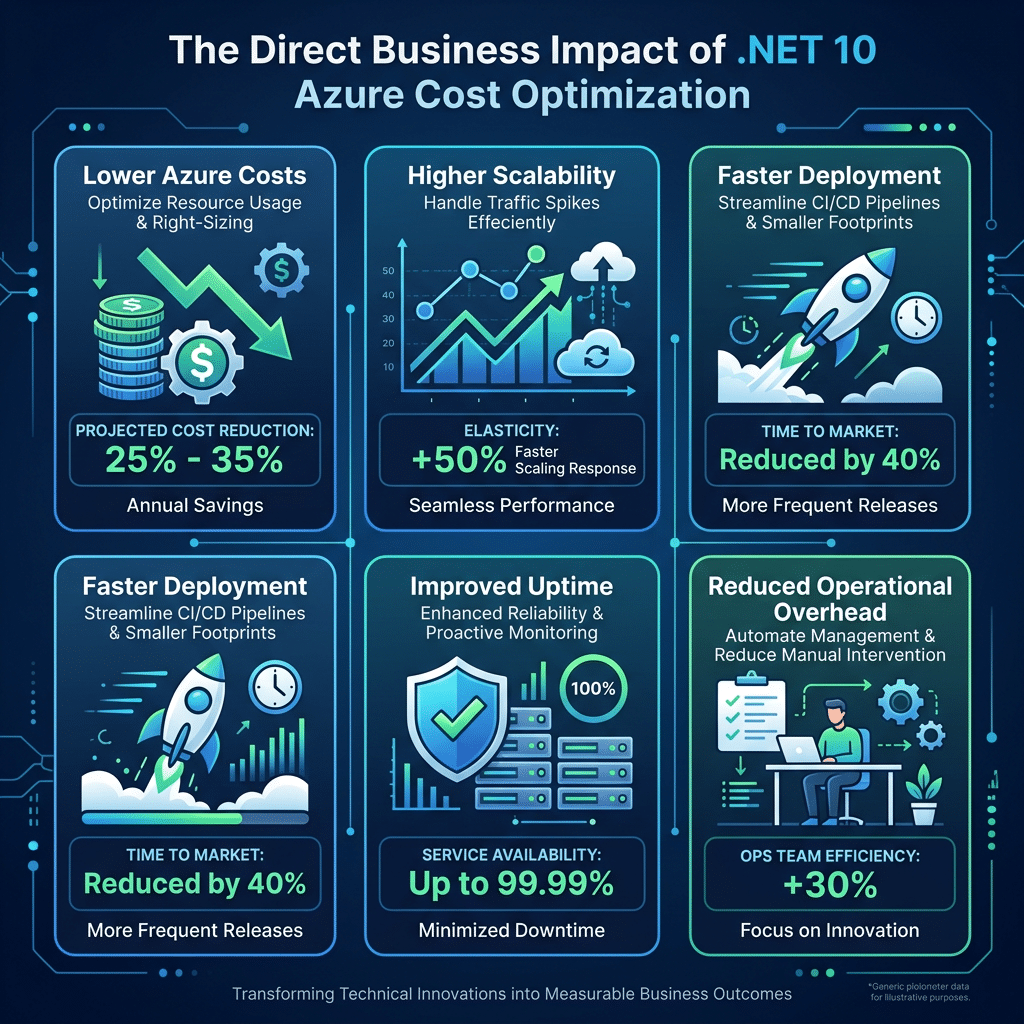
The financial impact of cloud inefficiency is no longer hidden inside IT budgets. In 2026, Azure infrastructure waste directly affects profitability, EBITDA margins, and long-term scalability.
Organizations adopting .NET 10 Azure Cost Optimization are achieving measurable business outcomes:
- 18–30% lower Azure infrastructure costs
- Faster release cycles
- Improved application responsiveness
- Reduced operational complexity
- Better cloud resource utilization
- Lower risk of performance bottlenecks during scaling
Most importantly, modernization allows engineering teams to focus on innovation instead of maintaining expensive legacy infrastructure.
For enterprises operating high-volume SaaS platforms, the transition to .NET 10 is increasingly becoming a financial necessity rather than an optional technical upgrade.
Leading the 2026 Agentic Enterprise
The shift toward .NET 10 Azure Cost Optimization is not just a technical upgrade; it is a prerequisite for the “Agentic Enterprise” of 2026. As AI agents move from simple chatbots to autonomous systems that perform tasks and reasoning, the underlying infrastructure must be fast, secure, and cost-efficient. Legacy systems act as “digital anchors” that prevent agents from executing at the speed of business.
By partnering with Vedhas Technology Solutions, organizations can navigate this transition with confidence. Vedhas’s 360° monitoring and “Get It Right the First Time” motto ensure that the 30% infrastructure savings are realized without the risks typical of unmanaged migrations.
The data from 2026 is clear: organizations that spend “smartest” on the cloud will thrive. .NET 10 Azure Cost Optimization provides the foundation for that intelligence, transforming IT from a cost center into a strategic growth engine.
Legacy Azure environments often consume more infrastructure resources than necessary, leading to rising operational costs, inefficient scaling, and reduced cloud ROI. Many organizations continue paying for oversized VM clusters, underutilized compute capacity, and inefficient application architectures without fully understanding where infrastructure waste exists.
Evaluate how efficiently your current Azure ecosystem utilizes compute, memory, storage, and container resources against modern .NET 10 performance standards. Vedhas Technology Solutions provides a tailored assessment of legacy .NET workloads, Kubernetes infrastructure, application performance bottlenecks, and cloud resource efficiency to identify opportunities for infrastructure optimization and long-term cost reduction.
Gain actionable insights into where your Azure spend delivers value — and where hidden inefficiencies continue impacting scalability, performance, and profitability.
Stop Overpaying. Start Modernizing.