Trapped by Your Own Technology: The Legacy System Dilemma
Imagine a major healthcare organization in early 2026 managing thousands of daily patient records. The Department of Health and Human Services has proposed its most significant Security Rule overhaul in two decades, making multi-factor authentication, AES-256 encryption, and rapid breach notification mandatory for all platforms processing patient information.
Their problem: core operations run on a decade-old monolith. Source code is brittle, the original developers have retired, and patching is nearly impossible.
A “Big Bang” rewrite means two years, millions of dollars, and high failure risk. Staying put means regulatory penalties, data breaches, and compounding operational failures. Neither option is acceptable.
This is the Legacy Tax — and it hits three ways simultaneously: inflated infrastructure costs that modern systems avoid, a shrinking talent pool that makes legacy maintenance increasingly fragile, and compliance gaps that widen with every passing quarter.
Organizations carrying this burden spend their IT budgets surviving rather than growing. The Strangler Fig Pattern for Legacy App Modernization is that better path forward.
Strangler Fig Pattern at a Glance
Strangler Fig Pattern for Legacy App Modernization is an incremental software modernization approach that replaces a legacy application one feature or service at a time instead of rebuilding the entire system in a single “Big Bang” project. New components are developed alongside the existing application and routed through an API gateway, allowing both systems to operate simultaneously until the migration is complete.
Organizations use this pattern to reduce migration risk, avoid downtime, improve scalability, strengthen security, and maintain business continuity throughout modernization. It is particularly effective for large enterprise applications where stopping operations or replacing the entire system at once is impractical.
In most enterprise modernization projects:
| If your organization needs to… | The Strangler Fig Pattern helps by… |
|---|---|
| Modernize without downtime | Migrating features incrementally while the legacy system remains operational. |
| Reduce migration risk | Deploying and validating one service at a time. |
| Improve scalability | Replacing monolithic components with independently scalable services. |
| Meet compliance requirements | Introducing modern security controls and API gateways without rebuilding the entire application. |
| Control modernization costs | Spreading investment across multiple migration phases instead of one large rewrite. |
Understanding the Core Architecture of the Strangler Fig Pattern
First conceptualized by software pioneer Martin Fowler, the Strangler Fig Pattern takes its name from the biological behavior of the Australian strangler fig. This plant begins its lifecycle as a seed in the upper branches of a host tree. Over time, its roots grow downward, wrapping around the host trunk and establishing a parallel support structure. Eventually, the host tree is completely overtaken and replaced, leaving the self-supporting fig tree in its place.
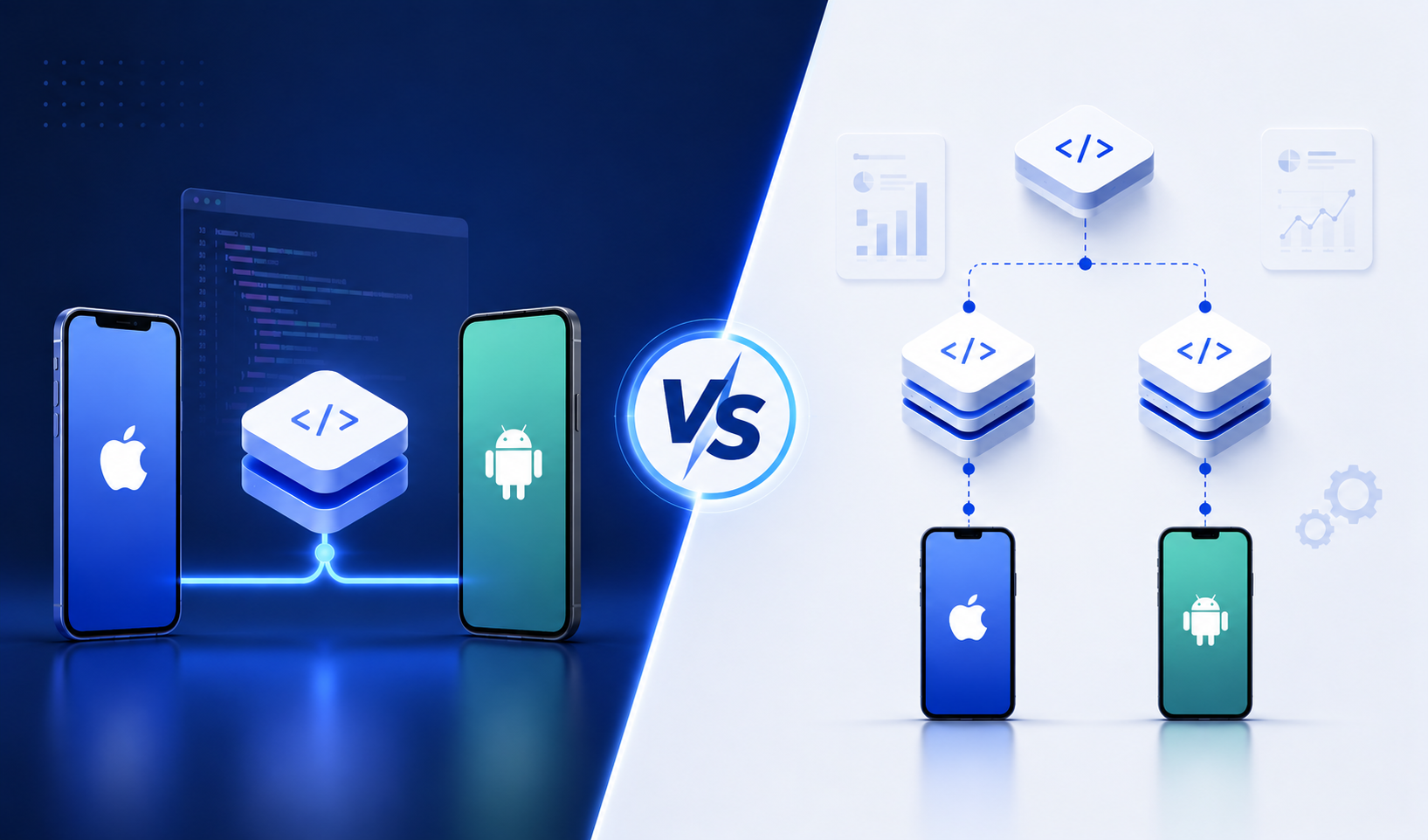
When applied to enterprise systems, the Strangler Fig Pattern provides a structured, incremental approach to replacing old software. Instead of replacing the entire system at once, individual business capabilities are carved out and rebuilt as modern, independent services. These new services run alongside the legacy platform, gradually taking over operations until the old system can be safely decommissioned.
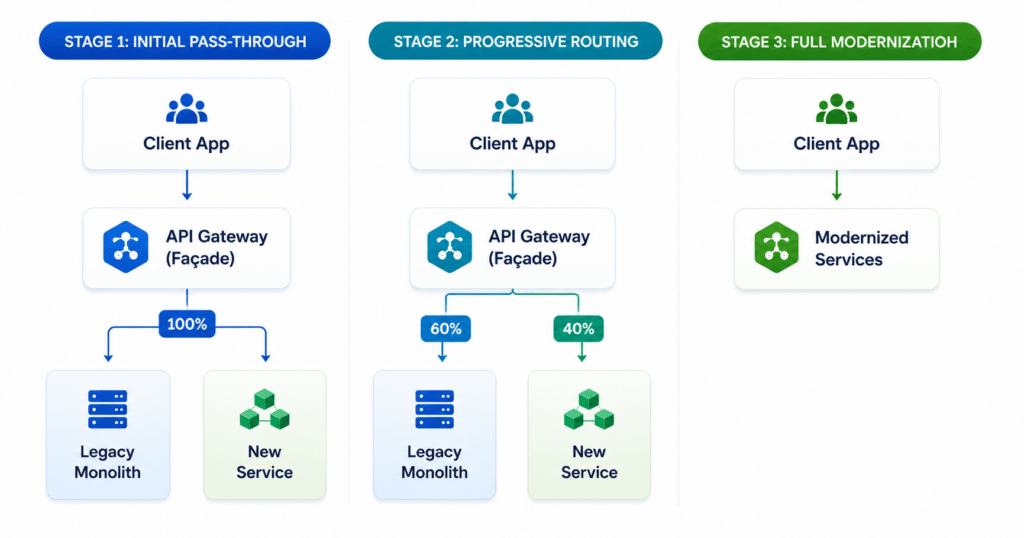
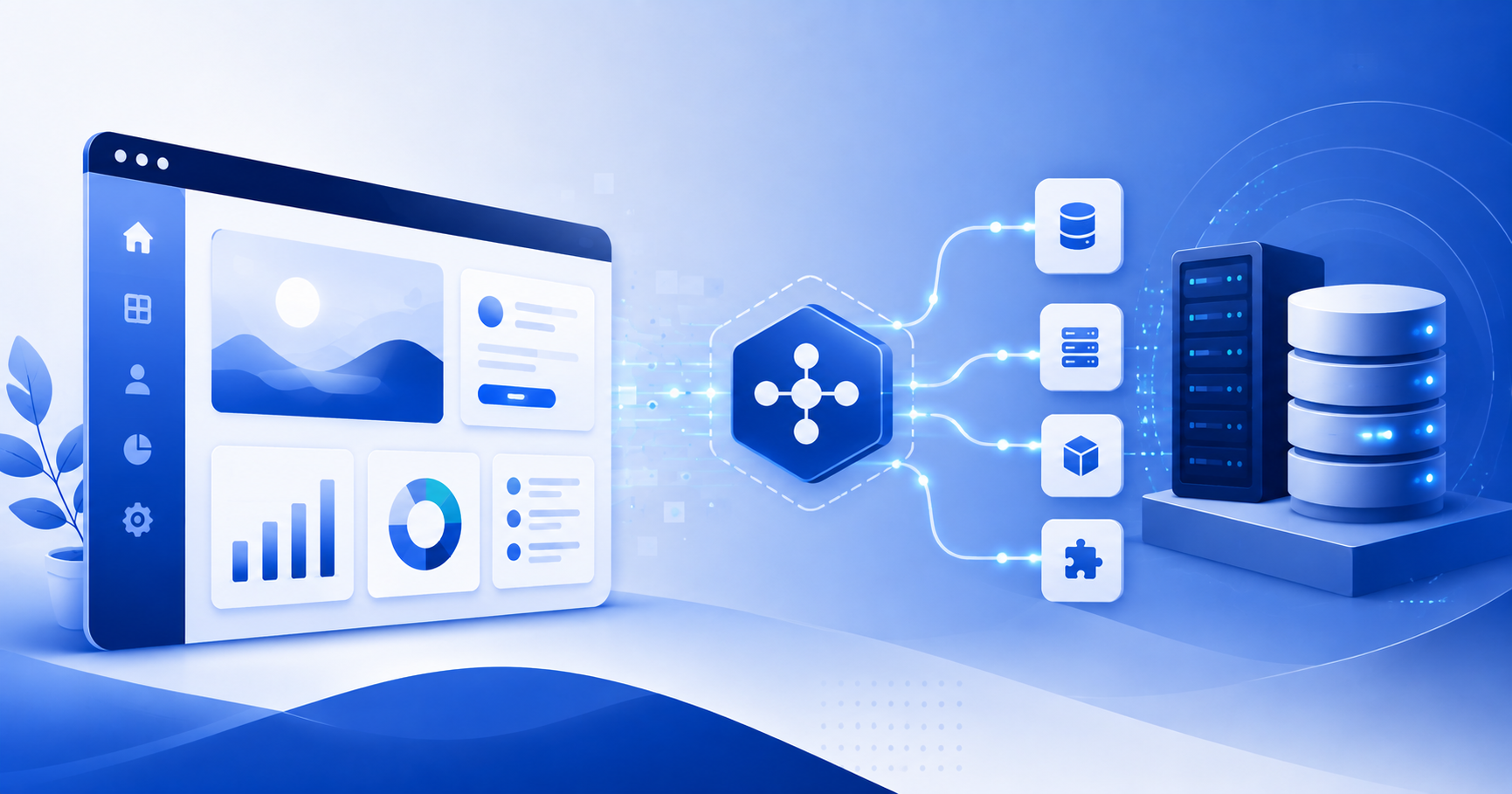
The key component of this architecture is the “façade” or API gateway. This gateway is deployed directly in front of the systems, intercepting all incoming client requests.
Initially, the gateway acts as a pass-through, routing all traffic directly to the legacy backend. As new, modernized services are developed, the routing rules within the gateway are adjusted.
Requests for migrated features are directed to the new services, while all other traffic continues to flow to the legacy backend without interruption. This transitional architecture allows organizations to modernize their systems at a manageable pace.
Phase-by-Phase Execution of the Strangler Fig Pattern
Successfully executing the Strangler Fig Pattern requires a structured, four-phase process — each building on the last without disrupting live operations.
Phase 1: Establishing the Façade
The first phase involves deploying a high-availability API gateway in front of the existing system. This gateway decouples the client interface from the backend database and logic, acting as the single control point for all traffic. By establishing this routing layer early, backend systems can be modified freely without touching client-side configurations or causing any downtime.
Phase 2: Slicing and Incremental Service Migration
Next, the engineering team identifies clear boundaries within the monolith for service extraction. The smartest starting point is always low-risk, high-value components with minimal dependencies — authentication systems, reporting engines, or notification services are common first candidates.
Each selected feature is rebuilt as an independent service on a modern technical stack and deployed in parallel with the legacy system. The gateway then redirects only that feature’s traffic to the new service, while everything else continues running on the monolith untouched. At this stage, the business sees zero disruption — but the modernization has already begun.
Phase 3: Managing the Database Transition
Migrating application logic is relatively straightforward. Separating a shared monolithic database is where most modernization efforts face their most complex challenge — and where the most risk lives.
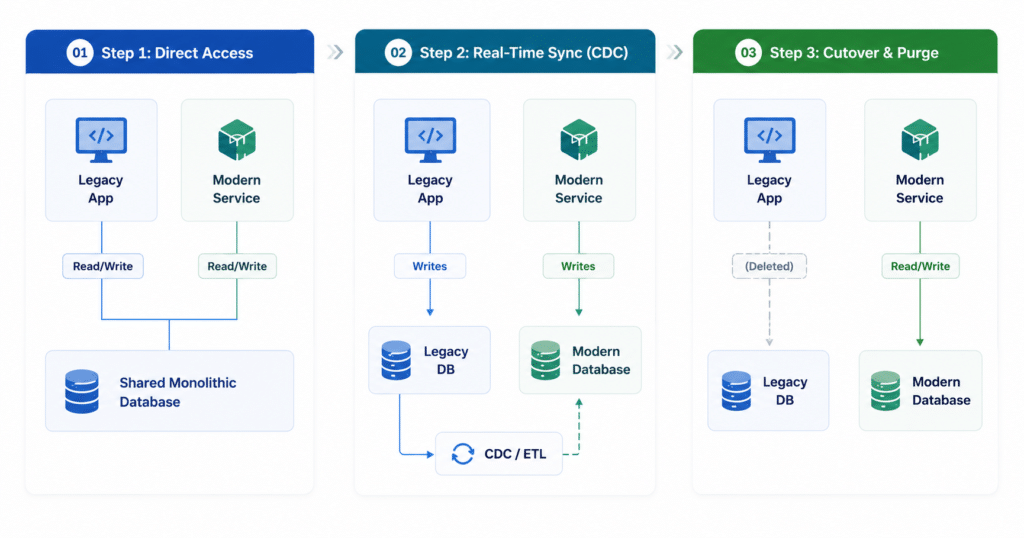
The process unfolds in three steps:
Step 1 — Shared Access: The new microservice initially reads from and writes to its relevant tables within the existing monolithic database. This lets the service logic be validated in production without any data synchronization risk.
Step 2 — Parallel Sync: A dedicated database is provisioned for the new service. Historical data is migrated across, and a real-time sync pipeline is established so that any writes to the legacy database are instantly mirrored to the new one. Both databases run in parallel while the team validates that data remains consistent across both.
Step 3 — Cutover: Once data integrity is confirmed, the new database becomes the system of record. Legacy tables, stored procedures, and triggers are cleanly removed. This process repeats domain by domain until the monolithic database is fully decomposed.
Phase 4: Decommissioning the Monolith
As each domain migrates successfully, the legacy system progressively loses its responsibilities. Once all services have been extracted and validated, the monolith is safely shut down — not in a single high-risk cutover moment, but as the quiet conclusion of a controlled, methodical process.
Why Modern Organizations Choose the Strangler Fig Pattern for Legacy App Modernization Over Big Bang Rewrites
The case for incremental modernization becomes clearest when set against the alternative. Here is how a traditional “Big Bang” rewrite compares to the Strangler Fig Pattern across the variables that matter most to the business:
| Operational Variable | Traditional “Big Bang” Rewrite | Strangler Fig Pattern |
|---|---|---|
| Operational Downtime | High risk; requires taking systems offline during cutover | Zero downtime; the routing layer enables continuous operations |
| Risk of Deployment Failure | High; all features are released at once, increasing potential issues | Low; features are deployed, tested, and validated incrementally |
| Time-to-Market for New Features | Slow; feature development is frozen during the rewrite | Fast; new features can be deployed immediately to modern services |
| Capital Allocation | Requires significant upfront investment and long budgets | Incremental costs; organizations pay for improvements step-by-step |
| Rollback Capability | Difficult; failures require database restores and code rollbacks | Simple; traffic can be instantly routed back to the legacy system |
By choosing the pattern, organizations avoid the pitfalls of a complete system rewrite. This progressive model allows technical teams to demonstrate value early in the project, keeping stakeholders aligned and maintaining momentum.
Realizing Financial ROI and Scalability
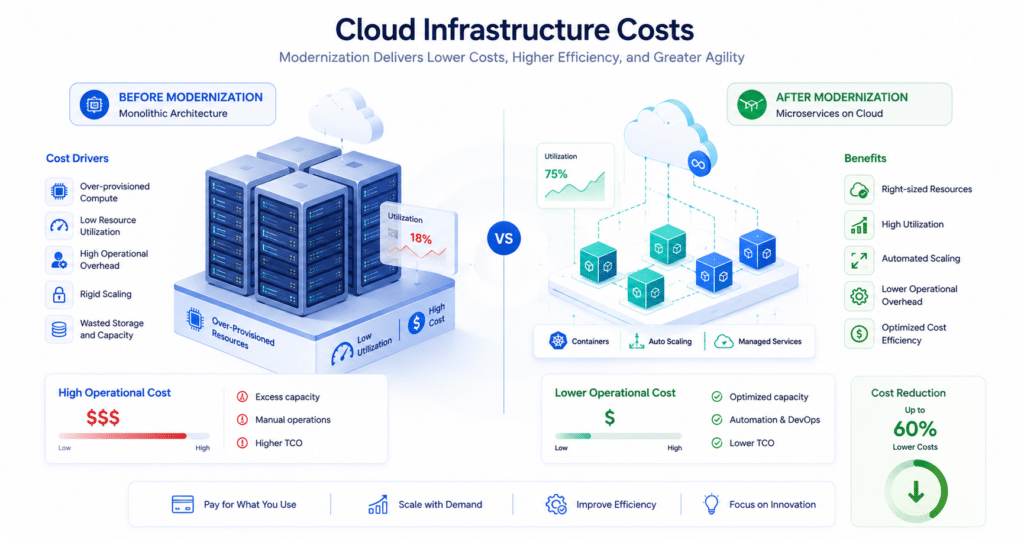
Modernizing legacy applications is a strategic investment that must be justified with clear financial returns — and the Strangler Fig Pattern delivers them in two concrete ways.
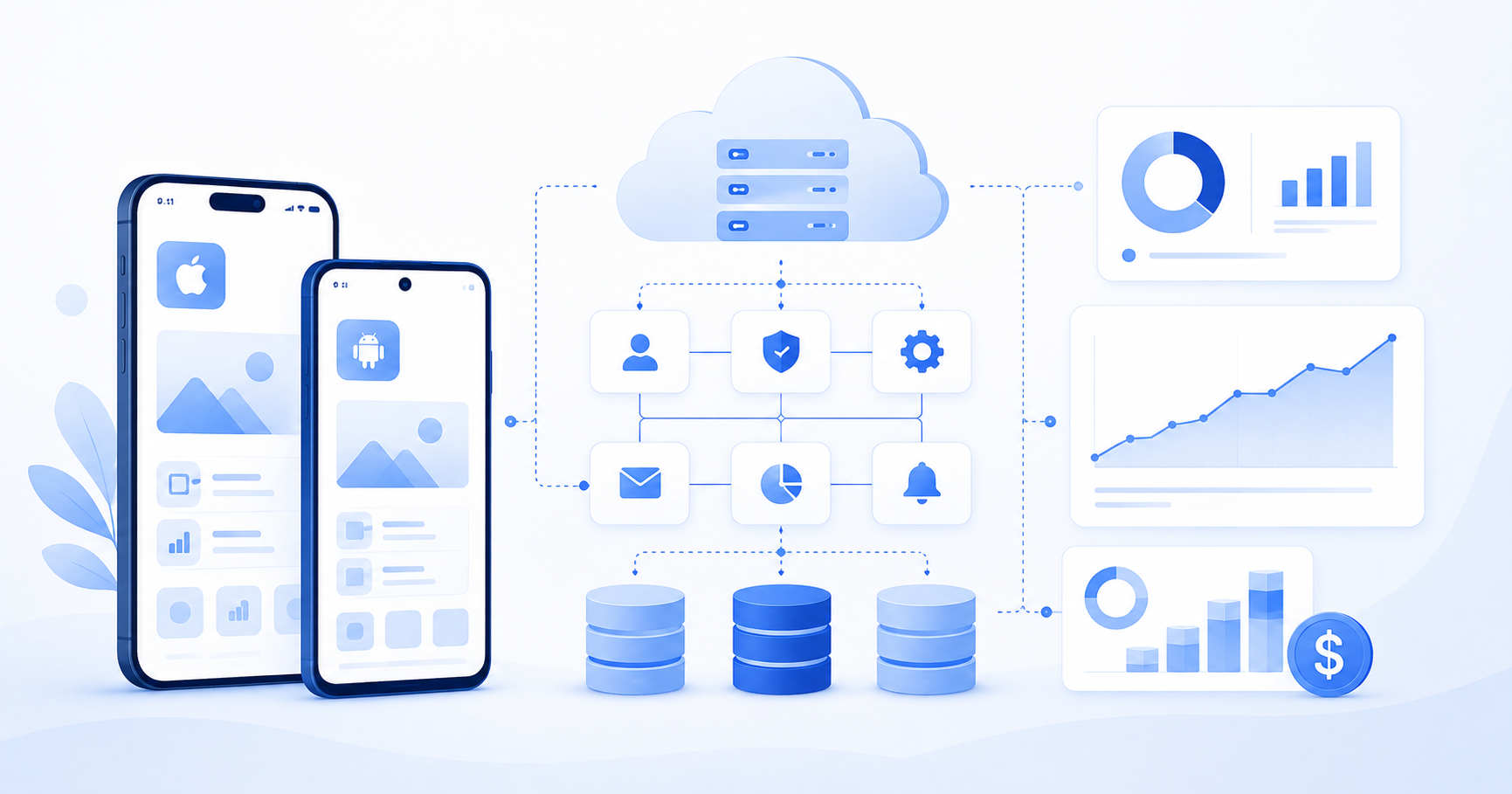
The first is infrastructure efficiency. Legacy systems typically run on over-provisioned servers sized to handle peak traffic, meaning organizations pay for maximum capacity around the clock regardless of actual demand. Decomposing the monolith into modular, cloud-native services changes that equation entirely — only the components under high demand need to scale, while everything else runs lean. Organizations that have made this shift commonly report significant reductions in cloud hosting costs, though actual savings vary depending on workload, architecture, and cloud provider.
The second is runtime performance. Migrating to modern frameworks like .NET 10 unlocks Native Ahead-of-Time (AOT) compilation — a capability that compiles application code directly into machine-readable format before execution. This eliminates the “cold start” delays common in serverless environments and significantly reduces memory consumption compared to traditional runtime-dependent applications. Smaller memory footprints mean smaller, more cost-effective cloud instances — and lower bills month over month.
Together, these two shifts mean modernization doesn’t just reduce technical debt. It actively improves the unit economics of running the business.
Closing the Compliance Gap Before It Closes You
For organizations in healthcare and financial services, modernization isn’t just a technology decision — it’s a compliance deadline. Legacy systems built on flat network architectures with outdated encryption don’t just create technical debt; they create regulatory exposure that grows more expensive with every passing quarter.
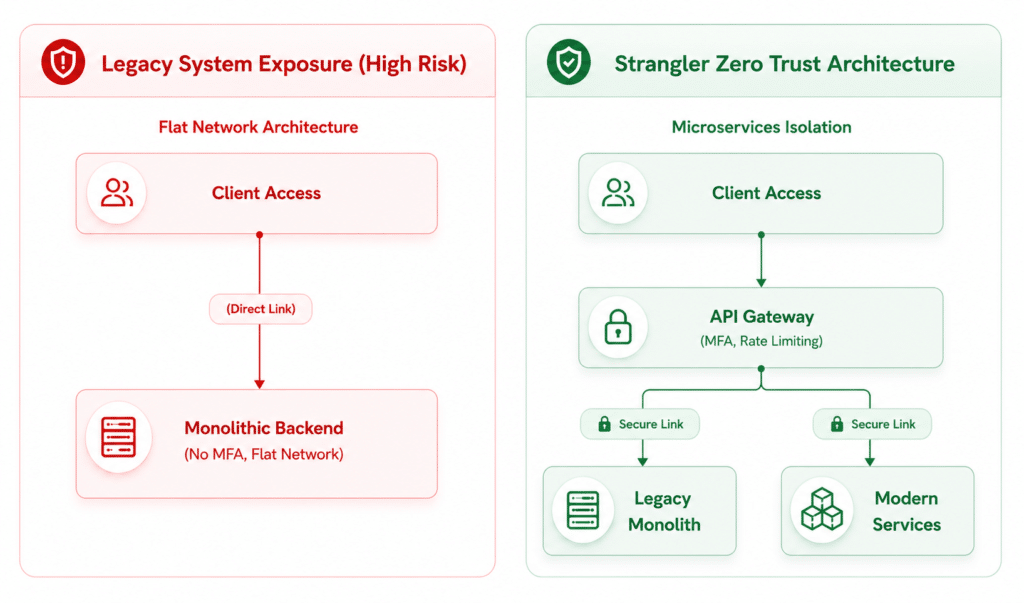
The Strangler Fig Pattern addresses this directly by introducing modern security controls at the gateway layer — without requiring a full system rewrite.
Zero Trust by Default
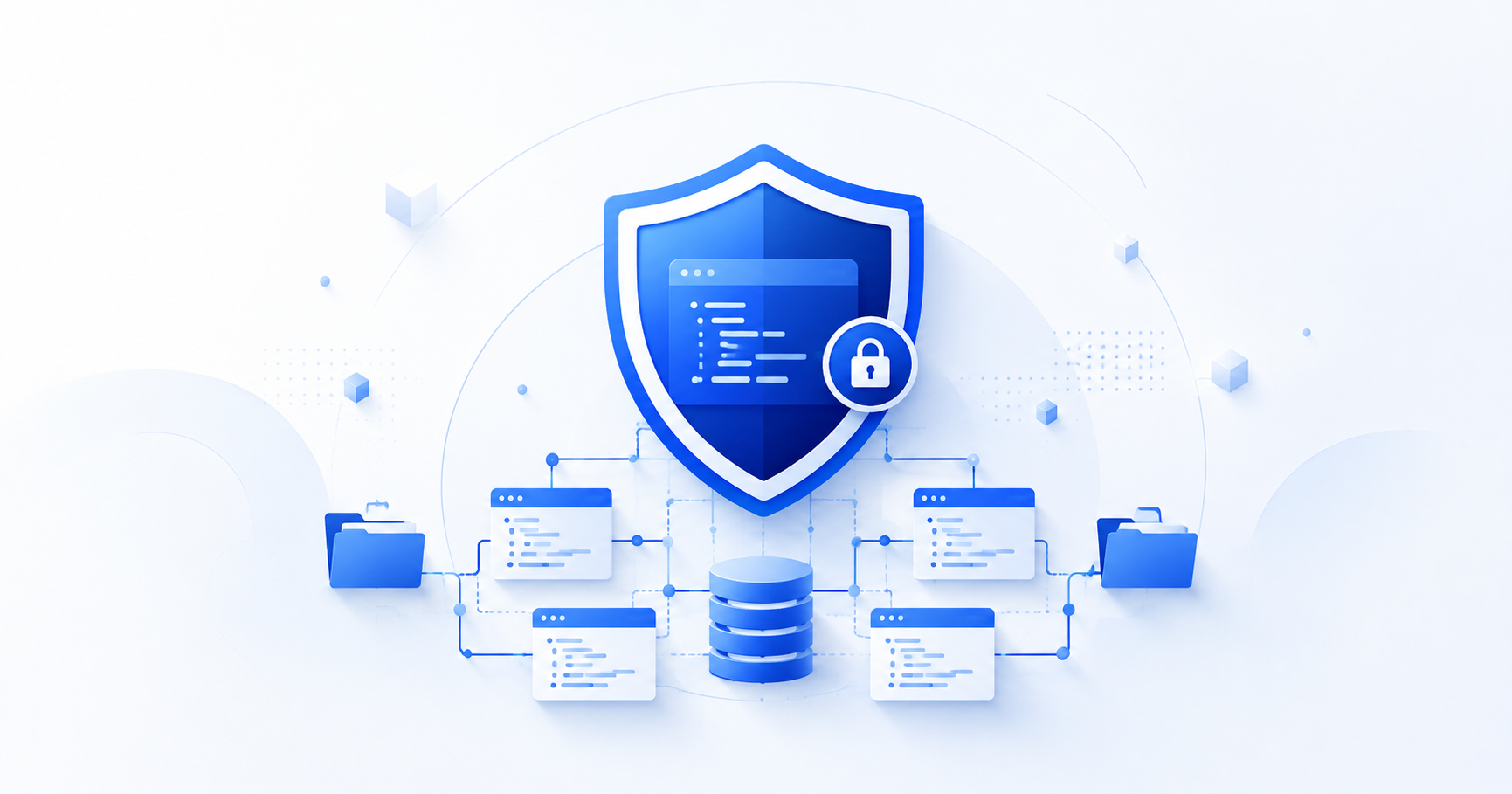
Placing the legacy monolith behind a secure API gateway immediately changes the security posture. Rather than exposing the entire system to incoming traffic, organizations can enforce granular access policies, service-to-service authentication, and network segmentation from day one. In the event of a breach, lateral movement is contained — attackers can’t move freely across a system that’s no longer flat.
HIPAA Compliance Without a Rewrite
The HHS 2026 Security Rule revisions carry real financial consequences for non-compliance — and the requirements are no longer flexible. AES-256 encryption at rest, TLS 1.2 or higher in transit, and mandatory MFA for accessing protected health information are now hard requirements. HIPAA violations in 2026 are penalized across a four-tier structure, with fines reaching up to $72,596 per individual violation — and when a breach affects thousands of patients, each record can be counted as a separate violation. Beyond the fines, healthcare data breaches now cost organizations an average of $10.93 million per incident when accounting for investigation, remediation, and legal exposure — the highest of any industry. Criminal liability applies in cases of willful neglect.
The gateway layer makes compliance achievable even for legacy components that don’t natively support modern protocols. Security controls are enforced at the entry point, buying organizations the time to modernize underlying systems without operating in violation in the interim.
Continuous SOC 2 Audit Readiness
Manual compliance reviews are no longer sufficient under the updated 2026 SOC 2 standards. Modernized microservices address this by generating detailed access logs, configuration baselines, and vulnerability reports automatically — creating a continuous evidence trail that integrates directly with compliance management platforms. Audit preparation shifts from a quarterly scramble to an ongoing, automated process.
The combined effect is significant: organizations that modernize incrementally using the Strangler Fig Pattern don’t just meet today’s compliance requirements — they build an architecture that absorbs future regulatory changes without crisis.
Choosing the Right Modernization Partner
A legacy modernization project is not a routine development engagement. The right partner is one that can decompose a live system without breaking it, navigate compliance requirements without slowing the project down, and manage the inherent uncertainty of working inside a decade-old codebase — all simultaneously.
In practice, that means a partner who will begin with an honest audit of your existing system — identifying where the real risk sits before a single line of code is touched. They will design the migration sequence methodically, configure the gateway layer, and establish database sync pipelines with zero disruption to live operations. Through execution, they will manage the incremental service rollout with full progress visibility at every stage, not just at milestones. And when the last legacy component is decommissioned, the engagement doesn’t end — the right partner stays involved, optimizing the architecture and ensuring the modernized system delivers on the business case that justified the investment.
Above all, there should be one accountable team across the entire lifecycle. No fragmented handoffs between strategy and delivery. No compliance knowledge gaps discovered mid-project. No ambiguity about who is responsible when something needs to be resolved.
Vedhas Technology Solutions is built around exactly this model — bringing together strategic oversight and deep execution capability under a single accountable team, exclusively focused on complex technical transformations.
Frequently Asked Questions About the Strangler Fig Pattern
How do I know if my legacy application is a good candidate for the Strangler Fig Pattern?
Not every legacy application requires the same modernization strategy. The Strangler Fig Pattern is best suited for business-critical systems that must remain operational during migration, have clearly identifiable functional domains, and require continuous enhancements. A technical assessment of application architecture, dependencies, and business priorities can determine whether this approach is the right fit.
How long does a typical Strangler Fig modernization project take?
The timeline depends on the application’s size, complexity, and number of business domains. Smaller modernization initiatives may be completed within a few months, while large enterprise systems can be modernized incrementally over one to three years. Because value is delivered in phases, organizations begin realizing business benefits long before the entire migration is complete.
Can the Strangler Fig Pattern be used for on-premises applications, or is it only for cloud migration?
The pattern works for both on-premises and cloud environments. Many organizations first modernize individual services while keeping their existing infrastructure, then gradually migrate those services to cloud platforms as part of a broader digital transformation strategy.
What are the biggest risks when implementing the Strangler Fig Pattern?
The most common challenges include incorrectly identifying service boundaries, managing data consistency between old and new systems, and maintaining governance across multiple services. These risks can be minimized through careful architecture planning, automated testing, continuous monitoring, and a phased implementation roadmap.
Can the Strangler Fig Pattern be combined with AI-assisted software modernization?
Yes. Many organizations use AI-powered code analysis, documentation generation, automated testing, and code refactoring tools alongside the Strangler Fig Pattern. While AI can accelerate modernization, architectural decisions and migration planning still require experienced engineers.
The Modernization Decision Doesn’t Get Easier With Time
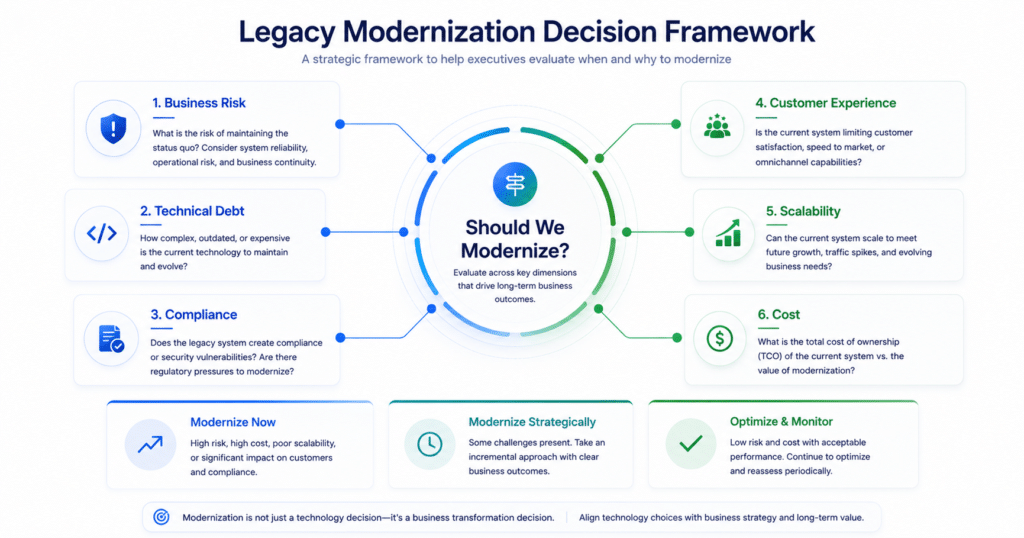
Every quarter spent on a legacy system is another quarter of inflated infrastructure costs, widening compliance exposure, and compounding technical debt. The question most leadership teams face isn’t whether to modernize — it’s how to do it without putting the business at risk in the process.
The Strangler Fig Pattern answers that question directly. It offers a controlled, incremental path forward that keeps operations running, reduces transition risk, and delivers measurable returns at every stage — without the all-or-nothing gamble of a Big Bang rewrite.
The right starting point is clarity. Before committing to a modernization roadmap, organizations need an honest picture of where they stand — which systems carry the most risk, which services are the best candidates for early extraction, and what a realistic transition timeline looks like.
That’s exactly what a consultation with Vedhas Technology Solutions is designed to provide. In a single focused session, a senior architect will walk through your current system landscape, identify your highest-priority modernization candidates, and outline a realistic path forward — specific to your business, your timeline, and your risk tolerance.
No sales pitch. No commitment. Just clarity on what modernization looks like for your organization.
Legacy systems don’t fail all at once — they erode gradually, until one compliance deadline, one security incident, or one critical system failure makes the cost of inaction impossible to ignore.
The Strangler Fig Pattern exists precisely for this moment. It gives technical leadership a way to modernize incrementally, protect business continuity, and build toward a modern architecture without betting the entire operation on a single high-risk rewrite.
The organizations that move first don’t just solve a technology problem. They reclaim the engineering capacity, financial efficiency, and competitive agility that legacy systems have been quietly consuming for years.
Modernization is not a disruption. Done right, it’s the end of one.