The High Stakes of Multi-Codebase Architecture
The year 2026 has brought a major challenge to enterprise mobile strategy: the legacy tax of maintaining multiple distinct codebases. For years, organizations have sustained separate development paths, employing native Swift developers for iOS and Kotlin engineers for Android. This fragmented architecture forces businesses to run double the quality assurance cycles, coordinate separate release schedules, and manage inconsistent user experiences.
As digital markets mature, maintaining separate teams has become a significant financial burden. If a healthtech platform in Delhi or an e-commerce brand in Mumbai delays a critical feature release on one platform, customer satisfaction drops. This gap in features directly harms brand consistency and lowers retention rates, which can drop by up to 50% when user experiences are inconsistent.
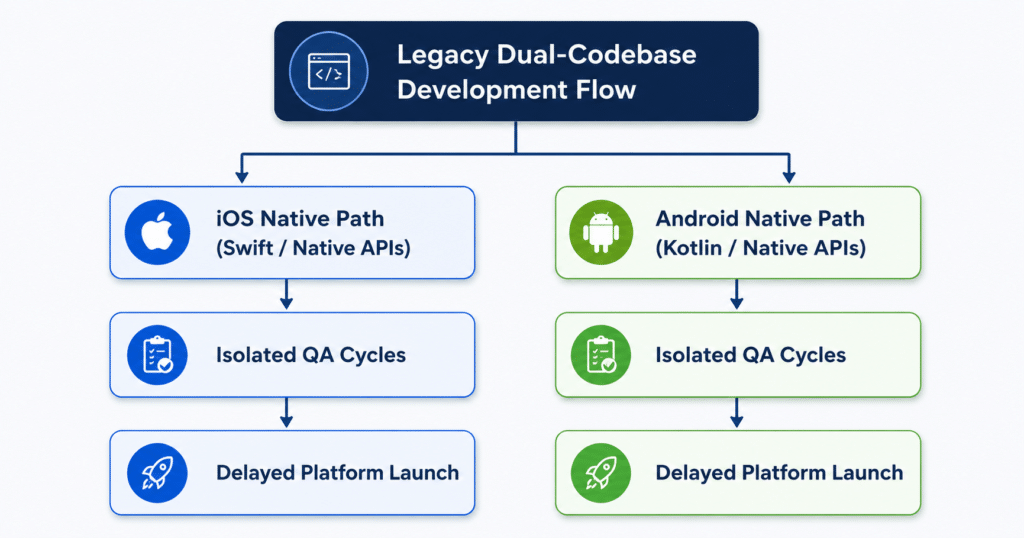
Furthermore, the domestic talent market in 2026 presents serious hiring challenges. Companies face rising operational costs and recruitment delays when hiring separate native development teams. By forcing two separate engineering structures to build the same business logic, enterprises lose valuable market velocity. This is one of the primary reasons why the cross-platform approach is becoming the preferred choice for organizations looking to reduce complexity while accelerating product delivery.
The widespread adoption of cross-platform app development in 2026 by 65% of Indian businesses stems from framework maturity that delivers 120 FPS performance while cutting development time by 30% to 40%. This approach allows a single, unified team to target both iOS and Android from one codebase, reducing initial capital expenditures by up to 50%. By utilizing advanced rendering architectures, businesses achieve native-parity user experiences without the burden of maintaining disjointed software codebases. For many leaders evaluating cross-platform vs native app development, the ability to support both platforms from a single codebase has become a decisive advantage.
Why the 65% Shift Is Happening
In India, the move toward cross-platform app development in 2026 is being driven by execution pressure, not just preference. According to NASSCOM’s analysis of emerging app development trends, cross-platform adoption is especially common among startups and SMBs because it helps them launch MVPs faster without maintaining multiple native teams. Flutter’s official positioning is a single-codebase framework for mobile, web, desktop, and embedded apps, while React Native says thousands of apps, from startups to Fortune 500 companies, are already using it in production. JetBrains also reports rising momentum across cross-platform technologies, including growing Kotlin Multiplatform usage. Together, these signals explain why more Indian businesses are treating cross-platform as the first choice rather than the fallback.
For startups and enterprises alike, cross-platform app development for businesses offers a practical way to launch products faster while maintaining cost efficiency.
For business leaders, the takeaway is simple: one codebase can mean faster launches, lower maintenance overhead, and a more flexible path to scale. The 65% figure should be viewed as a directional market estimate based on industry adoption trends, developer ecosystem growth, startup technology preferences, and the increasing enterprise adoption of frameworks such as Flutter, React Native, and Kotlin Multiplatform. Taken together, these indicators point to a clear shift toward cross-platform-first development as the preferred strategy for many Indian businesses in 2026.
As investment in digital products increases, this approach is increasingly viewed as a business strategy rather than merely a technical choice. This shift is also influencing how executives evaluate cross-platform vs native app development during technology planning discussions.
Why Maintaining Separate Mobile Teams Is Becoming Unsustainable
Persisting with legacy, separate native builds introduces serious risks to both operational agility and financial stability. In an ecosystem where India’s mobile market demands rapid, light, and performance-optimized software to serve over 26.4 billion annual downloads, businesses that fail to consolidate their application architecture risk being outpaced by agile competitors that deploy updates simultaneously.
Managing two separate native platforms often leads to disjointed codebases where security updates are out of sync. For healthcare and fintech platforms, this delay creates dangerous compliance vulnerabilities. Businesses that delay modernization often discover that a unified mobile strategy provides a more agile operating model than maintaining separate native teams.
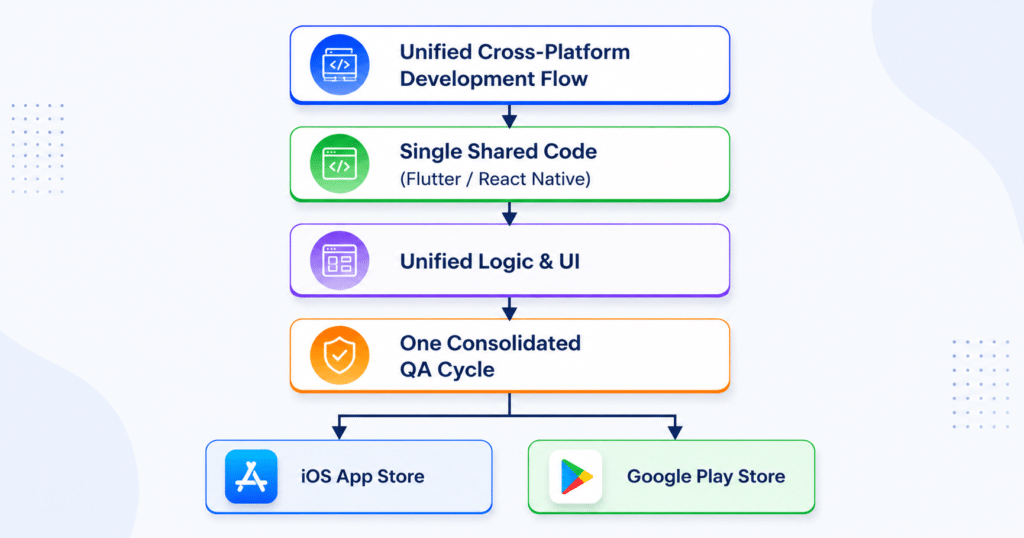
The resource-heavy nature of native development also drains budgets that could otherwise go toward product-market validation, user acquisition, or cloud infrastructure optimization. For startups and growing enterprises alike, the financial drain of separate engineering structures slows down growth and limits the ability to pivot based on real-time market feedback. This is particularly evident when comparing cross-platform vs native app development in rapidly changing markets.
Selecting the Right Stack for Cross-Platform App Development in 2026
The rise of cross-platform app development in 2026 is largely driven by the maturity of modern frameworks and development ecosystems.
By 2026, cross-platform frameworks have reached full maturity, removing the historical trade-off between development speed and application performance. The choice of technology is no longer a matter of convenience; it is a strategic decision that shapes an enterprise’s long-term digital footprint.
Traditional Native vs. Modern 2026 Cross-Platform Architecture
| Technical Characteristic | Legacy Native Architecture | Modern Cross-Platform Architecture | Business Impact |
|---|---|---|---|
| Codebase Management | Multiple disjointed codebases (Swift & Kotlin) | Single unified codebase (Flutter or React Native) | Slashes ongoing maintenance and update costs by up to 50%. |
| Rendering Engine | Platform-specific native UI view trees | Custom Impeller 2.0 GPU pipeline or JSI Fabric mapping | Delivers consistent 120 FPS animations and layout rendering. |
| Security Auditing | Separate platform security audits | Unified security and compliance scanning | Accelerates security reviews and ensures faster compliance. |
| Time-to-Market | 8 to 12 months for standard multi-role platforms | 4 to 6 months to launch on both platforms | Accelerates market entry by 30% to 40%, giving a critical competitive edge. |
Flutter, backed by Google, continues to lead the cross-platform market in 2026, capturing a 46% developer adoption rate. With its Dart compilation pipeline, Flutter compiles directly to machine code, bypassing old JavaScript runtimes and bridge bottlenecks. The implementation of the Impeller 2.0 rendering engine has completely replaced the old Skia renderer on iOS. On Android, Impeller is now the default for API 29+, pre-compiling all graphic shaders during the build phase. This shift completely eliminates layout jank, ensuring smooth 120 FPS scrolling and transition experiences across all devices.
React Native, backed by Meta, remains a powerful choice, particularly for teams with deep JavaScript and TypeScript expertise. Its New Architecture—which features the Fabric renderer, TurboModules, and the high-performance Hermes V1 engine—has eliminated the performance lags of legacy versions. By mapping React components directly to native platform views via the JavaScript Interface (JSI), React Native delivers native-parity performance with a lightweight runtime footprint.
For architectures requiring shared core business logic with fully native platform-specific interfaces, JetBrains’ Kotlin Multiplatform (KMP) has emerged as a compelling choice. Additionally,.NET MAUI serves as an enterprise workhorse for organizations heavily integrated with Microsoft Azure ecosystems.
These advancements have fundamentally changed the conversation around cross-platform vs native app development.
Business Outcomes That Matter More Than Framework Internals
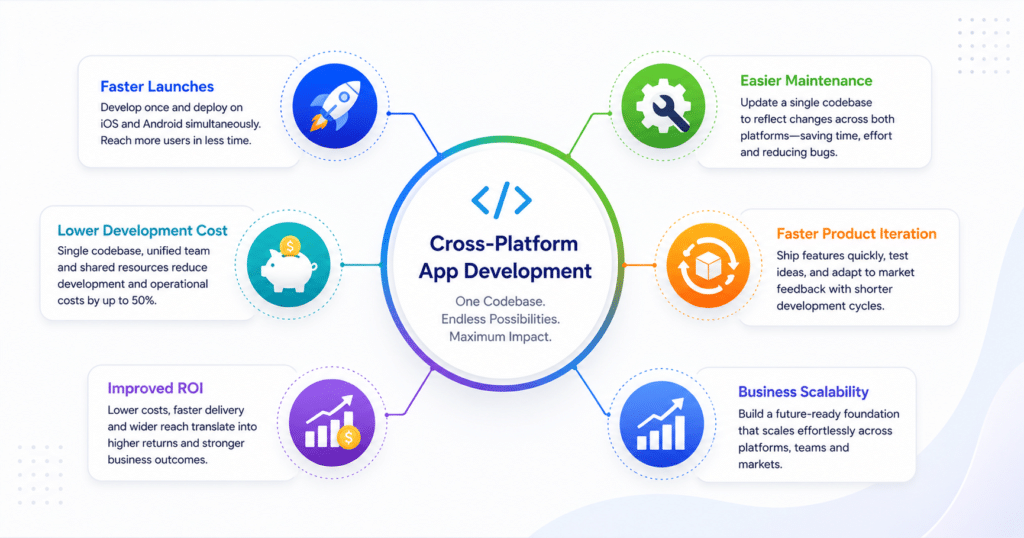
For decision-makers, the real question is not how a framework renders a screen. The real question is whether the app launches faster, costs less to build, and creates a better return on investment. In that context, cross-platform development delivers the outcomes that matter most: one codebase instead of two, faster rollout across iOS and Android, lower maintenance overhead, and simpler team management. These advantages directly reduce delivery risk and help businesses move from idea to market faster.
For startups, this means a quicker MVP and faster validation with real users. For growing businesses, it means fewer engineering dependencies and more budget available for marketing, product iteration, and customer acquisition. For enterprises, it means easier governance, fewer release bottlenecks, and a more predictable long-term technology strategy.
The most important benefit is not technical elegance. It is operational efficiency. When a business can maintain one shared product roadmap instead of managing separate iOS and Android timelines, teams spend less time duplicating work and more time improving the product. That is why cross-platform development has become a strategic choice for companies that care about speed, cost control, and scalability.
A simpler way to say it is this:
Cross-platform reduces complexity, accelerates launches, and improves the economics of mobile product development.
For organizations planning new products, this approach often delivers the strongest balance of cost, speed, and long-term maintainability.
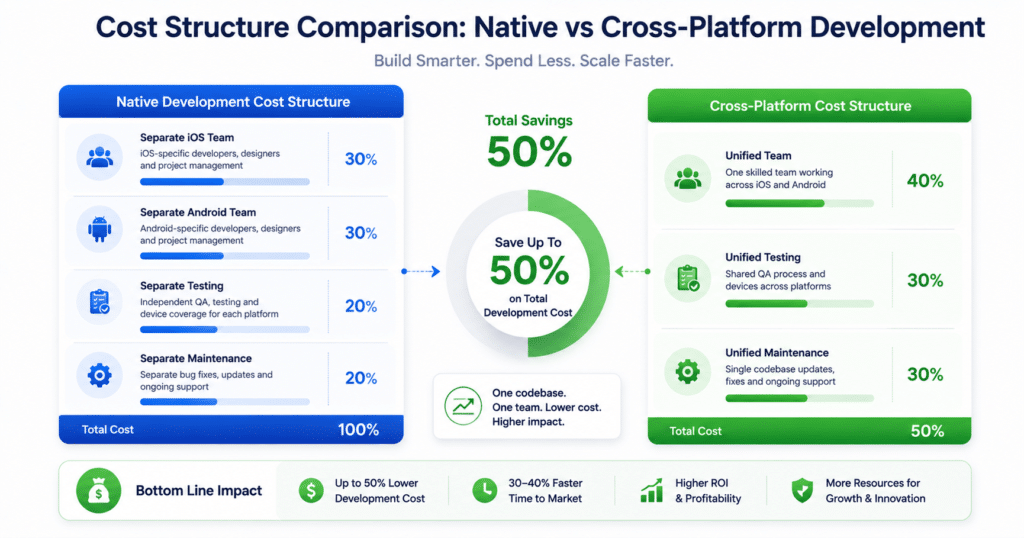
Financial Returns and Cloud Cost Minimization
The shift from multi-codebase development to a single, unified codebase delivers clear financial benefits that can be calculated using standardized software engineering economics. The initial development savings of adopting a unified platform can be estimated using the following model:
TCO native_iOS = ( Dev native_iOS + Dev native_Android ) – Dev cross_platform x ( 1 + λ )Here, Dev native_iOS and Dev native_Android represent the costs of running separate, dedicated native development teams. Dev cross_platform represents the cost of utilizing a single, unified development team. The coefficient λ represents the platform adjustment factor (typically between 0.10 and 0.15), which accounts for testing and tuning specific platform-level features.
In practical terms, a business that would otherwise maintain separate iOS and Android teams can often reduce development and maintenance expenses by consolidating engineering resources into a single cross-platform team.
The financial benefits of cross-platform app development in 2026 extend beyond development costs and into ongoing maintenance and operational efficiency.
Vedhas Technology Solutions integrates these development-phase savings with cloud cost optimization strategies. As a verified Google Cloud Partner, Vedhas designs highly optimized, scalable backends and uses Cloudflare content delivery networks to minimize data transfer latency. This comprehensive approach to cloud infrastructure frequently reduces ongoing server and database hosting bills by up to 40%. This cost reduction directly improves the operational margins of digital platforms.
This is one reason why the model is becoming increasingly attractive to budget-conscious organizations.
The “Build for Bharat” Paradigm: Vernacular UI, 5G, and UPI Payments
Indian enterprises face a unique set of user expectations and infrastructure conditions. This environment requires a distinct approach to mobile development.
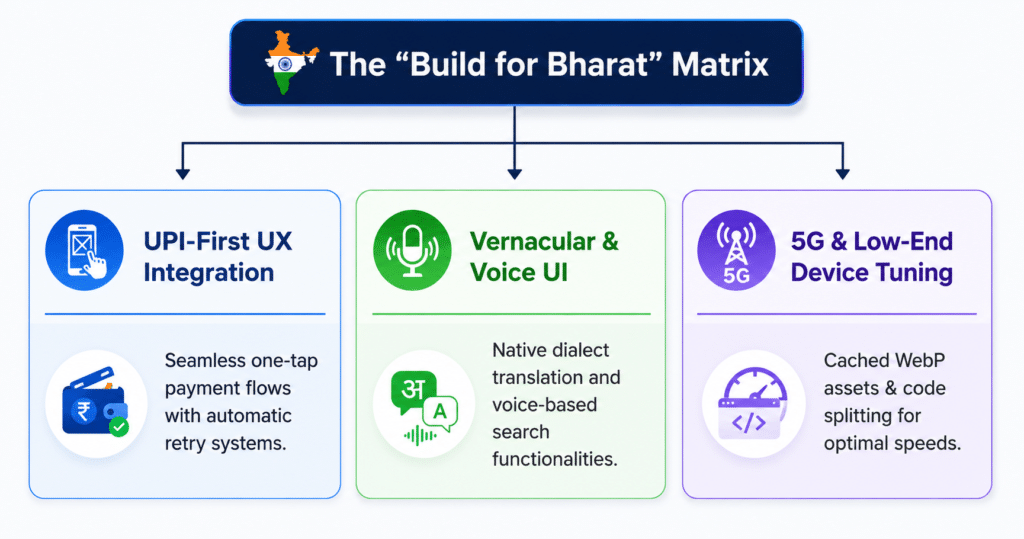
Designing for this market requires focusing on key localized features:
- UPI-First Payment Integrations: According to NPCI UPI transaction statistics, UPI processed 19.47 billion transactions in July 2025 alone. Cross-platform frameworks use mature plugins to integrate secure payment gateways (like Razorpay and PhonePe) with built-in retry logic directly into the app.
- Vernacular UI and Voice Navigation: Moving beyond simple English translation is vital for serving tier-2 and tier-3 cities. Applications must support local dialects and voice-based search to keep the user experience accessible.
- 5G Optimization and Low-End Device Tuning: While 5G adoption is expanding rapidly, apps must still run smoothly on budget devices. Using lightweight WebP image formats, lazy loading, and code splitting ensures fast performance on any network.
Modern cross-platform frameworks allow a single team to implement these features uniformly across both platforms. This approach ensures that every user, regardless of their device, receives the same high-quality, localized experience.
These capabilities further reinforce the value of a unified mobile strategy for organizations pursuing national-scale growth. The ability to implement these localized experiences from a single codebase is another reason Indian businesses are increasingly prioritizing cross-platform development.
Is Cross-Platform App Development Right for Your Business?
Technology decisions are ultimately business decisions. The question facing most organizations in 2026 is not whether cross-platform development is technically viable—it is whether maintaining separate iOS and Android development streams continues to deliver enough business value to justify the additional cost, complexity, and operational overhead.
This is why discussions around cross-platform vs native app development are now taking place at the executive level.
For many businesses, the answer is increasingly clear. A cross-platform approach aligns more closely with modern growth objectives, particularly when speed, scalability, and cost efficiency are priorities.
Organizations launching customer-facing digital products are under constant pressure to reduce time-to-market, optimize engineering investments, and respond quickly to changing customer expectations. In such an environment, maintaining multiple codebases often creates friction that slows innovation and increases long-term costs.
Cross-platform app development for businesses offers a different path. As a result, it has become a strategic priority for many product-led organizations. By enabling a unified product strategy across iOS and Android, businesses can streamline development, accelerate releases, and focus resources on growth initiatives rather than duplicate engineering effort.
When a Cross-Platform Strategy Creates the Greatest Value
A cross-platform-first approach is often the strongest choice when:
- Market speed is more important than platform-specific customization.
- The business needs to reach both Android and iOS users simultaneously.
- Budget efficiency and ROI are key decision factors.
- Product teams expect frequent feature releases and continuous improvement.
- Leadership wants to simplify engineering operations and reduce maintenance overhead.
- The organization is validating a new product, entering a new market, or scaling rapidly.
These conditions apply to the majority of modern business applications, including SaaS platforms, fintech products, healthcare solutions, e-commerce applications, logistics platforms, enterprise mobility tools, and customer engagement applications.
In these scenarios, the ability to move faster often creates a greater competitive advantage than the marginal technical benefits of maintaining separate native codebases. This trend continues to strengthen the business case for cross-platform app development for businesses.
When Native Development May Still Be the Better Investment
While cross-platform app development in 2026 has become the preferred approach for many organizations, there are cases where native development remains the optimal choice.
Businesses may benefit from a native-first strategy when:
- The product relies heavily on advanced device hardware capabilities.
- The application delivers graphics-intensive experiences, such as gaming platforms.
- Augmented Reality (AR), Virtual Reality (VR), or highly specialized performance requirements are central to the product experience.
- Platform-specific differentiation is a core business strategy.
- The organization already operates dedicated iOS and Android teams and can absorb the additional operational costs.
These situations are important but represent a relatively small percentage of business applications being developed today.
The Strategic Perspective
The most successful digital products are rarely the ones built with the most complex technology stack. They are the products that reach customers faster, adapt quickly to market feedback, and scale efficiently as demand grows.
For many Indian businesses, cross-platform development has become the preferred strategy because it aligns technology investments with business outcomes. It enables organizations to launch sooner, reduce development overhead, accelerate innovation, and focus resources where they create the greatest impact.
That shift in priorities is one of the primary reasons why an increasing number of Indian businesses are adopting a cross-platform-first approach in 2026.
How Vedhas Technology Solutions Delivers Business Impact
The practical benefits of choosing a unified cross-platform strategy are clear in the enterprise projects executed by Vedhas Technology Solutions. Since 2017, the firm has delivered specialized software modernization, cloud engineering, and digital transformation services.
Case Study: Launching a Cross-Platform Consumer App for a Retail Brand
A growing retail brand wanted to launch a mobile app for both Android and iOS users without increasing development overhead or extending delivery timelines. The business needed a faster path to market, a simpler release process, and a scalable foundation for future feature updates such as product discovery, personalized offers, order tracking, and in-app payments.
Vedhas Technology Solutions recommended a cross-platform-first approach so the brand could maintain a single codebase while reaching both major mobile ecosystems at the same time. This reduced coordination complexity, simplified testing, and allowed the product team to focus on customer experience instead of managing separate native builds.
The result was a more efficient launch process, a stronger mobile presence, and a practical technology foundation that supported ongoing product improvements. For the business, the key value was not just technical efficiency. It was the ability to launch faster, control costs, and respond to market demand without building two separate apps from scratch.
Business Impact
- Faster mobile launch across Android and iOS
- Lower development and maintenance overhead
- Easier feature rollouts and updates
- Better budget allocation toward marketing and growth
- A more scalable app strategy for future expansion
For decision-makers evaluating cross-platform vs native app development, outcomes like these often have a direct impact on long-term ROI.
Why This Matters
For founders and business leaders, this is the real advantage of cross-platform development. It reduces operational friction while helping the business get to market sooner. In competitive industries, that speed can directly influence user acquisition, retention, and revenue growth.
Frequently Asked Quesions
Why are businesses choosing cross-platform app development over native development in 2026?
Businesses are choosing cross-platform app development because it reduces development costs, shortens time-to-market, simplifies maintenance, and enables simultaneous deployment across iOS and Android using a single codebase.
Does cross-platform app development provide the same performance as native apps?
Modern frameworks such as Flutter and React Native now deliver near-native performance for most business applications. For e-commerce, fintech, healthcare, SaaS, and enterprise apps, the performance difference is often negligible.
How does cross-platform app development help businesses scale more efficiently?
Cross-platform app development enables businesses to manage a single codebase across multiple platforms, making it easier to release updates, maintain consistency, and respond quickly to changing market needs. This streamlined approach helps organizations focus more on innovation and growth rather than managing separate development workflows.
Is cross-platform app development the right choice for startups and enterprises?
Yes. Cross-platform app development is well-suited for startups that need rapid market validation and enterprises that want to streamline development, accelerate releases, and improve ROI while maintaining a consistent user experience across platforms.
Start with the right mobile strategy before you invest in development
Many enterprise software projects face delays due to hidden infrastructure problems or misaligned technical requirements. To help organizations prepare for growth, the engineering team at Vedhas Technology Solutions offers a comprehensive diagnostic review.
Choosing the right mobile app strategy can shape how fast your product launches, how much it costs to build, and how easily it scales later. If you are planning a new app, evaluating cross-platform development, or comparing it with native development, a short strategy call can help you avoid costly mistakes early.
During the consultation, we review your business goals, target users, feature priorities, budget range, and timeline to determine whether cross-platform development is the right fit for your app. The goal is simple: help you make a clearer, faster, and more informed technology decision.
In this consultation, we can help you assess:
- Whether cross-platform is the right choice for your product
- What your likely timeline and development approach could look like
- How to reduce cost without compromising business goals