The Real Cost of Search Invisibility
Google’s March 2026 core update, which rolled out between March 27 and April 8, 2026, was one of the more consequential updates in recent memory. Independent tracking data reported by Search Engine Land showed nearly 80% of top-three search results changing position, and almost one in four pages that had been ranking in the top 10 fell out of the top 100 entirely. Google did not frame this as a penalty for specific tactics — it was a broad recalibration of which quality signals matter most.
The signal that moved the most was “Information Gain”: whether a page contains anything a reader couldn’t already find on five other sites. Content produced at volume, built from the same sources as everything else ranking for a query, is the category that lost the most ground. Alongside this, Google’s own E-E-A-T framework put more weight on content attributed to identifiable, credentialed authors rather than generic “editorial team” bylines.
For B2B technology providers, this creates a real problem — and it’s exactly why E-E-A-T SEO for IT companies has become a boardroom-level concern rather than a marketing footnote. Marketing sites that are technically fast but built on generic, unattributed content, or that lack visible signals of who stands behind the claims, are exactly the profile this update targeted. The practical result: firms that don’t adapt are increasingly forced to rely on paid channels to replace organic pipeline that used to arrive for free.
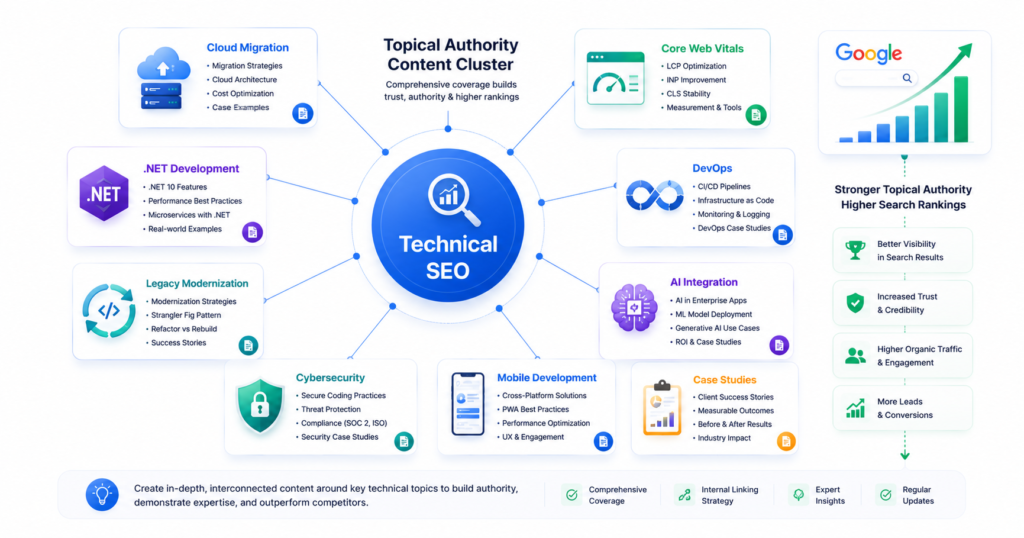
Analysis of the update from industry publication Evertune also pointed to a second, longer-term shift: domain-level authority is starting to outweigh page-level optimization. Sites that cover one subject area thoroughly — every sub-topic, multiple content formats, sustained over time — are outperforming broad sites that touch many topics shallowly. For a technology consultancy, that means a handful of deep, well-attributed pieces on the subjects you actually practice will do more for long-term visibility than a high volume of shorter, generic posts.
A Quick Diagnostic
Before investing in a content overhaul, it’s worth checking whether the underlying site is even eligible to rank well in the first place:
- Does every published article have a named, identifiable author with a real bio?
- Do case studies name specific clients, metrics, or outcomes — or do they lean on placeholders like “a leading enterprise”?
- Is ownership of the business (legal name, address, leadership) easy to find on the site itself?
- Would a basic SEO audit tool flag broken links, missing HTTPS, or slow load times on key pages?
A “no” to any of these is a more reliable predictor of ranking trouble than any single traffic statistic.
A Quick Diagnostic
Before investing in a content overhaul, it’s worth checking whether the underlying site is even eligible to rank well in the first place:
A “No” to any of these is a more reliable predictor of ranking trouble than any single traffic statistic.
The Core Framework: Defining E-E-A-T SEO for IT Companies
To build a resilient web presence, tech companies need to align their properties with all four pillars of Google’s E-E-A-T guidance – Experience, Expertise, Authoritativeness, and Trustworthiness.
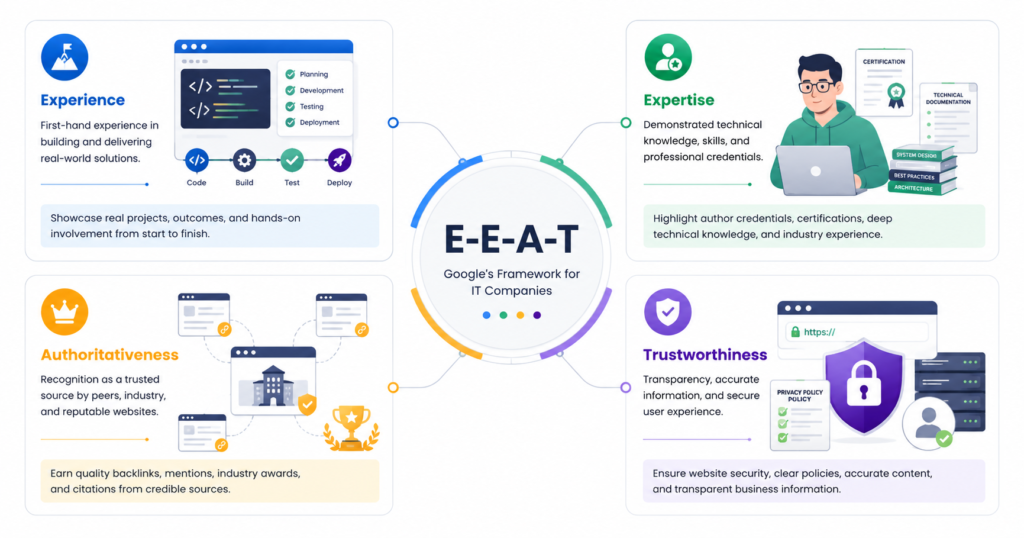
Trustworthiness is the pillar everything else depends on. If a site has weak security, hides who owns it, or makes claims that don’t check out, no amount of expert content or backlinks will offset the demotion that follows.
How to Build Trust with Google
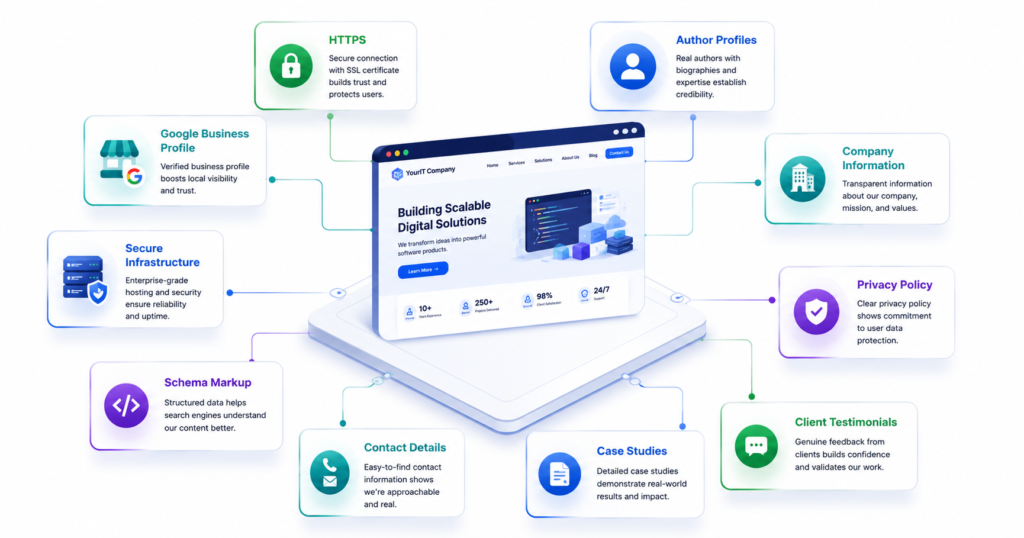
Establishing trust is a joint effort between engineering and marketing, and it starts with basics that crawlers and readers both check:
- Consistent entity listings. The legal business name, address, and contact details should match exactly across the website, social profiles, and business directories.
- Transparent ownership and policies. Visible information about who runs the company, a real privacy policy, and — where relevant — editorial standards for published content.
- Active security hygiene. Valid SSL/TLS, no broken links or dead pages, and basic bot protection.
Beyond these basics, structured data plays a growing role. Schema.org’s Organization, Person, and FAQPage markup are established, widely documented standards that help search engines map the relationships between a business, the named experts who work there, and the services offered. This isn’t a Vedhas-specific claim — it’s how Google’s own structured data documentation describes the purpose of these schema types.
None of this replaces substance with markup. Schema tells a crawler how to interpret information that’s already true and already on the page — it doesn’t manufacture credibility out of nothing. A business with an accurate Organization schema and a hollow “About Us” page will still read as thin; the markup and the underlying content need to match. This is worth stating plainly because a common mistake among technology vendors is treating structured data as a shortcut around building the actual trust signals it’s supposed to describe.
It’s also worth being realistic about timeline. None of these changes produce an overnight ranking shift. Google re-crawls and re-evaluates pages on an ongoing basis, so improvements to authorship, ownership transparency, and site security compound gradually rather than immediately — which is one more reason to be skeptical of any vendor promising fast, guaranteed ranking gains.
Technical Infrastructure as a Trust Signal
Site performance is now read as a proxy for operational credibility, not just a UX nicety. A slow, dated backend suggests a company that isn’t keeping pace — and that impression affects both search ranking and how a prospective client sizes up a vendor.
.NET 10, released as a Long-Term Support (LTS) version, made Native Ahead-of-Time (AOT) compilation production-ready for a much wider range of workloads, according to Microsoft’s own ASP.NET Core documentation. In plain terms: modern, actively maintained frameworks tend to start faster, use fewer server resources, and carry a smaller attack surface than legacy monoliths. That combination is legible to both search engines and technical due-diligence teams, which is why infrastructure choices belong in a trust-and-credibility conversation, not just an engineering one.
There’s also a support-lifecycle argument that’s easier to verify than any performance claim. LTS releases like .NET 10 come with a defined, multi-year window of security patches from Microsoft — a fact any client can check directly against Microsoft’s own support lifecycle documentation. A vendor building on an actively supported stack is making a checkable claim about long-term maintainability. A vendor still running client systems on an out-of-support framework version is carrying a security liability a technical buyer can identify in minutes — exactly the kind of gap the “Trustworthiness” pillar of E-E-A-T is designed to surface.
Demonstrating First-Hand Experience in Content
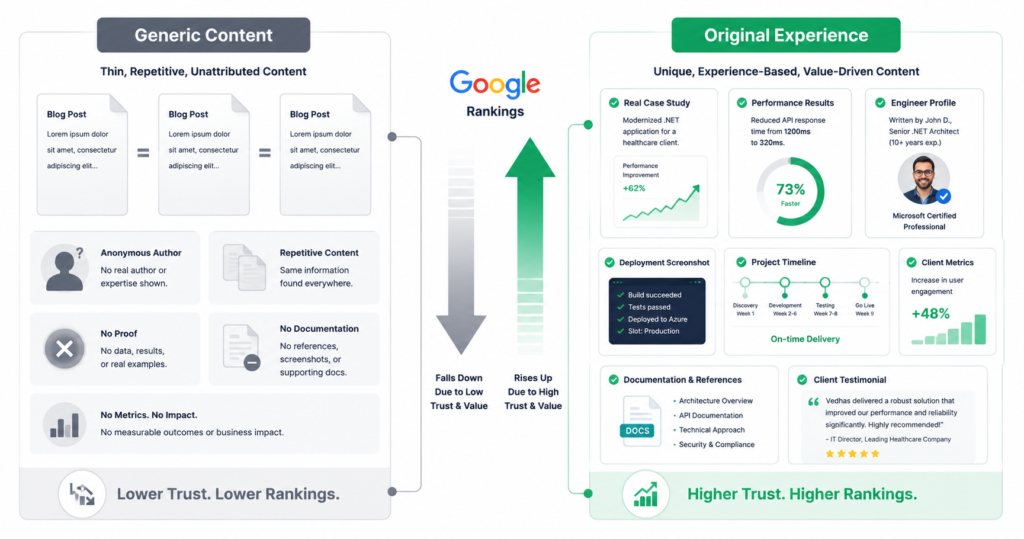
Because Information Gain is now such a heavily weighted signal, generic, theory-only content is a liability. To clear that bar, technical content needs to show work that couldn’t have been copied from a competitor’s page:
- Documented outcomes. Real before/after metrics from actual projects — response times, uptime improvements, resource usage — rather than industry-average figures presented as if they were the reader’s own likely result.
- Honest trade-offs. The actual compromises made on a project (for example, choosing JIT over AOT compilation to preserve a reflection-heavy library), rather than a one-sided “everything got better” narrative.
- Named contributors. Notes, decisions, or observations attributed to specific engineers or project leads, not an anonymous “our team.”
This kind of specificity is exactly what Google’s guidance and independent analysis of the March 2026 update both point to as the difference between content that holds its ranking and content that gets displaced by something more original.
Why Author Expertise Affects SEO and AI Citation
Attribution is no longer a courtesy — it’s a ranking input. Search systems increasingly evaluate the credibility of the person behind a piece of content: their background, published history, and professional footprint. Anonymous or generic corporate bylines carry less weight for competitive, high-consideration search terms.
Practical steps for a B2B tech company:
- Build real author profiles. Bio pages with genuine credentials and links to verifiable professional profiles (LinkedIn, published talks, prior work).
- Use SameAs schema markup. This structured data links an author’s byline directly to their external professional profiles, giving search engines a way to verify identity rather than take a name at face value.
- Keep experts visibly active. Regular, attributed contributions from senior engineers, architects, or project leads — not just occasional guest posts — build a track record over time.
Content written and reviewed by named subject-matter experts is also what tends to get surfaced and cited in AI-generated search summaries, since those systems are pulling from the same credibility signals.
Case Studies as Proof of Regulatory and Technical Trust
For B2B technology vendors, detailed client case studies remain one of the strongest trust signals available, because they’re concrete and checkable in a way that marketing copy isn’t.
In regulated sectors like healthcare or government, a case study is most credible when it names the actual compliance frameworks involved — HIPAA for healthcare data handling, SOC 2 for security controls — and describes specifically how they were implemented (audit logging, encrypted data storage, access controls), rather than referencing them as vague badges of trust. Pairing that with a measurable, named outcome (an uptime figure, a booking increase, a resolved compliance gap) gives both search engines and a risk-averse buying committee something they can independently evaluate.
A weak case study and a strong one often describe the same project — the difference is specificity. “We helped a healthcare client improve their patient portal” is unfalsifiable and does nothing for E-E-A-T. “We rebuilt a telemedicine intake system on HIPAA-compliant hosting, added automated audit logging, and reduced average patient booking time by a stated, verifiable margin” gives a reader something to check, ask about in a sales call, or compare against a competing vendor’s claims. The specificity is the trust signal — not the achievement alone.
This also protects the business making the claim. Vague, unverifiable marketing statements are precisely what the March 2026 update’s emphasis on Information Gain penalizes, since they read identically to a hundred other vendors’ generic claims. Specific, attributable outcomes are much harder to replicate — which is exactly why they carry more ranking and persuasive weight.
The Vedhas Approach: Transparency as a Trust Signal
Vedhas Technology Solutions, incorporated in 2017, works across full-stack development, mobile applications, cloud integrations, and B2B technical SEO. In line with the trust principles above, the firm is explicit about what it doesn’t do:
- No unrealistic guarantees. No promises of top rankings in 30 days; timelines are set based on the actual scope of a project.
- No high-pressure sales tactics. Proposals are meant to be reviewed properly, not signed under an artificial deadline.
- Transparent cost structures. Project quotes are scoped and shared upfront rather than introducing costs after work begins.
- Support that continues after launch. Ongoing monitoring and post-deployment review rather than the relationship ending at go-live.
- In-house delivery. Work is handled by Vedhas’s own teams, not passed to unnamed subcontractors.
- No vendor lock-in. Clients receive full ownership of code and assets at project completion.
Support Standards
Vedhas publishes internal SLA targets for ongoing support work, summarized below. As with any vendor’s service commitments, these should be confirmed in a signed SLA or contract rather than treated as a public guarantee:
| Priority | Initial Response | Target Resolution |
|---|---|---|
| Emergency (site down, critical bugs) | 2 hours | 4–8 hours |
| High (major feature broken, security concern) | 4 hours | 24–48 hours |
| Medium (minor bugs, feature requests) | 24 hours | 3–5 business days |
| Low (general questions, enhancements) | 48 hours | 1–2 weeks |
An E-E-A-T Checklist for Decision-Makers
For a CTO, founder, or business owner evaluating their own site — or a prospective technology partner’s — the following questions summarize what this guide covers:
- Attribution: Does published content carry named, credentialed authors with verifiable professional profiles, or generic bylines?
- Evidence: Do case studies and claims include specific, checkable outcomes, or vague language that could describe any vendor?
- Transparency: Is it easy to find who owns the business, where it’s based, and how to reach a real person?
- Security and infrastructure: Is the technology stack actively supported, patched, and running on current, maintained frameworks?
- Structured data: Is the site using Organization, Person, and FAQPage schema to make the above verifiable to search engines, not just to human readers?
- Depth over volume: Is the content strategy building deep authority in a small number of subject areas, or spreading thin across many unrelated topics?
None of these require a large budget to fix. Most are editorial and operational discipline — naming real people, publishing real numbers, and keeping infrastructure current — rather than a technical overhaul.
Is Your Site Actually Ready for 2026 Search — or Just Hoping?
Most generic “Get a Quote” forms don’t tell you anything about where your site actually stands. Before you spend another quarter guessing, get a clear, no-cost picture of it: a free Infrastructure Readiness Assessment covering your backend configuration, database security posture, cloud setup, and performance bottlenecks — with concrete, written recommendations at the end, not a sales pitch disguised as an audit.
No pressure, no obligation — just a straight answer on where you stand.
Frequently Asked Questions About E-E-A-T SEO for IT Companies
How long does it take to improve E-E-A-T for an IT company website?
Improving E-E-A-T is an ongoing process rather than a one-time task. Depending on your site’s authority, content quality, and crawl frequency, noticeable improvements in organic visibility may take several weeks to several months.
Does publishing more blog posts automatically improve E-E-A-T?
No. Publishing more content alone does not improve E-E-A-T. Google values original insights, demonstrated expertise, and trustworthy information over the sheer volume of content.
Can small IT companies compete with larger brands using E-E-A-T?
Yes. Smaller IT companies can compete by publishing expert-led content, showcasing real project experience, maintaining transparent company information, and building authority within a focused niche rather than covering too many unrelated topics.
Should service pages also follow E-E-A-T principles?
Absolutely. Service pages should include clear author or company credibility, customer testimonials, case studies, certifications, accurate claims, and transparent business information to strengthen trust for both users and search engines.
Does E-E-A-T affect AI-generated search results?
Yes. AI-powered search experiences are more likely to reference content that demonstrates expertise, credibility, and trustworthy information, making strong E-E-A-T signals increasingly important for visibility.
Which industries benefit the most from E-E-A-T optimization?
E-E-A-T is particularly important for industries where trust influences purchasing decisions, including IT services, SaaS, healthcare, finance, cybersecurity, legal services, and enterprise consulting.
How often should an IT company review its E-E-A-T signals?
Reviewing E-E-A-T every three to six months is a good practice. Regular audits help keep author information, technical content, security measures, case studies, and company details accurate and up to date.