
The $200,000 Question Nobody Warns You About
Your CTO chose the framework. But you are signing the cheque.
That single sentence is why this article exists. Every week, a founder or business owner sits across from a development team, hears the words “we recommend Angular” or “we’re a React shop,” nods confidently, and authorises a budget they do not fully understand. Months later, the real costs begin to surface: a key developer resigns and recruiting his replacement takes 60 days and drains nearly $40,000 in lost productivity and hiring fees. Or the agency delivers a technically sound product built on a framework with a shrinking talent pool, making future upgrades progressively more expensive.
This is not a technology blog. It is a business risk guide. And at the heart of that risk, in 2026, is the React vs Angular choice.
The React vs Angular 2026 debate is no longer something you can safely delegate entirely to your engineering team. According to the Stack Overflow Developer Survey 2025, React is actively used by 44.7% of professional developers worldwide, compared to Angular at 18.2%. The latest Stack Overflow Developer Survey 2025 Web Framework Rankings further highlights how strongly React continues to dominate frontend adoption in 2026.That 2.5x gap in developer adoption has a direct and measurable impact on your hiring timeline, your hourly rates, your contractor availability, and ultimately your total development budget. This is one of the most important realities in the modern React vs Angular market.
Developer Adoption 2026 (Stack Overflow Survey 2025)
US Job Listings Ratio (LinkedIn + Indeed + Glassdoor, Q1 2026)
According to aggregated data from LinkedIn, Indeed, and Glassdoor for Q1 2026, React job listings outnumber Angular positions by approximately 2.3:1 in the United States. What that means for you as a CTO, founder, or business owner is not a technical footnote. It is the difference between filling a critical engineering role in three weeks or three months.
By the end of this React vs Angular CTO decision guide, you will know exactly which framework fits your business model, what the real hiring cost and development timeline difference looks like in 2026, and what Vedhas Technology Solutions recommends based on delivering React and Angular projects for US-based clients across healthcare, SaaS, and e-commerce sectors.
What React and Angular Actually Are — In Plain English
Before we go deeper into the React vs Angular comparison, here is a plain-English explanation that does not require a computer science degree.
React: The Flexible Contractor
React is best understood as hiring a highly skilled contractor who arrives with exceptional core skills but expects you to furnish the workspace. This flexibility is one reason the React vs Angular debate often favors React for startups. React handles one job exceptionally well — building fast, interactive user interfaces. For everything else your application needs, like navigation between pages, managing data, handling forms, or fetching information from a server, your development team selects and assembles the right tools from a wide ecosystem. This makes React flexible and fast to get started with, but it means your team makes more architectural decisions as the project grows using the Next.js React framework and other tools.
Angular: The Full-Service Firm
Angular is more like hiring a full-service professional firm. For enterprises, the React vs Angular comparison often shifts because Angular prioritizes structure and governance. When Angular arrives on your project, it comes with everything already built in — navigation, form handling, data management, security standards, and a strict project structure. There is no guesswork about which tools to use, because the framework has already decided. Angular enterprise structure means your team spends less time on architectural decisions and more time building features — ideal for large regulated-industry applications.
Who Uses What in the Real World?
Understanding who uses what helps ground the React vs Angular debate in real business outcomes rather than developer preference. The React vs Angular comparison becomes clearer when you look at the types of companies using each framework successfully.
- React: Meta (Facebook), Netflix, Airbnb, Instagram, Uber — consumer-facing, high-performance products. These examples explain why the React vs Angular decision varies depending on whether your product is consumer-facing or enterprise-focused.
- Angular: Google Workspace, Microsoft Azure Portal, Deutsche Bank trading platforms, Samsung internal tools — enterprise and regulated-industry applications
The Hiring Reality — Where CTOs Lose 60 Days and $40,000
This is the section most agency blogs skip. Yet this is where the React vs Angular hiring gap directly impacts delivery speed and cost.It is also the most important one for anyone making a frontend framework business decision in 2026.
React Developer Cost vs Angular Developer Cost — 2026 Data
React vs Angular
Developer hiring & cost comparison — US & India markets
The Talent Pool Gap: Why React Accelerates Hiring by 30 to 50 Percent

For most US businesses, the React vs Angular hiring comparison clearly favors React because the candidate pool is much larger. The developer talent pool for React is the largest of any frontend framework globally — React pulls approximately 49 million weekly npm downloads compared to Angular’s 2.3 million. The React 44.7% developer usage statistic from Stack Overflow 2025, versus Angular 18.2% developer usage, translates directly into your recruiting reality: when you post a React developer role, your team is fishing in a 2.5x larger pond.
Angular talent is concentrated in enterprise software, financial services, and government contracting. This difference heavily influences the long-term React vs Angular hiring strategy for scaling companies. Senior Angular developers are often longer-tenured and command a premium precisely because of scarcity. For teams building in regulated sectors, this expertise is valuable. For startups and growth-stage businesses, that smaller pool creates real friction in scaling your team.
The Hidden Cost Nobody Quotes
- Average time to fill a specialised software engineering role: 40 to 60 days — two full months of lost velocity before the hire even starts
- Replacing a developer costs 50–200% of their annual salary when recruiting, lost productivity, and ramp-up time are included
- React developers average 2–3 years at a company — build a talent continuity plan from day one
- Frontend development outsourcing to India: React senior developer $45K–$80K total annually vs $180K–$260K for a US-based equivalent — a 65% saving with no meaningful quality gap when vetting is rigorous
Project Type Match — Which Framework Fits Your Business Model
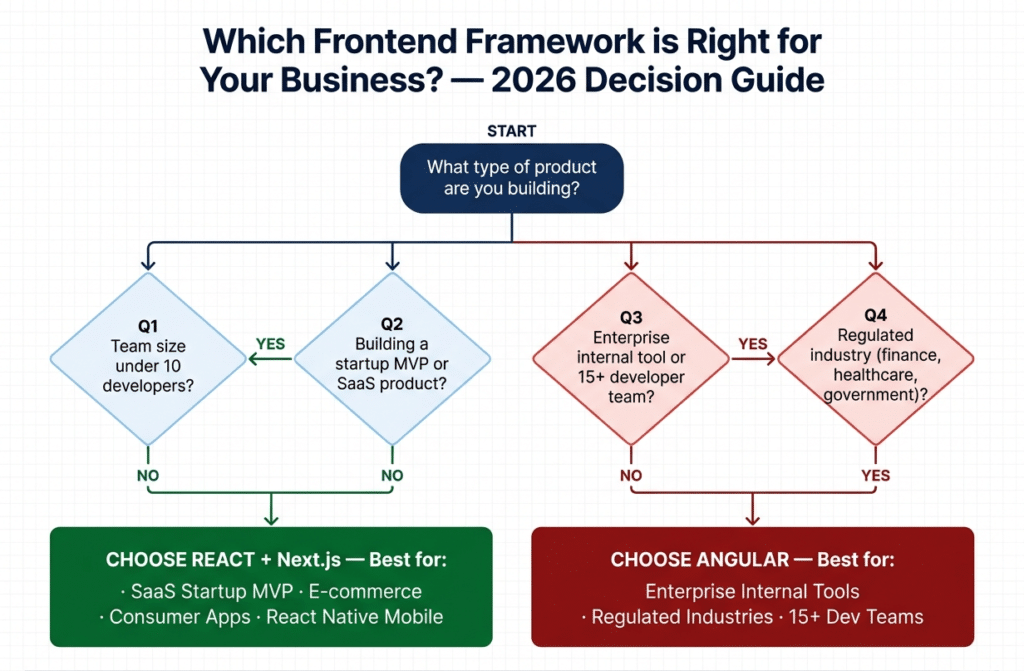
This is the section where you self-identify your position in the React vs Angular decision based on your actual business model. A smart React vs Angular strategy starts with understanding your growth stage and team structure. Read the two columns and honestly assess which describes your situation.
Choose React If:
- Building a SaaS startup or MVP — React + Next.js React framework is the default for startups and product companies in 2026. Framework adoption around Next.js continues to grow because of its SSR, SEO, and performance advantages.
- Your product is consumer-facing — e-commerce, marketplace, customer portal, or content platform
- Team size is 1 to 10 developers and you value flexibility over rigid structure
- You want to share code between your web app and React Native mobile app — one codebase, two platforms
- Hiring speed matters — you need to scale your team quickly in the next 12 months. That hiring flexibility is a major advantage in the React vs Angular startup ecosystem.
- You are building an AI-powered product where the ecosystem of SDKs (Vercel AI SDK, LangChain JS, streaming UIs) adds competitive advantage
Choose Angular If:
- Building large-scale enterprise applications with a team of 10 or more developers where Angular enterprise structure reduces governance overhead
- Your organisation operates in a regulated industry — banking, healthcare, government — where audit trails and strict coding standards are mandatory
- Your project is a long-term internal tool — ERP, CRM platform, admin dashboard — where maintainability over 5 years matters more than launch speed. This is where the React vs Angular enterprise comparison starts favoring Angular.
- More than 70% of Fortune 500 companies that run Angular do so for internal enterprise applications — if your context matches this, Angular is purpose-built for you
The Honest Decision Matrix
| Your Business Situation | Recommended Framework |
| Startup, MVP, first product | React + Next.js |
| SaaS platform, 1–10 developers | React + Next.js |
| Consumer app or e-commerce | React |
| Mobile + web shared codebase | React + React Native |
| Enterprise internal tool, 10+ devs | Angular |
| Regulated industry (finance, healthcare) | Angular |
| Government or compliance-heavy app | Angular |
| AI-powered product or SaaS startup MVP | React |
Time to Market — How Your Framework Choice Affects Your Launch Date
As a founder, the React vs Angular choice is not just an architectural decision — it is a direct input to your go-to-market timeline and, by extension, your revenue. It is a direct input to your go-to-market timeline — and by extension, your revenue.
- React time to market: Simple to medium applications ready in 2–4 months. In practical terms, the React vs Angular timeline comparison usually favors React for fast-moving startups. React’s flexibility means experienced developers build features from day one without significant framework setup overhead.
- Angular time to market: Longer initial ramp due to TypeScript configuration and module architecture, but more predictable delivery at scale for teams of 15 or more developers.
- Technical debt frontend risk: Choosing Angular for a 2-person startup creates unnecessary complexity that slows you down. Choosing React for a 20-person enterprise without enforced architecture standards creates a different type of technical debt frontend teams spend months untangling.
If your agency quotes the same timeline for a React startup MVP and an Angular enterprise build, ask more questions. The difference in team size, setup requirements, and architectural overhead should produce meaningfully different timelines and cost structures.
The 3-Year Total Cost of Ownership Comparison
Most business owners see the initial development quote. Very few evaluate the long-term React vs Angular maintenance and hiring costs properly. Almost none see the 3-year total cost of ownership picture — and that gap is where the most expensive mistakes happen.
Year 1: Initial Build Cost Benchmarks
| Cost Component | React | Angular |
| Simple app (basic features) | $5,000 – $15,000 | $7,000 – $18,000 |
| Mid-level product (APIs, dashboards) | $15,000 – $40,000 | $20,000 – $50,000 |
| Enterprise platform | $50,000 – $150,000+ | $60,000 – $180,000+ |
| US Senior Dev — Annual Total Cost | $180,000 – $260,000 | $195,000 – $270,000 |
| India Senior Dev — Annual Total Cost | $45,000 – $80,000 | $55,000 – $95,000 |
Year 2 to 3: Where the Real Cost Difference Emerges
- The total cost of employment is 1.5x to 2x the base salary in Year 1 once recruitment fees, benefits, and onboarding productivity loss are fully counted
- React’s larger developer talent pool creates a structural hiring advantage — filling a vacancy in 3–4 weeks instead of 8–12 weeks for a specialised Angular role
- Angular’s opinionated structure reduces onboarding time for stable large teams — new engineers navigate the codebase in days because Angular enterprise structure is predictable
- Hire React developer India strategy: A senior React developer in India costs $45K–$80K total versus $180K–$260K US-based — a saving of up to 65% with rigorous vetting
Vedhas’s Honest Verdict — What We Recommend for US Businesses in 2026
Here is something most technology consultancies avoid saying: we have a clear recommendation, and it is not “it depends”. Our React vs Angular recommendation changes depending on whether speed or governance matters more to your business.
- For startups, growth-stage companies, SaaS startup MVP products, and e-commerce platforms: React + Next.js React framework. The developer talent pool advantage is real, the time to market benefit is real, and React Native mobile gives you cross-platform optionality as you scale.
- For large enterprises, regulated industries, and organisations building complex internal systems with 10 or more developers: Angular. The Angular enterprise structure genuinely reduces governance overhead at scale. When consistency and long-term maintainability outweigh speed and hiring flexibility, Angular earns its overhead.
Why we take a position: Research from Forrester shows that 92 percent of B2B buyers begin their research already thinking about at least one vendor. In a world where your CTO, your agency, and three other consultancies are all giving you nuanced “it depends” answers, the most useful thing a trusted partner can do is give you an honest, opinionated React vs Angular for business owners recommendation based on your actual situation.
Vedhas Technology Solutions has been delivering React and Angular projects for US-based clients since 2008, working with healthcare platforms, SaaS companies, and enterprise businesses. We have seen firsthand what happens when a startup chooses Angular for a 3-person team and spends six months fighting framework overhead instead of building product. We have also seen what happens when a 20-developer enterprise chooses React without architectural standards and produces an unmaintainable codebase after 18 months.
The framework is not the destination. It is the vehicle. The right React vs Angular decision depends entirely on the scale and direction of your business. Choose the right one for the journey you are actually making.
FAQ — 6 Questions Every Business Owner Asks Before Signing
Is React cheaper to build with than Angular in 2026?
For most projects, yes — React is cheaper in the short term. React developers are more widely available in the developer talent pool, which keeps the React developer cost vs Angular developer cost differential competitive. Simple to medium React applications typically cost $5,000 to $40,000 depending on complexity. Angular projects generally run 10 to 20 percent higher in initial build cost. However, for enterprise applications with large teams, Angular enterprise structure can reduce long-term maintenance costs and lower the total cost of ownership over 3 to 5 years.
Which framework is easier to find developers for in 2026?
React is significantly easier to hire for. This is one of the biggest advantages in the modern React vs Angular talent market. According to the Stack Overflow Developer Survey 2025, React 44.7% developer usage versus Angular 18.2% developer usage means the React talent market provides 2.5x more candidates. React job listings outnumber Angular positions 2.3:1 in the United States as of Q1 2026. For business owners evaluating hire React developers vs Angular developers, the React talent market delivers faster hiring timelines and generally more competitive rates. Angular developers are concentrated in enterprise consultancies and regulated-industry firms, which means they are available but command a premium.
Can we switch from Angular to React later if we change our minds?
Yes, but it is expensive and disruptive. Migrating between frameworks is not a simple refactor — it typically involves rebuilding significant portions of the application. The most common approach is the Strangler Fig Pattern, where new features are built in the target framework while existing functionality continues to run in the original. This manages technical debt frontend teams must plan for carefully. A React vs Angular migration is rarely a technical problem — it is a budget and timeline problem. Plan the right choice upfront. The best strategy is making the right React vs Angular for business owners decision upfront — which is exactly what this guide and a Vedhas consultation are designed to help you do.
Is React good enough for enterprise applications in 2026?
Yes, with the right architectural standards in place. React powers enterprise products at Meta, Netflix, Airbnb, and hundreds of Fortune 500 companies. However, React does not enforce Angular enterprise structure by itself — enterprise teams using React need to establish explicit conventions and enforce them through tooling and code review. Without those standards, large React codebases accumulate technical debt frontend teams struggle to manage. With proper architecture, React scales extremely well. Angular remains the preferred choice for teams of 15 or more developers where consistency across contributors is the higher priority.
Which framework is better for a startup MVP in 2026?
React is the clear recommendation for any SaaS startup MVP in 2026. For startups, the React vs Angular decision is usually resolved in React’s favor because of speed and ecosystem flexibility. React + Next.js React framework gives a small team the fastest path from idea to working product, with SSR built in for SEO performance and the option to expand to React Native mobile later without rebuilding your frontend. The time to market advantage is real: simple to medium React applications are typically production-ready in 2 to 4 months. Unless your MVP is a complex, form-heavy enterprise system requiring strict governance from day one, React is the right starting point for your frontend framework business decision 2026.
How much does it cost to hire a React vs Angular developer in India in 2026?
This is one of the most strategically important questions for US companies using frontend development outsourcing to manage costs. To hire React developer India: approximately $15,000 to $35,000 per year for a senior developer, versus $95,000 to $145,000 for an equivalent US-based hire. A senior Angular developer in India runs slightly higher at $20,000 to $45,000 annually. When total cost of employment is factored in, a US company can engage a senior React developer through a vetted Indian development partner like Vedhas Technology Solutions for $45,000 to $80,000 total annually — a saving of up to 65 percent versus a comparable US hire, with no meaningful quality gap when the engagement is structured and managed correctly.
Not Sure Which Framework is Right for Your Business? Is Your Stack Right?
Vedhas Technology Solutions has been delivering React and Angular projects for US-based clients since 2008. We serve startups, growth-stage companies, and enterprises across healthcare, SaaS, and e-commerce from our offices in Bothell, Washington and Hyderabad, India. You will walk away with a direct, honest recommendation — not a generic answer, not a sales pitch. If you are still evaluating React vs Angular, this consultation will help you avoid an expensive long-term mistake.