
Operational Risks: Why Modernization Demands a Website Redesign SEO Checklist
The most common fear among CTOs and founders planning a website redesign is not the cost, the timeline, or the technical complexity. It is this: “What if we rebuild the entire platform and wake up the next morning to find our search rankings have disappeared?”
That fear is well-founded. Unplanned migrations are one of the most reliable ways to destroy years of accumulated SEO equity in a matter of days. Broken indexing signals, lost historical backlinks, and immediate organic traffic drops do not announce themselves in advance — they show up in Google Search Console two weeks after launch, when the damage is already done and qualified leads have stopped coming in.
The pressure to modernize is also real and growing. Staying on a legacy stack is no longer a neutral decision — slow load times, rising infrastructure costs, and stricter privacy regulations make it an active competitive disadvantage.
The good news is that a website redesign does not have to cost you your rankings. Organizations that execute migrations with a structured SEO checklist — one that establishes performance baselines before a single line of code changes, maps every old URL to its new destination, and validates technical health before and after launch — consistently preserve their search visibility through the transition.
This blog walks through exactly that process, phase by phase.
What This Blog Covers
Phase 1 — Pre-Launch Audits
Crawl the live site, export 12 months of page-level performance data, audit your backlink profile, and identify your highest-converting pages — all before a single line of code changes.
Phase 2 — URL Architecture and Redirects
Preserve existing URL structures wherever possible, map every unavoidable change to an individually assigned 301 redirect, and implement redirects at the server level — not through CMS plugins.
Phase 3 — Security, Compliance, and Technical SEO
Lock down the staging environment from public and search engine access, replace risky tracking pixels with server-side alternatives, and enforce TLS 1.3 encryption and AES-256 database security before go-live.
Phase 4 — Post-Launch Monitoring
Run a full crawl within the first hour of going live, submit a clean sitemap immediately, and maintain a structured 90-day monitoring cadence with defined thresholds for warning signs versus normal fluctuation.
Phase 5 — Backend Optimization
Evaluate whether your target platform supports modern compilation frameworks that directly improve Core Web Vitals scores and reduce infrastructure costs after migration stability is confirmed.
Phase 1: Pre-Launch Audits — What to Baseline Before Anything Changes
Before modifying any backend code, altering stylesheets, or moving hosting databases, the engineering and search marketing teams must establish a detailed baseline of the active production website. Without it, there is no way to know what changed, what broke, or what caused a traffic drop after launch.
Comprehensive Crawling and Indexation Inventory
A full SEO audit starts with crawling every page of the live site before anything is touched. Tools like Screaming Frog or Sitebulb are the industry standard for this. The crawl should capture every active URL, HTTP status code, canonical tag, title tag, heading structure, and schema markup configuration — saved as a baseline dataset that becomes the reference point for every validation check before launch.
Tell your team: Run a full site crawl on the current production environment and export the complete results. Nothing moves forward until this exists.
Historical Performance and Traffic Baselines
High-level traffic numbers are not enough. The team needs twelve months of granular data from Google Search Console and GA4 — segmented by individual page, not site-wide totals. Organic traffic per page, click-through rates, and exact keyword ranking positions for each URL. These page-level figures become the benchmark that makes it possible to detect and respond to ranking drops quickly, rather than weeks after the damage has compounded.
Tell your team: Export page-level organic traffic, CTR, and keyword positions from Search Console and GA4 for the past twelve months, broken down by individual URL.
Link Equity Protection
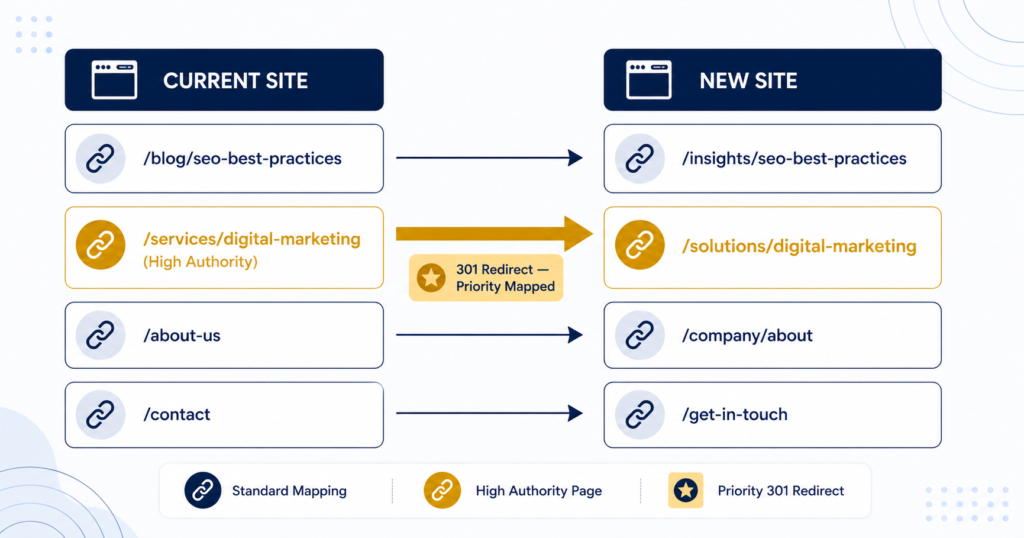
Inbound links from external websites are credibility signals built over months or years — and they can be wiped out in a migration if the pages holding them are renamed or deleted without proper handling. Before the redesign begins, audit the full backlink profile using a tool like Ahrefs or SEMrush to identify which pages carry the highest-value external links. Those pages are flagged as priority assets and given individually mapped redirects — not bulk treatment — to ensure their authority transfers cleanly to the new system.
Tell your team: Produce a list of the top link-earning pages on the current site. These get individual redirect mapping, not batch redirects.
Isolating Priority Pages
Some pages — the ones driving the majority of trial sign-ups, lead submissions, demo requests, or purchases — are disproportionately valuable to the business. These must be explicitly identified and protected before the redesign begins. Their content depth, heading structure, keyword focus, and internal linking must be preserved exactly. Trimming content from these pages during a redesign in the name of cleaner design is one of the most common and costly migration mistakes — and it almost always shows up as a ranking drop on the pages that matter most.
Tell your team: Identify the top ten to fifteen pages by conversion contribution. These get no content or structural changes without explicit SEO review.
Phase 2: URL Architecture and Redirect Strategies
Search engines recognize websites as networks of specific URL addresses. If a URL path is altered without a clear transition plan, search engine algorithms treat the original page as deleted — resetting its rankings and authority from scratch. Getting this phase right is what separates migrations that preserve search equity from ones that destroy it.
Enforcing URL Parity and Structure
The safest way to redesign a website without losing rankings is to keep existing URL paths exactly as they are. If the current structure is clean and performing well in search, maintaining identical paths on the new system eliminates a major category of migration risk entirely. When URL changes are unavoidable, every modification must be managed through a detailed 301 redirect map so search crawlers always know where to find the new location.
Tell your team: Default to preserving existing URLs. Every URL that must change needs an explicit redirect mapped to its closest relevant replacement before launch.
The Danger of Blanket Homepage Redirects
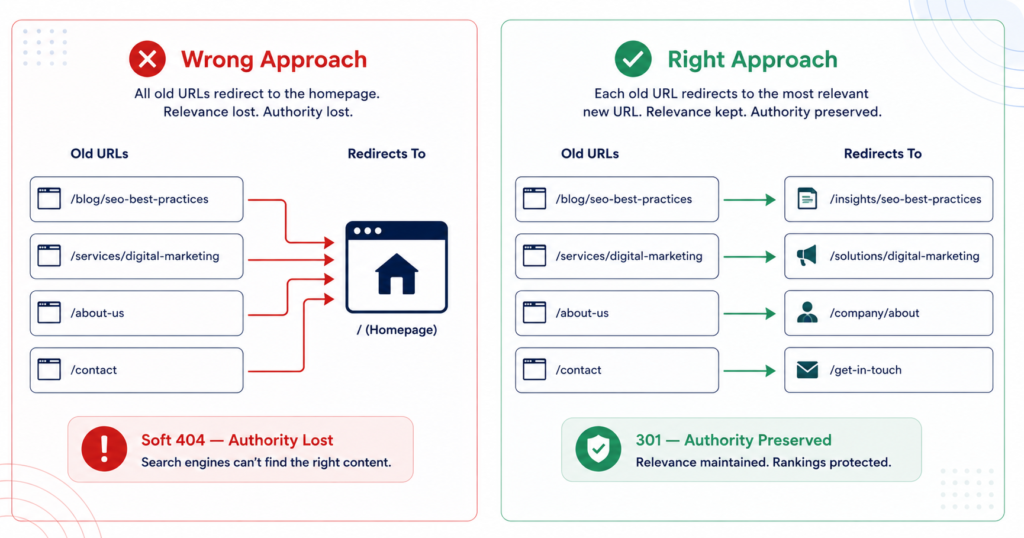
Redirecting all old or deleted pages to the homepage is one of the most damaging migration mistakes. Search engines treat mass homepage redirects as soft 404 errors — they discard the authority of the old pages rather than passing it forward. Every old URL must map directly to its most relevant replacement. For pages being permanently retired, a 410 (Gone) status code is the correct response — it signals an intentional removal and helps search engines crawl the rest of the site more efficiently.
Tell your team: No page redirects to the homepage unless it is genuinely the closest replacement. Retired pages with no equivalent get a 410, not a 301.
Implementing Server-Side Redirections
Redirects must be handled at the server level — configured in Nginx, Apache, or at the CDN edge — not through CMS plugins. Server-level redirects execute faster, reduce server load, and avoid the latency that plugin-based redirects introduce to every page request. For high-traffic sites, that performance difference directly affects Core Web Vitals scores and crawl efficiency.
Tell your team: Redirect logic belongs in server configuration, not a CMS plugin. Confirm all 301s are implemented at the infrastructure level before launch.
Cleaning Redirect Chains and Updating Internal Links
Chained redirects — URL A to URL B to URL C — burn crawl budget and slow page load times. Every redirect must point directly to its final destination with no intermediate hops. Once the redirect map is clean, all internal links across body copy, navigation, and footers must be updated to point directly to the new URLs — users and crawlers should never pass through a redirect to navigate the site.
Tell your team: Collapse any redirect chain longer than one hop before launch. Update all internal links to point directly to final URLs, not redirected ones.
Phase 3: Security, Compliance, and Technical SEO
A high-performance modern website must balance search crawlability with user security and data privacy requirements. For enterprises in regulated sectors like healthcare, finance, or e-commerce, the migration phase is the ideal moment to close security gaps that legacy platforms have accumulated over time.
Protecting the Staging Environment
All development, testing, and content staging must happen in a secure environment that is completely invisible to the public and to search engines. The staging environment should be protected behind password authentication or IP restrictions.Its robots.txt must disallow all crawling and every template must carry a noindex tag — both of which must be deliberately removed as part of the go-live process.
Tell your team: Confirm that the staging environment is blocked from public access and search engine crawling before any development work begins. Add noindex removal to the launch checklist.
Eliminating Compliance Risks from Third-Party Pixels
Standard third-party tracking pixels — Google Ads, Meta, and similar tools — have come under significant regulatory scrutiny for healthcare platforms and businesses handling sensitive user data. Under evolving HHS data privacy guidance, deploying these pixels on pages that capture health intent or host patient-facing forms carries meaningful compliance risk. The recommended approach is to remove these scripts from data-intake pages entirely and replace them with server-side tagging frameworks that strip personal identifiers before sending anonymized, aggregate data to analytics platforms.
Tell your team: Audit every tracking pixel on data-collection pages before launch. Any pixel that transmits user-identifiable data from sensitive pages should be replaced with a server-side equivalent.
Hardening Security Infrastructure
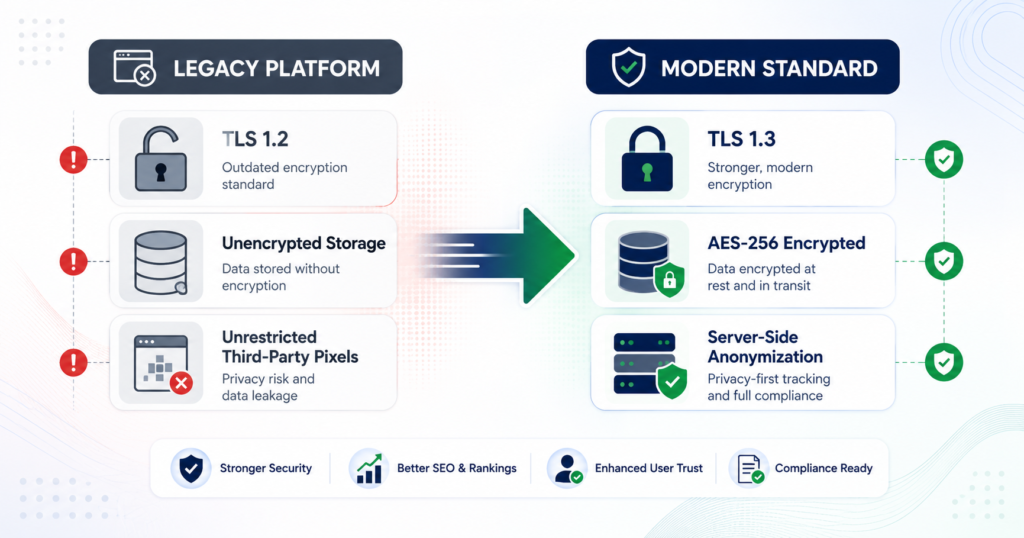
Search engines actively factor website security into rankings. The minimum standard for any enterprise platform is HTTPS enforcement using TLS 1.3, AES-256 encryption for all databases at rest, and automated SSL certificate renewal to prevent lapses that trigger browser security warnings and damage user trust. The compliance table below summarizes where legacy configurations typically fall short and what the modern standard looks like across each dimension.
| Compliance & Security Feature | Legacy Configuration | Modern Standard | Impact |
|---|---|---|---|
| User Tracking Safeguards | Unrestricted third-party pixels | Server-side anonymization; consent banners | Prevents data leaks; avoids regulatory fines |
| Transmission Security | TLS 1.2 | TLS 1.3 encryption | Faster connections; secured data in transit |
| Database Encryption | Plaintext or basic storage | AES-256 encryption at rest | Protects sensitive customer and patient data |
| Vendor Agreements | Absent or unverified | Signed Business Associate Agreements (BAAs) | Establishes full regulatory compliance |
Tell your team: Verify TLS version, database encryption standard, SSL auto-renewal configuration, and BAA status with every third-party vendor before the migration goes live.
Displaying Transparent Privacy Disclosures
Privacy disclosures are both a regulatory requirement and a search quality signal. Every enterprise site needs current privacy policies, terms of service, and cookie consent banners in place at launch. For healthcare platforms, the Notice of Privacy Practices must sit in the global footer as a persistent link — one click, no forms, no search steps.
Tell your team: Place footer privacy links before launch and verify they resolve directly to the current, complete document — not to a search page or a gated resource.
Phase 4: Post-Launch Surveillance and Performance Monitoring
Going live is not the finish line — it is the moment when vigilance becomes most critical. The staging-to-production switch is where silent failures hide: a noindex tag left in place, a redirect pointing to the wrong destination, a sitemap still referencing old URLs. The development and SEO teams must be in active monitoring mode from the moment the new site goes live.
Running Post-Launch Crawls and Validations
The first action after launch is a comprehensive crawl of the live production site — not the staging environment, but the actual live domain. This crawl is compared directly against the pre-launch baseline dataset to confirm three things: all 301 redirects are resolving correctly, canonical tags are pointing to the right live URLs, and every staging-specific noindex tag and crawl block has been successfully removed. Any discrepancy between the baseline and the live crawl is a problem that needs immediate attention, not a post-launch ticket.
Tell your team: Run the post-launch crawl within the first hour of going live. Compare it against the baseline before declaring the launch successful.
Submitting Clean Sitemaps and Speeding Up Indexation
Once the live crawl is verified, generate and submit a clean XML sitemap containing only active, indexable URLs through both Google Search Console and Bing Webmaster Tools. A sitemap with redirected, noindexed, or removed URLs in it creates unnecessary confusion for search engine crawlers. For high-priority pages — top converters, key landing pages, cornerstone content — use Google’s URL Inspection tool to request manual re-indexing rather than waiting for the standard crawl cycle. Sites that publish content frequently can also use Google’s Indexing API to accelerate discovery of new pages.
Tell your team: Submit a clean sitemap on launch day. Manually request re-indexing for the top ten to fifteen priority pages identified in Phase 1 — do not wait for Google to find them on its own.
The 90-Day Performance Monitoring Phase
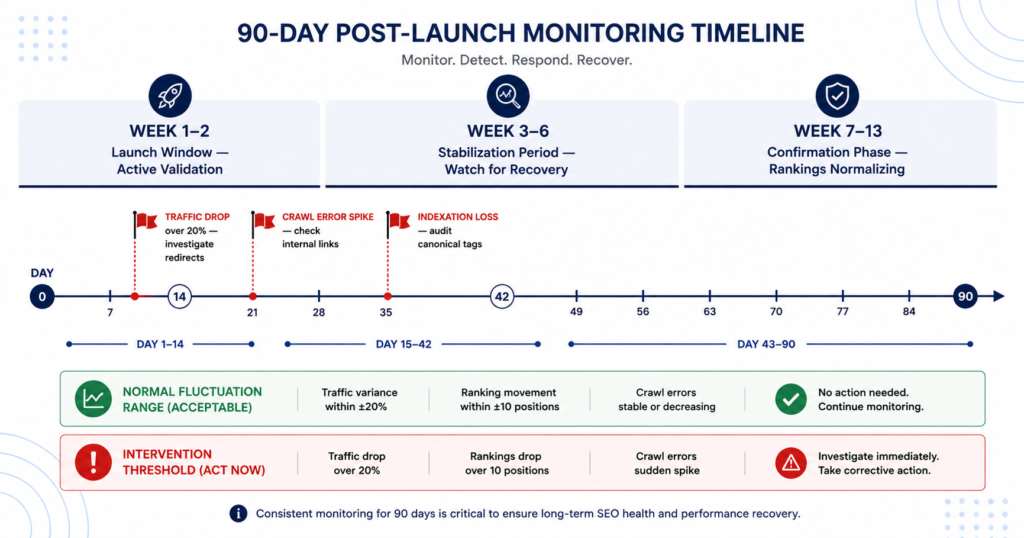
Search engine rankings routinely fluctuate for several weeks after a major migration before stabilising. This is normal — but it requires active monitoring to distinguish expected fluctuation from a genuine problem that needs intervention. Teams must maintain a structured ninety-day review phase tracking keyword ranking shifts, organic traffic trends, crawl errors, and indexation changes through Google Search Console. Server log analysis should also be part of this phase, confirming that search engine bots are navigating the new site structure as intended.
Knowing what a warning sign looks like is as important as knowing what to monitor. Three warning signs that require immediate investigation rather than a wait-and-see approach:
- Organic traffic drops more than fifteen to twenty percent in the first two weeks and does not recover by week three — redirect failure
- Crawl errors spike suddenly in Search Console — broken internal links or misconfigured redirect destinations
- Indexation drops on previously ranking pages — noindex tags or canonical misconfigurations that survived launch
Tell your team: Set up a weekly Search Console and GA4 review cadence for the first ninety days. Define thresholds in advance — what counts as normal fluctuation versus what triggers an immediate investigation — so the team is not making judgment calls under pressure after launch.
Phase 5: Platform Optimization – How Backend Architecture Affects Your SEO Performance
Once post-launch stability is confirmed, the migration window opens a second opportunity — optimizing the backend stack for sustained long-term SEO performance.
Server response time is not just an infrastructure concern — it directly affects Core Web Vitals metrics like Largest Contentful Paint and Interaction to Next Paint, both of which Google uses as ranking signals. The backend stack an organization migrates to matters as much as the frontend redesign.
How Backend Architecture Affects SEO Performance
Traditional web applications rely on Just-In-Time (JIT) compilation, where code is translated into machine language at runtime each time a user requests a page. This adds server overhead and slows initial response times — directly degrading the Core Web Vitals scores that determine search visibility.
Modern frameworks like .NET 10 LTS address this through Native Ahead-of-Time (AOT) compilation, which translates code into platform-specific machine language at the build stage rather than at runtime. The application launches without loading the standard runtime engine, resulting in faster server responses from the first request. For enterprise platforms running on containerized or serverless cloud architectures, this approach delivers three measurable outcomes that connect directly to SEO performance and infrastructure costs:
- Faster server response times — application startup times reduce by up to seventy percent, directly improving Time to First Byte and Largest Contentful Paint scores
- Lower memory consumption — up to forty percent reduction in RAM usage, allowing more container instances on existing compute tiers without scaling costs
- Smaller deployment footprint — application sizes shrink from roughly twenty-five megabytes down to under four megabytes, accelerating deployment and reducing cloud storage overhead
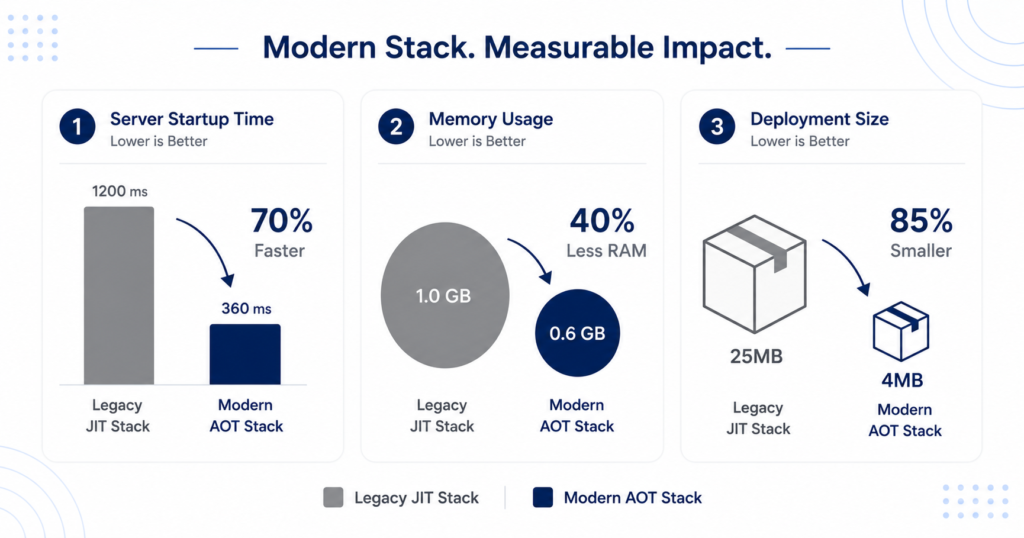
The performance gap between legacy JIT stacks and modern AOT-compiled applications is significant enough to affect both search rankings and monthly infrastructure bills — making backend modernization a business decision, not just a technical one.
Tell your team: Evaluate whether the target platform supports Native AOT compilation during the migration planning phase. The Core Web Vitals improvement alone can justify the upgrade from an SEO standpoint, independent of the infrastructure cost savings.
Why Enterprise Leaders Trust Vedhas Technology Solutions for SEO-Safe Migrations
Executing a website migration without losing search visibility requires more than a checklist — it requires a partner who understands that technical decisions made during a redesign have direct consequences on organic traffic, lead generation, and revenue.
Vedhas Technology Solutions is a full-spectrum technology and digital growth partner serving US businesses across healthcare, finance, e-commerce, and enterprise SaaS — with a delivery model spanning Bothell, Washington and Hyderabad, India. The team brings together custom software engineering, cloud infrastructure, AI-enhanced SEO, and digital marketing under one roof — because the two migration failure modes are well known: a technical team that ignores SEO, and a marketing team whose recommendations cannot be implemented. Vedhas operates at both layers simultaneously.
For organizations in compliance-sensitive industries — healthcare platforms with HIPAA-aligned data workflows, financial services with strict governance requirements, or high-growth SaaS businesses where organic traffic is a primary revenue channel — that integrated capability is not a convenience. It is a migration risk control.
If your organization is planning a website redesign and cannot afford to lose the search equity it has built, the consultation starts here.
Frequently Asked Questions: Website Redesign and SEO Migration
How long does a website migration typically take, and when is the SEO risk highest?
For a mid-sized enterprise website, a properly managed migration runs eight to sixteen weeks from pre-launch audit to post-launch validation. The highest SEO risk window is the seventy-two hours immediately after the staging-to-production switch — this is when misconfigured redirects, leftover noindex tags, and sitemap errors surface fastest. Rushing this window to meet a launch deadline is the most common cause of post-migration traffic loss.
Can we run the old site and the new site simultaneously to avoid downtime?
Yes, but the new environment must be completely blocked from search engine crawling — via robots.txt and noindex tags — for the entire duration. If both environments are publicly indexable simultaneously, search engines treat them as duplicate content and actively damage rankings on both versions. A single, well-planned cutover with a validated redirect map in place is safer than an extended parallel-running period.
What happens to our SEO if we change our domain name during the redesign?
A domain migration is the highest-risk SEO change possible — significantly more complex than a same-domain redesign. Even with perfect redirect execution and Google Search Console’s Change of Address tool, expect a temporary ranking dip of four to eight weeks. The strong recommendation is to separate the two projects: complete the redesign on the existing domain first, stabilize rankings, then execute the domain migration independently.
How do we handle SEO for a site with thousands of pages, many with little or no traffic?
Use tiered prioritization. Top pages by traffic, conversions, and backlinks get individually mapped redirects and content preservation reviews. Mid-tier pages get category-level redirects to the closest equivalent section. Pages with zero traffic, zero backlinks, and no conversions over twelve months are candidates for a 410 retirement rather than redirection. Protect SEO equity where it actually exists — do not waste crawl budget maintaining thousands of redirects to pages that never earned any authority.
How do we know if our migration was successful, and what does full recovery look like?
Measure against the pre-launch baseline from Phase 1. A successful migration shows organic traffic returning to within ten percent of pre-migration levels within sixty to ninety days, keyword rankings stabilizing on priority pages, and inbound link authority transferring cleanly. For a well-executed same-domain migration, full recovery typically takes sixty to ninety days. Poorly executed migrations — especially those involving domain changes or bulk homepage redirects — can take six to twelve months, and some losses may be permanent if high-authority pages were retired without proper redirects.
Ready to Redesign Without Losing Your Rankings?
A website redesign does not have to mean starting over in search. The difference between a migration that preserves search equity and one that destroys it is almost always preparation and execution — not intent. Every team planning a redesign intends to protect their SEO. The ones that succeed have a structured process and the right partner behind them.
Vedhas Technology Solutions works with CTOs, founders, and technical leads to plan and execute migrations that protect organic traffic from day one. Two ways to start:
Get a tailored Infrastructure Readiness Assessment — the Vedhas consulting team reviews your current CMS configuration, database architecture, data protection workflows, and hosting setup to identify page speed opportunities, security gaps, and infrastructure cost reductions before your migration begins.
Schedule a direct technical consultation — bring your current platform challenges, migration requirements, and timeline to a focused conversation with a specialist who can map a realistic path forward.
Your redesign should make your platform stronger in every dimension — including search.