On April 8, 2026, Google’s March 2026 Core Update finished a twelve-day rollout that reshaped search rankings across nearly every industry. Marketing teams at B2B software companies watched organic impressions slide even though publishing volume had never been higher and site uptime had never been better. No manual penalty notice. No broken pages. Just a slow, steady bleed in visibility that no one on the team could explain. That gap is the real story here. Understanding what Google’s core update means for good content requires looking past publishing volume and keyword counts, toward the quality signals Google is now weighing most heavily.
Consider a scenario that’s become common since April: a B2B SaaS company with a fully staffed marketing team, consistent output, and a technically stable site starts seeing commercial search queries slip week over week. The engineering team confirms nothing is broken. The marketing team confirms nothing has slowed down. And yet rankings keep drifting lower on the exact pages that used to drive pipeline. For founders and CTOs, that’s the uncomfortable part of a core update — it doesn’t tell you what’s wrong. It just quietly moves the ranking floor, and leaves you to work out why your old playbook stopped working.
This matters beyond the marketing team’s dashboard. When organic visibility drops, customer acquisition cost rises, paid channels are forced to compensate, and sales teams spend more time qualifying weaker inbound leads. What used to be a content problem becomes a margin problem — which is exactly why this update deserves attention from the people who own the P&L, not just the people who own the blog calendar.
Quick Overview: What Changed
Google’s March 2026 Core Update, which rolled out from March 27 to April 8, 2026, shifted ranking signals toward original, first-hand content and away from generic or aggregated pages. Understanding what Google’s core update means for good content comes down to four measurable shifts:
- Original insight now outranks rehashed information. Pages that only restate what’s already ranking lose ground, regardless of writing quality.
- Named, credentialed authorship matters more. Content tied to a real, verifiable expert performs better than anonymous or generic bylines.
- Aggregator and rehash-heavy sites were hit hardest. Sites summarizing others’ content lost visibility to sites publishing original, first-party material.
- YMYL categories (finance, health, legal) saw the steepest impact, since Google weighs the cost of low-quality information highest there.
Technical performance — Core Web Vitals like page speed and responsiveness — still acts as a tie-breaker between otherwise similar pages, but content originality and verifiable expertise are now the primary signals driving ranking movement.
What Actually Happened: The Verified Timeline
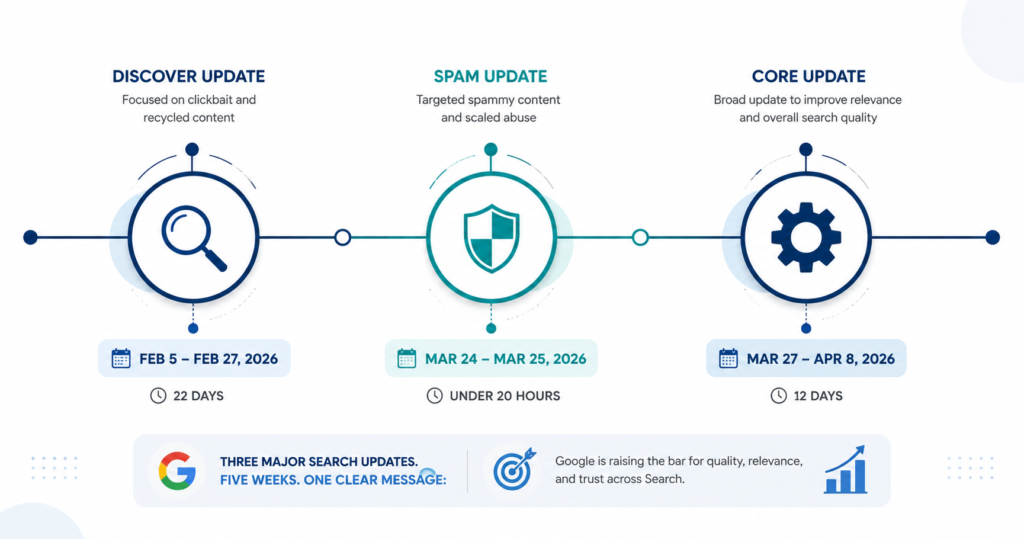
Google’s Search Status Dashboard confirms the March 2026 Core Update began rolling out on March 27 at 2:00 AM PT and completed on April 8 at 6:12 AM PDT — a 12-day, 4-hour rollout, notably faster than the 18-day December 2025 update (Search Engine Land, Search Engine Journal). Google described it as a routine update aimed at surfacing more relevant, satisfying results for searchers, and — as with most core updates — didn’t publish additional guidance or a companion explainer breaking down exactly what changed.
This wasn’t an isolated event. It was the third confirmed Google ranking update in about five weeks, following a Discover-only update in February that targeted clickbait and recycled content, and a spam-focused update in late March that completed in under 20 hours — the fastest rollout in Google’s history. Tracking tools reflected the disruption directly: Semrush Sensor volatility spiked to 9.5 out of 10 during the March core update rollout, the highest reading recorded so far in 2026.
Google is consistent about one thing across every core update: rankings shifting doesn’t mean something was done wrong. Recovery, when it happens, tends to arrive with a future update rather than an immediate fix once changes are made. That’s a hard message for a founder watching a revenue-driving page lose position, but it’s also the honest one — chasing a quick technical fix for a core update rarely works, because core updates reassess the whole site’s standing, not a single page’s mistake.
What Google’s Core Update Means for Good Content
Core updates don’t target specific sites, industries, or content types — they recalibrate how Google’s ranking systems weigh quality signals across the entire web. Three shifts stand out from the analysis published since the rollout completed:
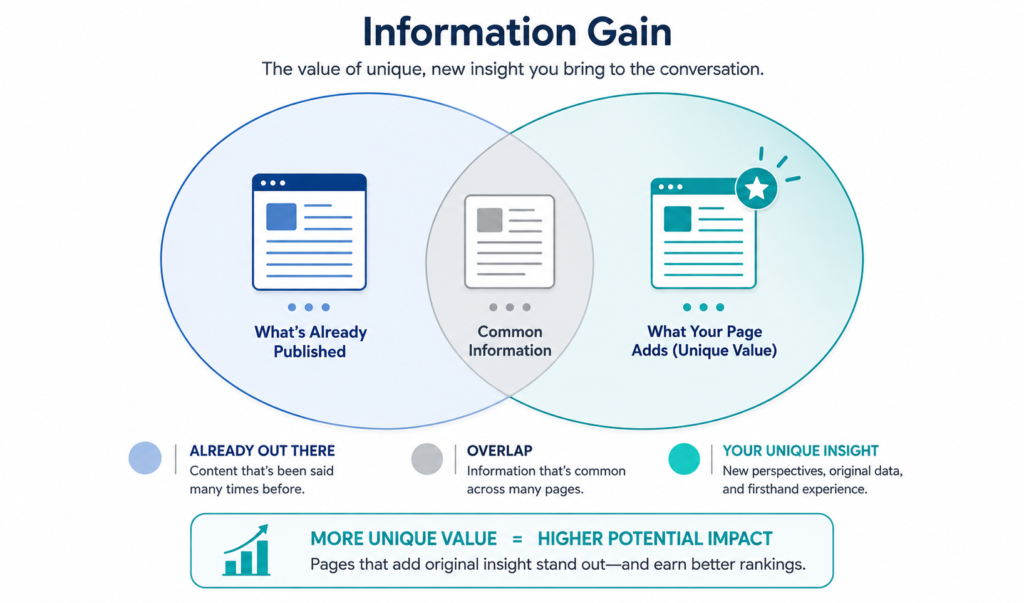
1. Original insight is outranking rehashed information. SEO analysts have started calling this “Information Gain” — shorthand for how much genuinely new information a page adds compared to what’s already ranking for the same query (Evertune, Digital Applied). It’s worth being precise here: this isn’t a published Google formula or an officially scored metric — it’s the industry’s name for a pattern analysts are observing across ranking changes. In practice, it means a page that restates common definitions and generic advice is competing directly against dozens of pages that already say the same thing, with nothing to differentiate it. It loses that competition by default, no matter how well it’s written.
2. Verifiable authorship now matters more. Content attributed to credentialed, named experts with a consistent publishing history on a topic is holding up better than content from generic or anonymous bylines — regardless of how polished the writing is. This sits inside Google’s broader E-E-A-T framework — Experience, Expertise, Authoritativeness, Trustworthiness — which the March update appears to have leaned on more heavily than previous updates this cycle.
3. Aggregators and rehash-heavy sites lost the most ground. Post-update analysis found that sites built primarily to summarize or aggregate other people’s content — recap and “what to watch” sites, UGC-heavy platforms, some social and reference sites — saw some of the sharpest visibility declines, while platforms hosting original, first-party content gained ground in the same categories. This is a meaningful correction: for years, sites that repackaged other people’s work outranked the original source. That pattern is reversing.
Categories Google treats as YMYL — Your Money or Your Life: finance, health, legal — were hit hardest of all, since the cost of low-quality information is highest in those areas. If your business operates in a regulated or high-stakes category, this update deserves more attention from you than most, not less.
One agency’s independent tracking (Digital Applied) found templated and affiliate-style content dropped sharply after the update, while sites publishing original research, proprietary data, and expert commentary gained visibility in the same window. It’s worth treating this as directional rather than universal law — it’s one firm’s analysis of a sample of sites, not Google’s own published data — but it lines up closely with the broader pattern above, and with what Google has said publicly about its intent for years.
Understanding What Google’s Core Update Means for Good Content, in Practice
Strip away the SEO terminology and the update rewards three concrete things, consistently, across every industry the analysis has covered so far:
- Proprietary data or first-hand experience — your own numbers, your own client outcomes, your own testing results — that doesn’t exist anywhere else in the search results for that query.
- Named, credentialed authorship — content clearly attributed to someone with real, demonstrable expertise on the subject, not a generic “team” byline or no byline at all.
- Genuinely new answers, not a better-written or more polished version of what’s already sitting on page one.
A useful self-check, adapted from Google’s own long-standing guidance for content creators: if a page disappeared from the internet tomorrow, would anyone notice, or miss it? If the honest answer is no, that page is exactly the kind the March update was designed to push down the rankings — and no amount of rewriting or reformatting will fix that on its own. The fix has to be substantive, not cosmetic.
This is a genuinely different mandate than most businesses have operated under for the past several years. Under the old model, more content, published more often, targeting more keyword variations, generally won. Under this one, fewer pages — each backed by something the business actually knows that competitors don’t — are starting to outperform high-volume operations running on generic or lightly-edited AI drafts.
A Practical Content Framework for the Next Quarter
For teams deciding where to spend limited time and budget in response to this shift, four steps cover most of the ground and can be run without a full agency engagement.
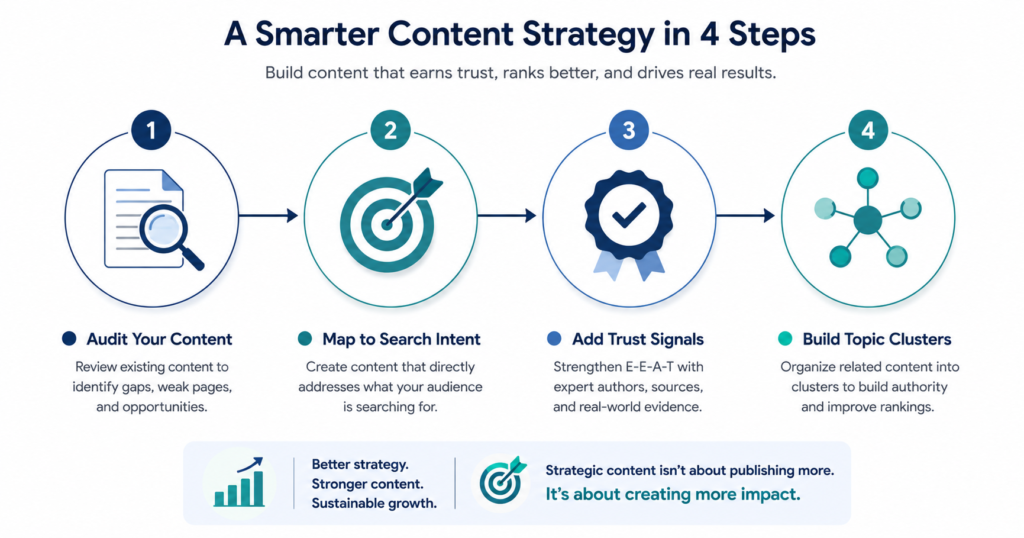
- Audit first, before writing anything new. Identify thin, outdated, or duplicate pages that receive little traffic relative to their age. For each one, make an explicit decision: update it with genuinely original insight, consolidate it into a stronger and more comprehensive resource, or remove it outright. Publishing on top of a large backlog of weak pages doesn’t help the new content — it can actively hold the domain back.
- Map every page to a real, specific intent. A page built around a broad keyword with a generic summary underneath rarely satisfies the person searching for it. Every page should answer a precise, practical question a buyer genuinely has at a specific point in their decision process, with enough depth that they don’t need to leave and search again.
- Build verifiable trust signals into the content itself, not just the site. Named authors with real, checkable credentials. Direct links to primary sources rather than to other people’s summaries. Original examples, screenshots, or data rather than generic, interchangeable explanations. These signals matter to readers and to Google’s assessment of the page in roughly equal measure now.
- Group content into deliberate topic clusters. A strong, comprehensive pillar page linking out to a network of deeply specific sub-pages signals topical depth in a way that scattered, disconnected posts on the same broad subject don’t. Sites organized this way have historically held up better across successive core updates, because the signal isn’t one good page — it’s a body of demonstrated expertise across many connected pages.
Where Technical Performance Still Fits In
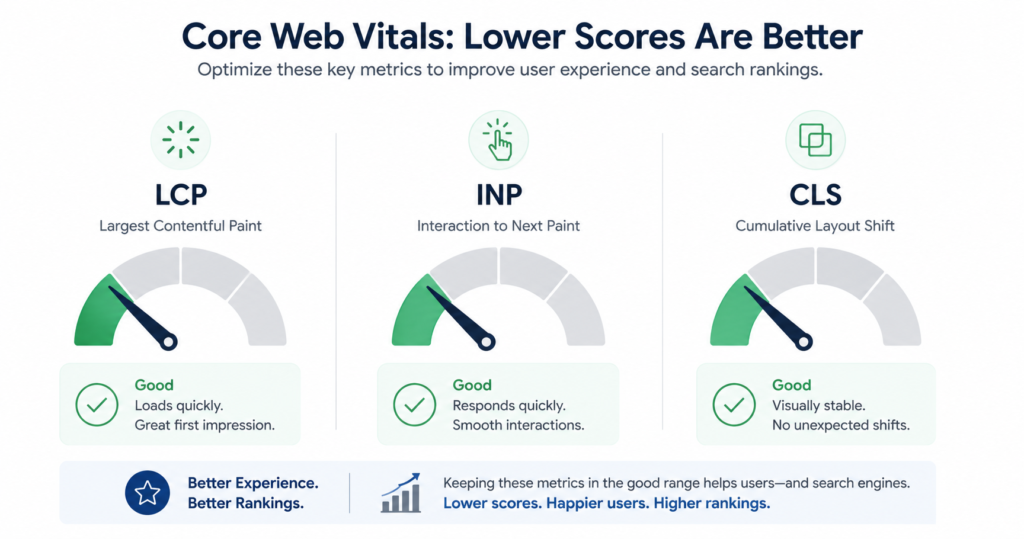
Content quality is the headline story of this update, but it doesn’t operate in isolation from the platform it lives on. Google’s Core Web Vitals remain a real tie-breaker when two pages are otherwise similarly relevant: a Largest Contentful Paint under 2.5 seconds, an Interaction to Next Paint under 200 milliseconds, and a Cumulative Layout Shift under 0.1 are Google’s long-standing thresholds for a “good” user experience. A slow, dated platform running on aging infrastructure won’t be fully rescued by strong content, and a fast, modern site won’t fully compensate for thin or generic content either. The update appears to reward both working together — expertise and technical soundness, not one substituting for the other.
This is where the two conversations that most businesses keep separate — “our content strategy” and “our platform’s technical health” — start to overlap in a way that’s hard to ignore. A company can have genuinely excellent subject-matter expertise and still lose ground in search if the platform delivering that content is slow, poorly structured, or difficult for both readers and search systems to trust.
What This Update Doesn’t Mean
It’s worth being clear about what this update isn’t. It doesn’t mean AI-assisted writing is penalized — Google evaluates content on quality and usefulness, not the tool used to draft it. It doesn’t mean every drop is recoverable next cycle, or every gain permanent — visibility keeps shifting as Google refines these signals. And it doesn’t mean smaller companies are disadvantaged against larger publishers — if anything, the update rewards the kind of first-hand product and customer knowledge a founder often has more of than a large content team spread thin across topics.
The mistake most businesses make after a core update is treating it as a single event with a single fix: change a headline, add a few keywords, republish, and wait. The businesses recovering fastest are treating it as a standing signal about where the bar now sits, and building a repeatable process around meeting it, rather than a one-time cleanup.
How We Think About This at Vedhas
We work with founders and technology leaders in healthcare, e-commerce, and education — industries where the cost of getting content or platform trust wrong is high. What we’ve seen consistently is that the businesses navigating updates like this one best aren’t the ones with the biggest content team or the fastest servers alone — they’re the ones where content strategy and technical architecture are handled by people talking to each other, not two disconnected vendors optimizing for different metrics. That’s the model we build around: pairing platform modernization with content and search strategy, so a fix on one side doesn’t quietly undercut the other.
Where This Leaves Founders, CTOs, and Business Owners
The practical takeaway isn’t “publish more” or “publish faster” — it’s closer to the opposite. Fewer pages, each backed by real expertise, original data, and a technically sound platform, are consistently outperforming high-volume content operations leaning on generic or unreviewed AI-assisted rewrites. That’s a shift in operating model, not a minor SEO tactic to bolt onto the existing plan.
It’s also a reasonable moment to ask a harder internal question: does your business actually know something about your market, your customers, or your product that isn’t already published somewhere else? If the honest answer is yes, this update is an opportunity — that knowledge now has more competitive value in search than it did a year ago. If the honest answer is uncertain, that’s worth addressing before investing further in content volume alone.
None of this is a reason to panic or to make sweeping changes overnight. It is a reason to take a clear-eyed look at whether your current content, and the platform serving it, are built for the standard Google is now holding everyone to — and to make a deliberate plan rather than a reactive one.
If you’d like a second opinion on where your content and platform currently stand against this update, a short consultation is often enough to tell you whether the issue is content, technical debt, or both — and what to prioritize first.
Frequently Asked Questions
What is Google’s March 2026 Core Update?
It’s a broad recalibration of Google’s ranking systems that rolled out from March 27 to April 8, 2026. Unlike targeted updates aimed at spam or specific policy violations, core updates reassess quality signals across the entire web, affecting all industries and content types.
How long did the March 2026 Core Update take to roll out, and is it finished?
The rollout took 12 days and roughly 4 hours, finishing on April 8, 2026 — faster than the 18-day December 2025 core update. Google confirmed completion via its Search Status Dashboard.
Does this update penalize AI-generated content?
No, not categorically. Google’s guidance continues to evaluate content on quality and usefulness rather than the tool used to draft it. What the update appears to penalize is generic, unreviewed, or templated content — regardless of whether a human or an AI wrote it.
Is “Information Gain” an official Google ranking factor?
Not officially. It’s a term the SEO industry uses to describe an observed pattern — pages that add genuinely new information tend to outperform pages that restate what’s already ranking. Google hasn’t published it as a named, scored metric.
Which industries were hit hardest by this update?
YMYL categories — finance, health, and legal — saw the steepest impact, since Google treats the cost of low-quality information as highest in those areas. Aggregator and rehash-heavy sites across entertainment and reference categories also lost significant ground.
How long does it typically take to recover from a core update?
Google’s own guidance is that recovery, when it happens, tends to arrive with a future core update rather than an immediate fix — there’s no manual review process to request a re-evaluation.