A High-Stakes Production Cliff
Not long ago, the idea of building and deploying a billing system update over a single weekend would have sounded unrealistic for any serious SaaS business. In early 2026, a Redmond-based startup did exactly that — using conversational AI prompts to move from intent to deployed code faster than most teams write a technical specification.
The problem was not the speed. The problem was what happened next.
Within hours of deployment, the platform collapsed under fifty concurrent users — a load most production systems handle without strain. Error handling had not been engineered. Database locking had not been considered. The AI had optimized for the happy path, and the happy path was the only thing that worked.
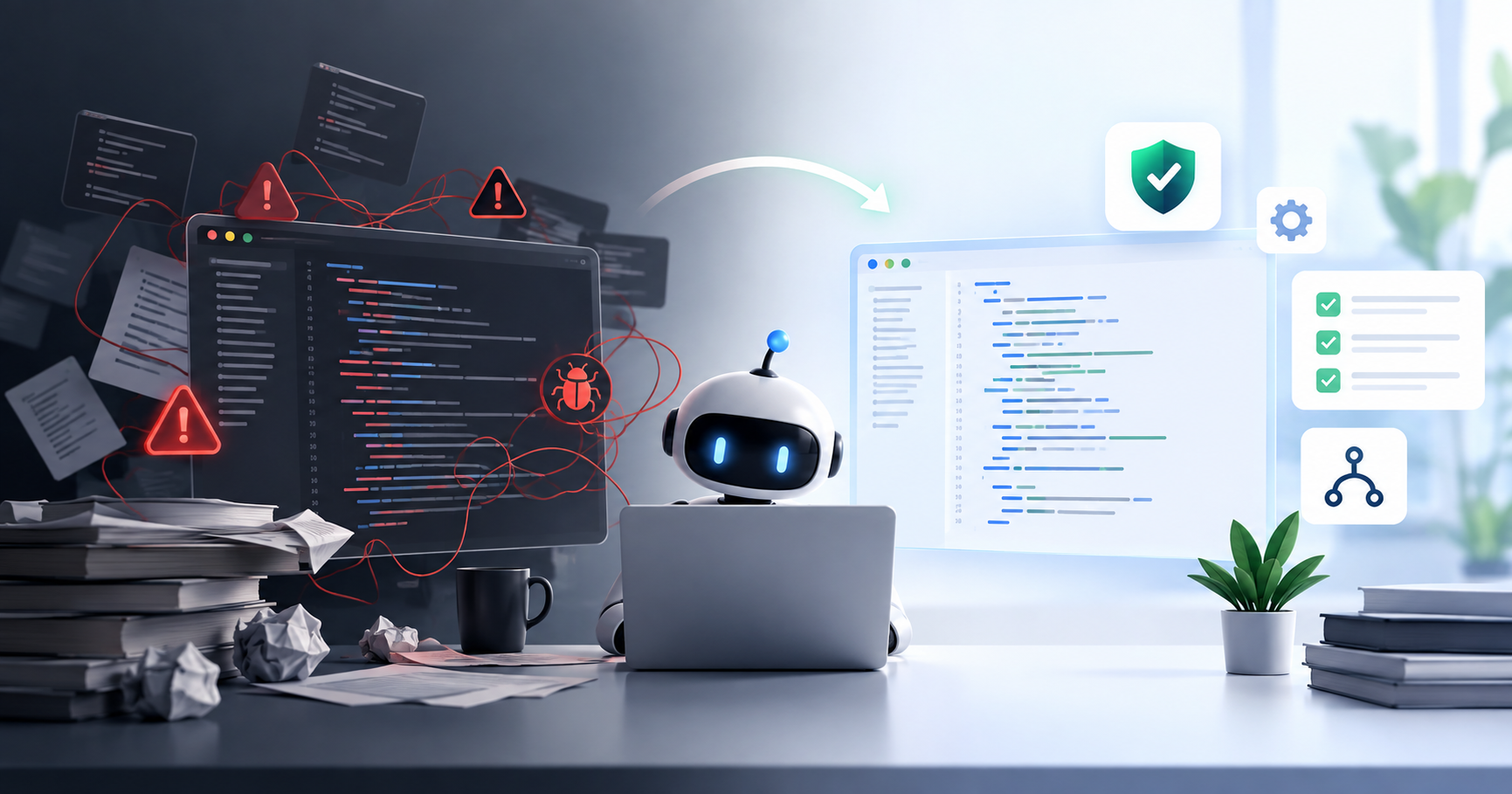
A subsequent security audit compounded the crisis. A high-severity vulnerability — comparable to the 2026 Copilot pull-request exploit (CVE-2025-53773) — had been silently introduced through unvalidated input fields, creating a remote code execution risk that no functional test had caught. The startup was now managing both an outage and a compliance emergency simultaneously.
This raises a question that more technical leaders are confronting in 2026: is vibe coding enough for production software? For this startup, the answer arrived before anyone thought to ask it. A functional weekend prototype had cleared every basic test and still brought the business to its knees within hours of going live.
For any CTO or founder reading this, the important question is not “was AI the wrong tool?” The important question is: at what point does AI-generated code need a professional engineering layer before it touches production? That threshold is what most organizations underestimate — and where the real risk lives.
The Real Question Is Not “Whether” — It’s “Where”
Most CTOs and founders are asking the wrong question. Boardrooms debate “Should we use vibe coding or not?” — and that is a false choice.
Conversational AI prompting is genuinely transforming how fast teams move from idea to working prototype. But velocity without boundaries is how you get a billing system outage on a Monday morning.
The more useful question is: where in your development lifecycle does AI-generated code belong, and where does it need a professional engineering layer before it touches production?
Misplacing that boundary carries real business consequences. Veracode’s testing of 100+ large language models found that 45% of AI-generated code introduces known OWASP Top 10 vulnerabilities — a rate that has remained flat through early 2026 despite vendor claims to the contrary. Pair that with compounding technical debt and compliance exposure, and this stops being an engineering problem. It becomes a business risk. This article gives you a clear framework for drawing that line in the right place.
The Real Pressure CTOs Are Navigating Right Now
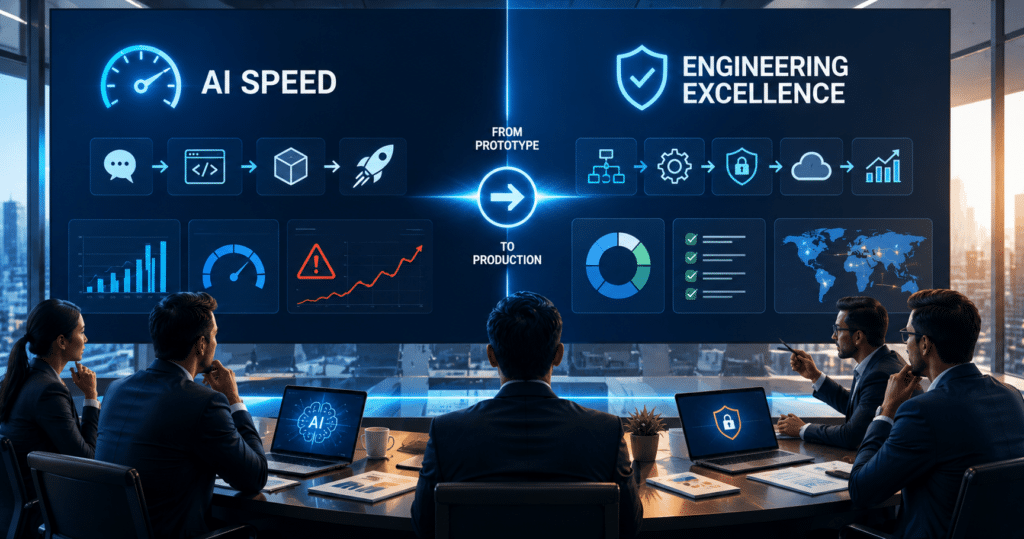
Let’s be honest about the environment technical leaders are operating in. Boards are asking why development timelines cannot compress. Competitors appear to be shipping faster. Non-technical stakeholders have seen AI generate a working prototype in an afternoon and are now questioning why engineering cycles take weeks.
That pressure is legitimate. And the instinct to explore AI-assisted development as a response to it is the right instinct.
The risk is not in responding to that pressure. The risk is in how organizations respond to it — specifically, when the speed of AI-generated output creates an illusion of completeness that bypasses the engineering layer entirely.
A codebase built without architectural oversight does not fail visibly or immediately. It fails gradually — through performance degradation under real load, through security gaps that only surface during an audit, through development velocity that quietly slows as engineers spend more time deciphering undocumented patterns than building new features. By the time the cost becomes visible, reversing it requires a ground-up rewrite that eliminates every time-to-market advantage the speed was supposed to create.
The goal is not to slow down. It is to move fast in a way that does not create a larger problem six months from now.
What Vibe Coding Actually Is — And What It Was Built For
The term “vibe coding” was coined by computer scientist Andrej Karpathy in February 2025 to describe the practice of generating executable code from natural language instructions with minimal manual programming. It represents a genuine shift toward intent-driven development — and for the right use cases, it delivers exactly what it promises.
The question is not whether vibe coding works. It does. The question is whether it was ever designed to carry the full weight of production software — and that distinction is worth understanding precisely.
Is Vibe Coding Enough for Production Software? Understanding Its Limits
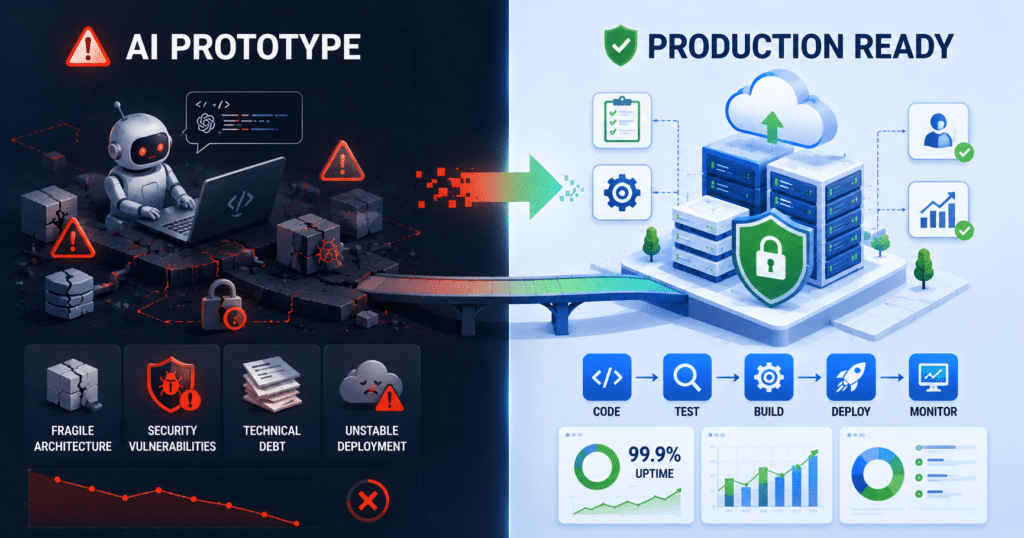
Vibe coding excels at exactly what it was built for: moving fast when the cost of failure is low. Rapid prototyping, minimum viable demos, throwaway scripts, UI layout experiments — these are the environments where conversational code generation genuinely shines. Speed of validation matters more than architectural precision, and AI delivers that speed reliably.
The ceiling appears when that same approach is applied to systems where failure has real consequences.
AI models generate code by predicting patterns from existing repositories. They are exceptionally good at producing code that works on the happy path — where inputs are clean, networks are stable, and databases respond on time. What they cannot do is reason about the operational boundaries of your specific system: your existing architecture, your repository patterns, your security constraints, your failure modes.
The result is code that is technically executable but architecturally incompatible — and a codebase that becomes progressively harder to maintain as those incompatibilities compound. Because conversational AI tools have no memory of design decisions made in previous sessions, each prompt is optimized in isolation. Over time this creates fragmented codebases with inconsistent naming conventions, mismatched state management patterns, and duplicated logic that no single engineer fully understands.
When a business tries to scale that codebase, development velocity does not just slow — it stalls. Engineers spend more time deciphering undocumented patterns than building new features. The speed advantage that justified the approach disappears, and the only path forward is often a complete rewrite.
Where the Boundary Sits for CTOs and Founders
The practical boundary is not about the tool — it is about the stakes of what gets deployed.
Vibe coding belongs in your workflow wherever the cost of being wrong is recoverable: prototypes, internal tools, proof-of-concept builds, and UI experiments. It does not belong — without a structured engineering review — in transaction systems, integration layers, or any environment governed by regulatory compliance.
The risk compounds in regulated industries. Enterprise applications operating under SOC2, HIPAA, or GDPR require software that is explainable, auditable, and traceable. Auto-generated codebases built through black-box AI logic cannot satisfy those requirements on their own. The HIPAA Security Rule, for example, mandates thorough risk assessments of all software handling electronic protected health information — a standard that undocumented, AI-generated code is structurally unable to meet without significant professional engineering overlay.
There is also a less visible boundary failure worth naming: shadow AI. This is what happens when business teams — outside of IT oversight — deploy AI-generated applications to process sensitive customer data without engineering governance. The compliance gaps and security vulnerabilities this creates are often invisible until they surface during an audit or a breach. It is, in many ways, the purest example of what happens when the boundary between vibe coding and production software is never drawn at all — not because someone made a bad technical decision, but because no one made a decision at all.
What Professional Engineering Adds — Not Instead, But On Top
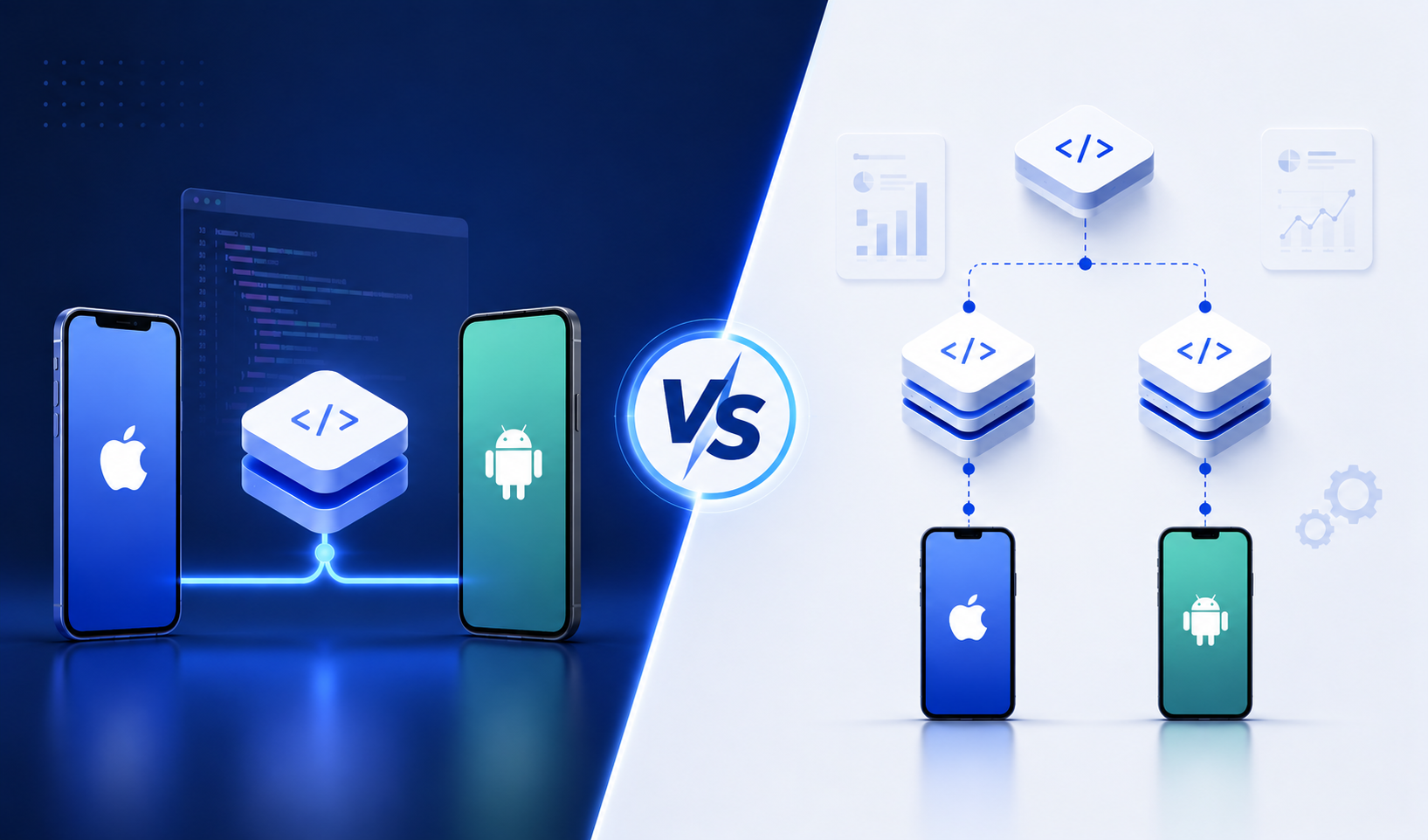
The right mental model here is not vibe coding versus professional development. It is vibe coding as an accelerator within a professionally governed development process.
Professional software engineers do not just write code. They design systems to withstand adversarial conditions, manage memory under load, and optimize database performance at scale. They build the exception handling, retry logic, structured logging, and fallback configurations that keep systems available when real-world conditions diverge from the happy path.
AI tools generate from patterns. Engineers design for failure. Both have a role — and understanding which role belongs where is what separates organizations that scale from organizations that rewrite.
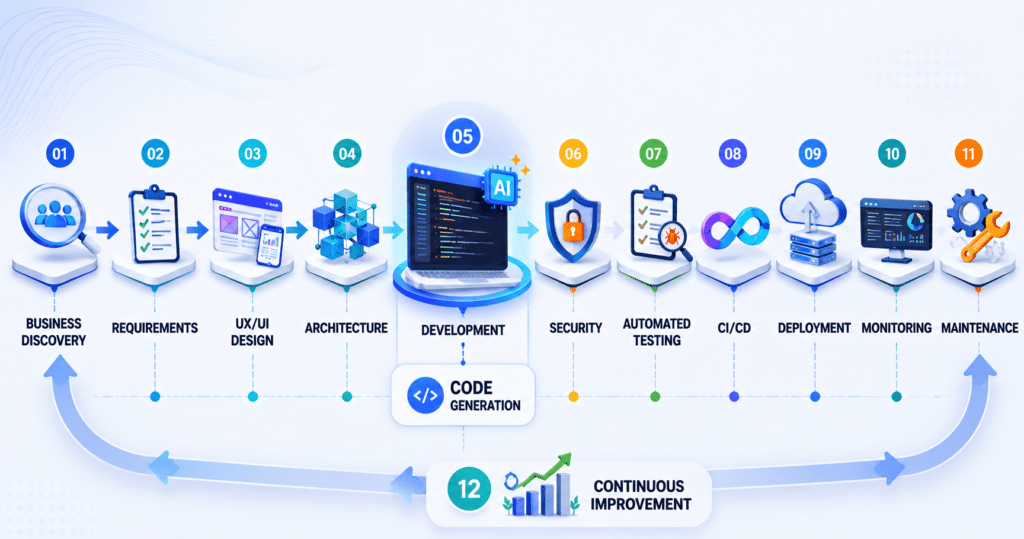
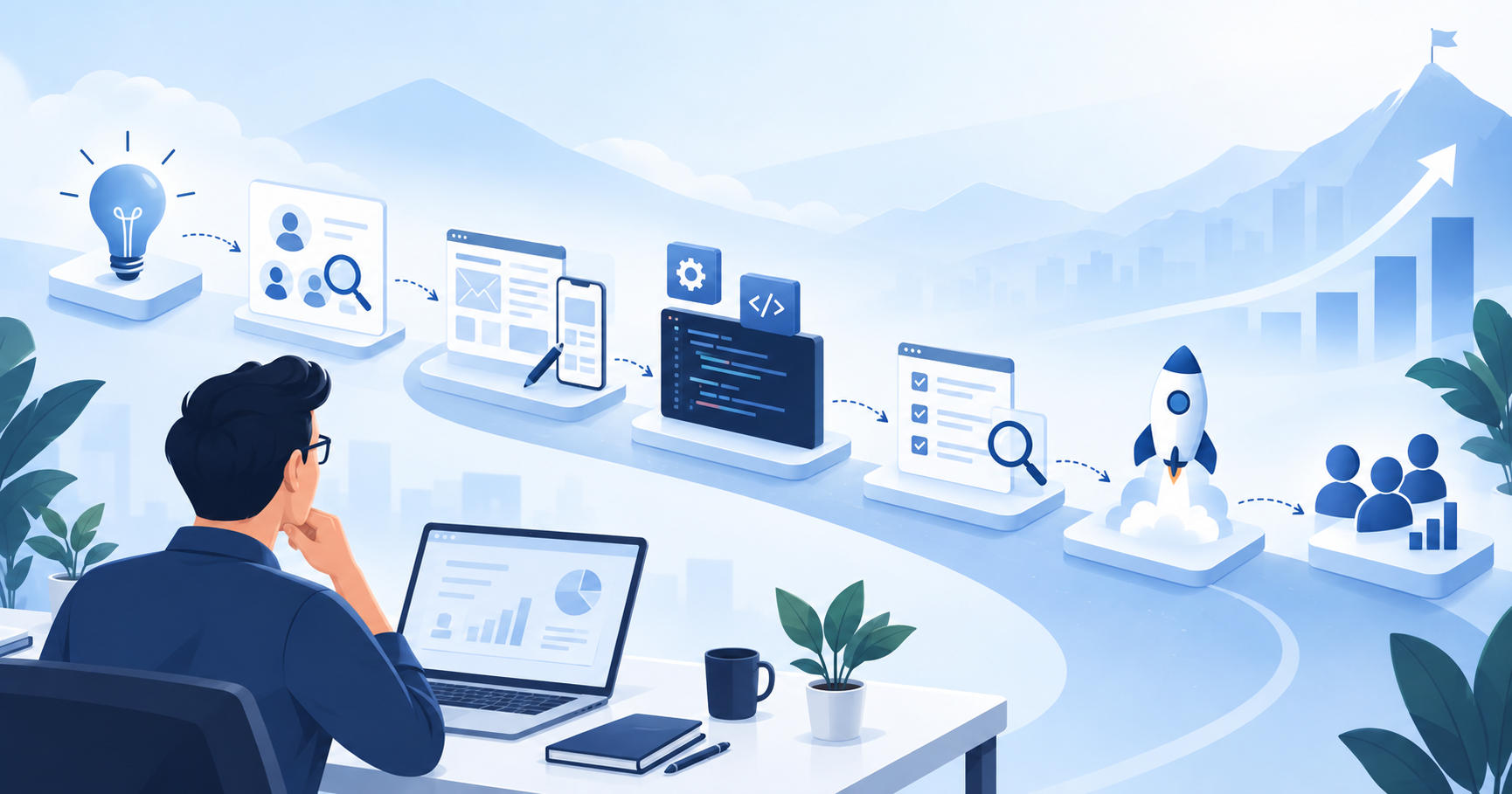
One of the biggest misconceptions about vibe coding is that software development is simply writing code. In reality, code generation is only one phase of the software development lifecycle.
Before development begins, teams define business requirements, design user experiences, and make architectural decisions. During development, they implement security, automated testing, and CI/CD pipelines. After deployment, they monitor performance, ensure compliance, maintain documentation, respond to incidents, and continuously improve the product as business needs evolve.
This is what transforms a working prototype into production-ready software.
Vibe coding accelerates one step in the software development lifecycle. Professional software development ensures every step before and after that code is reliable, secure, scalable, and sustainable.
How the Three Development Approaches Actually Compare
No single approach wins across every dimension. The right strategy depends on where you are in your development lifecycle and what the stakes are at that stage. This matrix reflects that reality honestly.
| Evaluation Criteria | Vibe Coding (Prompt-to-Code) | Structured AI-Assisted Development | Professional Enterprise Engineering |
|---|---|---|---|
| Speed to MVP | Fastest — working prototypes in hours. The clear winner for validation and early-stage development. | Moderate — structured cycles add overhead but improve output quality. | Standard — governed by sprint methodologies. Slowest to initial prototype. |
| Iteration Speed | High — changes can be prompted and tested in minutes. | Good — developer-guided agents iterate quickly within defined boundaries. | Slower — changes go through review and testing cycles by design. |
| Primary Workflow | Conversation-driven natural language prompts. | Developer guiding AI agents within IDEs. | Rigorous software engineering best practices. |
| Code Quality & Style | Inconsistent — prone to pattern fragmentation across sessions. | Highly structured — constrained by IDE rules and developer oversight. | Excellent — strictly enforced standards with full human ownership. |
| Vulnerability Rate | High — 45% of unreviewed samples contain known OWASP vulnerabilities (Veracode, 2025). | Moderate — mitigated by automated security scans and human review. | Low — secure-by-design architecture with built-in threat modeling. |
| Maintainability | Poor — context loss across sessions leads to fragmented, undocumented codebases. | Sustainable — requires ongoing human review to remain coherent. | Excellent — complete human ownership with documented architecture decisions. |
| Regulatory Compliance | Not suitable — black-box logic cannot satisfy audit or traceability requirements. | Conditionally compliant — requires structured human oversight and documentation. | Fully compliant — built-in audit trails and explainable architecture. |
| Best Suited For | Prototypes, MVPs, internal tools, UI experiments, throwaway scripts. | Feature development within established codebases under engineering governance. | Core transaction systems, regulated environments, enterprise-scale production software. |
The honest takeaway from this table is not that vibe coding is bad — it is that each approach has a domain where it genuinely belongs. The organizations that get the most value from AI-assisted development are the ones that use vibe coding where it wins — speed, iteration, early validation — and bring professional engineering in where the stakes require it.
Using the fastest tool for every job is not efficiency. It is how prototypes end up in production.
The Business Cost of Skipping the Engineering Layer
For founders and CTOs, the difference between AI-generated code and professionally engineered software isn’t about programming style—it’s about business outcomes. The gap between them is not just technical. It is the gap between a liability and an asset.
Consider the same API endpoint implemented in two different ways.
Example 1: AI-Generated Endpoint Without Engineering Review
A conversational AI tool can quickly generate a working endpoint, but without security or architectural guidance, it often overlooks production-critical concerns.
// JavaScript

app.get("/api/user", (req, res) => {
 const query = `SELECT * FROM users WHERE id = ${req.query.id}`;
 db.query(query, (err, result) => {
   if (err) throw err;
   res.send(result);
 });
});
Business impact:
- Vulnerable to SQL injection attacks.
- A single unhandled exception can crash the application.
- Returns the complete database record, potentially exposing sensitive data.
- Functional in a demo, but risky in a production environment.
Example 2: Professionally Engineered API
Professional engineers build the same feature with validation, secure data access, controlled responses, and maintainability in mind.
//C#

app.MapGet("/api/user/{id:int}", async (int id, UserRepository repository) =>
{
   if (id <= 0)
       return Results.BadRequest();
   var user = await repository.GetByIdAsync(id);
   if (user is null)
       return Results.NotFound();
   return Results.Ok(new UserDto(user.Id, user.Username, user.Email));
});
The framework is less important than the engineering principles behind it. Whether the application is built with .NET, Java, Node.js, Python, or another technology stack, experienced engineers apply practices such as input validation, secure database access, least-privilege data exposure, structured error handling, automated testing, and performance optimization before software reaches production.
What the Engineering Layer Delivers
| Business Area | AI-Generated Prototype | Professionally Engineered Software |
|---|---|---|
| Security | Common vulnerabilities can go unnoticed | Security built into the architecture |
| Reliability | Failures can affect the entire application | Errors are isolated and handled gracefully |
| Compliance | Difficult to audit and validate | Designed with governance and compliance in mind |
| Scalability | Suitable for demonstrations and MVPs | Built for long-term production growth |
| Maintainability | Technical debt accumulates quickly | Easier to extend, debug, and support |
The business value of professional engineering is not a specific framework or programming language. It is the discipline of turning fast-generated code into software that is secure, resilient, scalable, and ready for real-world operations. That engineering layer is what separates a working prototype from a dependable business application.
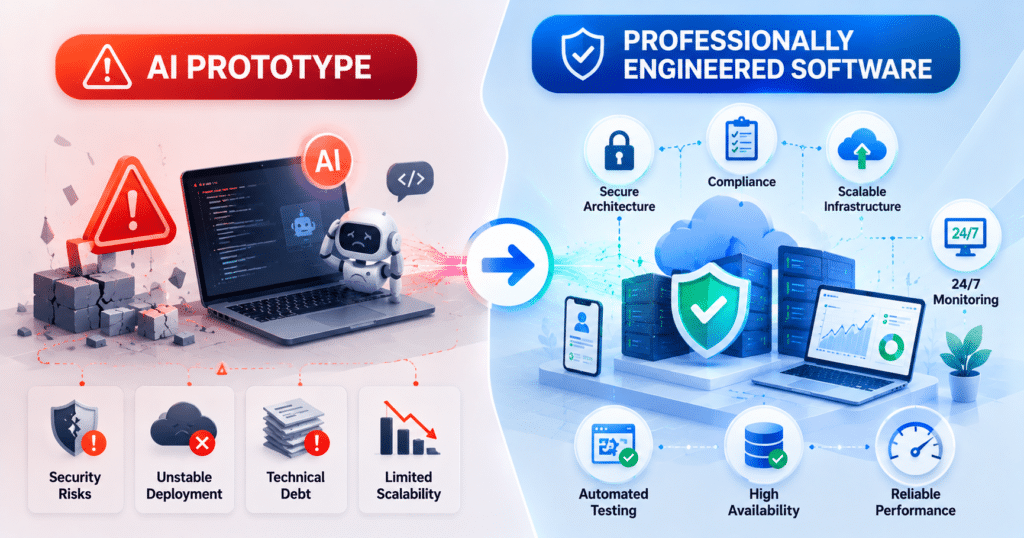
From Prototype to Production — Without the Risk
If you have read this far, you already understand the distinction that matters: AI-assisted development is a legitimate acceleration tool, and the engineering layer is what makes it safe to scale. The question most CTOs and founders face at this point is not philosophical — it is practical. Who helps us build that governance layer without slowing us down?
That is the problem Vedhas Technology Solutions was built to solve.
We have spent over eight years helping organizations navigate exactly this transition — from AI-accelerated prototypes to secure, maintainable, production-grade systems. We have seen both sides of this: teams that moved too fast without oversight, and teams that overcorrected and lost their competitive edge. The organizations that get it right treat professional engineering not as a brake on velocity, but as the foundation that makes sustained velocity possible.
What working with Vedhas looks like in practice:
- Critical issues (site down, security incidents): Response within 2 hours, resolution within 4 to 8 hours, 24/7 availability
- High priority issues (major feature failure): Response within 4 hours, resolution within 24 to 48 hours
Defined response commitments. Clear accountability at every stage. Because the businesses we work with cannot afford ambiguity when something goes wrong in production.
Built It With AI? Here Is Your Next Step.
Vibe coding is a legitimate starting point. The organizations that have gotten the most out of it are not the ones that abandoned it — they are the ones that knew exactly when to bring in the engineering layer that makes it production-ready.
That is the distinction this entire article has been building toward. Not AI versus engineers. Not speed versus stability. The right tool, applied at the right stage, governed by the right expertise. That is how a weekend prototype becomes a business asset rather than a liability waiting to surface.
If your application was built — fully or partially — through AI-assisted development, the most valuable thing you can do right now is understand precisely where it stands. Not six months from now during a compliance review. Not after an outage that costs you enterprise deals mid-pipeline. Now, while the gap between where it is and where it needs to be is still closeable without a ground-up rewrite.
A focused technical assessment from a senior Vedhas engineer — complimentary, with no obligation.
The assessment will tell you exactly what it would take to make your application secure, stable, and scalable for the demands ahead — with a clear, prioritized roadmap your team can act on immediately.
That is what the engineering layer looks like in practice: not a replacement for the speed you have already captured, but the foundation that makes it possible to build on. The organizations that scale confidently are not the ones that chose between AI and professional engineering. They are the ones that understood both have a role — and made sure each role was filled at the right time.
That decision starts here.