Why Speed Matters in MVP App Development
In today’s startup ecosystem, speed has become a competitive advantage. Markets evolve rapidly, customer expectations shift constantly, and new competitors can emerge overnight. For founders and business leaders, waiting six to twelve months to launch a product is often no longer a viable strategy.
At the same time, advances in artificial intelligence and modern development frameworks have dramatically accelerated software delivery. Teams can now build and launch products faster than ever before. However, speed alone does not guarantee success.
Many startups make the mistake of rushing into development without validating their assumptions, resulting in bloated products, missed deadlines, and wasted engineering budgets. Others over-engineer their solutions, spending months building features that customers neither need nor use.
This creates a costly dilemma for decision-makers: should they launch quickly and risk delivering an incomplete product, or spend significant time and resources perfecting a product before understanding whether the market actually wants it?
The answer lies in building a Minimum Viable Product (MVP)—a focused, testable version of the product designed to validate core business assumptions with real users as quickly as possible.
A well-executed MVP is not a stripped-down prototype or a half-finished application. It is a strategic product designed to deliver core value, collect meaningful insights, and provide the data needed to make informed business decisions.
By following a structured MVP app development in 8 weeks framework—consisting of discovery and validation, rapid design and engineering, iterative testing, and launch—startups can bring a testable product to market quickly while minimizing development risk, preserving capital, and accelerating product-market fit.
The True Cost of Inaction and Over-Scoping
The primary reason startups fail—accounting for roughly 35-42% of cases—is a lack of genuine market need. Yet, many organizations spend hundreds of thousands of dollars building a complete product line before validating their core assumptions. This approach leads to extreme engineering waste, excessive technical debt, and an unsustainable burn rate.
Furthermore, traditional development models often suffer from a complete lack of financial transparency. Technical leaders frequently choose offshore agencies with cheap hourly rates, only to face unexpected fees, late deliveries, and poor code quality that must be completely rebuilt.
Without a clear product validation strategy, startups exhaust their capital building features that their target audience does not actually want or need.
What Counts as a Testable MVP?

A common misconception among founders is that an MVP is simply a smaller version of the final product. In reality, a testable Minimum Viable Product (MVP) is the simplest version of a product that allows a business to validate its core assumptions with real users.
A testable MVP is not defined by the number of features it contains. Instead, it is defined by its ability to answer critical business questions such as:
- Do customers actually need this solution?
- Will users regularly engage with the product?
- Are customers willing to pay for it?
- Which features deliver the most value?
A successful MVP typically focuses on one primary user problem and includes only the essential functionality required to solve that problem. Features that do not directly contribute to validating the product hypothesis should be postponed for future iterations.
For example, an early-stage food delivery startup does not need loyalty programs, advanced analytics dashboards, or AI recommendations in its MVP. The initial product only needs enough functionality to allow customers to browse restaurants, place orders, and complete payments.
MVP vs Full Product: Understanding the Difference
One of the biggest mistakes startups make is treating an MVP as a fully featured product. An MVP is designed to validate assumptions and collect feedback quickly, whereas a full product focuses on scaling, optimization, and long-term growth. Understanding this distinction helps founders avoid overbuilding and launch faster.
| MVP | Full Product |
|---|---|
| Focuses on validating the core idea | Focuses on scaling and expanding the business |
| Contains only essential features | Includes advanced and supporting features |
| Built to gather user feedback quickly | Built to optimize growth, retention, and revenue |
| Typically launched in weeks | Often developed over several months |
| Lower development cost and risk | Higher investment and longer timelines |
| Prioritizes learning and iteration | Prioritizes scale, automation, and optimization |
Why 8 Weeks Is a Realistic Timeline for MVP Development
Many founders assume that launching a software product requires six months or more. However, modern development frameworks, cloud infrastructure, and pre-built services have significantly reduced development timelines.
An MVP app development in 8 weeks timeline strikes the right balance between speed and quality.
Launching in less than eight weeks often forces teams to compromise on validation, testing, or product quality. Conversely, extending development beyond eight to ten weeks frequently leads to feature creep, rising costs, and delayed market insights.
A structured 8-week timeline provides enough time to:
- Validate the business idea and define clear requirements.
- Design and test user experiences through prototypes.
- Develop core product functionality.
- Integrate essential third-party services such as payments and notifications.
- Conduct quality assurance testing before launch.
- Release the product to real users and begin collecting feedback.
Most importantly, an 8-week launch window enables startups to test market demand before committing significant engineering resources, helping founders reduce product risk and preserve valuable runway.
Common Mistakes That Delay MVP Launches
Even with a clear roadmap, many startups fail to launch on time because of avoidable mistakes. Understanding these challenges early can help founders keep their MVP development process on schedule.
- Trying to Build Too Many Features: The most common reason MVP projects miss deadlines is over-scoping. Teams often attempt to include every feature requested by stakeholders instead of focusing on the core value proposition.
- Changing Requirements Mid-Development: Frequent requirement changes create confusion, increase rework, and disrupt development sprints. Defining and locking the MVP scope early significantly improves delivery speed.
- Building Everything from Scratch: Custom-building authentication systems, payment engines, or notification services unnecessarily extends development timelines. Leveraging proven third-party tools accelerates delivery and reduces risk.
- Delaying User Validation: Many teams wait until the product is fully developed before seeking customer feedback. Early validation through prototypes and pilot users helps identify issues before they become expensive to fix.
- Ignoring Technical Foundations: Skipping infrastructure setup, automated testing, or basic security measures to save time often leads to delays later in the project lifecycle.
By avoiding these common pitfalls, startups can significantly increase their chances of launching a testable product within the planned 8-week timeframe.
The Startup MVP Development Process: A Week-by-Week Roadmap

Successful MVP app development in 8 weeks depends on disciplined scope management, rapid iteration, and continuous stakeholder alignment. The goal is not to build everything at once, but to move from idea to validation as quickly and efficiently as possible. A strong MVP process reduces wasted effort, keeps the team aligned, and ensures the product is ready for real user feedback.
Weeks 1–2: Strategy, Discovery, and Validation
The first two weeks are about clarity. Before any development starts, the team should define the business problem, confirm that the opportunity is real, and decide exactly what the MVP must do.
- Define the core hypothesis: Clearly state the problem the product solves and the outcome it should deliver.
- Speak to target users: Run short interviews with potential customers to confirm the need, urgency, and expectations.
- Prioritize features: Use a method like MoSCoW to separate essential features from everything that can wait.
- Create a clickable prototype: Build wireframes or mockups in Figma to test the user journey before development begins.
- Lock the scope: Finalize the MVP feature set early to avoid unnecessary changes later.
This stage ensures the team is building a product people actually need, not just a list of assumptions.
Weeks 3–4: Architecture, Planning, and Parallel Development
Once the scope is clear, the team can move into technical planning and core setup. The focus here is on building a strong foundation without slowing down delivery.
- Set up the infrastructure: Choose a reliable cloud environment that supports security, scalability, and fast deployment.
- Plan the data structure: Design the database so it supports the current MVP while leaving room for future growth.
- Use mock APIs where needed: Allow front-end and back-end work to progress in parallel instead of waiting on each other.
- Set up CI/CD pipelines: Automate testing and deployment so updates move smoothly into staging.
- Implement authentication and access control: Use trusted third-party services to speed up secure user management.
This phase is about reducing development friction and preparing the product for fast execution.
Weeks 5–6: Core Feature Development and Integrations
With the foundation in place, the team can focus on the main value-driving features. At this stage, every build decision should support the MVP’s core purpose.
- Build the primary workflow: Deliver the central experience that proves the product’s value.
- Integrate essential services: Add payment, messaging, email, or other tools only if they are required for the MVP to function.
- Add product analytics: Track user behavior so the team can measure what is working.
- Run sprint demos: Review progress regularly with stakeholders to keep the project aligned and avoid last-minute surprises.
The objective in this phase is simple: make the product usable, measurable, and ready for testing.
Weeks 7–8: Testing, Hardening, and Launch
The final two weeks are for quality assurance and launch preparation. This is where the team checks the product in real conditions and fixes anything that could affect usability, stability, or trust.
- Test across devices and scenarios: Check functionality, performance, and compatibility before launch.
- Strengthen security: Review authentication, data handling, and any compliance requirements relevant to the product.
- Run vulnerability checks: Look for issues such as weak access controls, exposed secrets, or unstable code.
- Set up monitoring: Make sure errors, outages, and usage issues can be detected quickly.
- Soft launch to pilot users: Release the product to a small audience, collect insights, and prepare for the next iteration.
By the end of week 8, the product should be live, testable, and ready for learning from real users.
What a High-Velocity MVP Tech Stack Should Prioritize
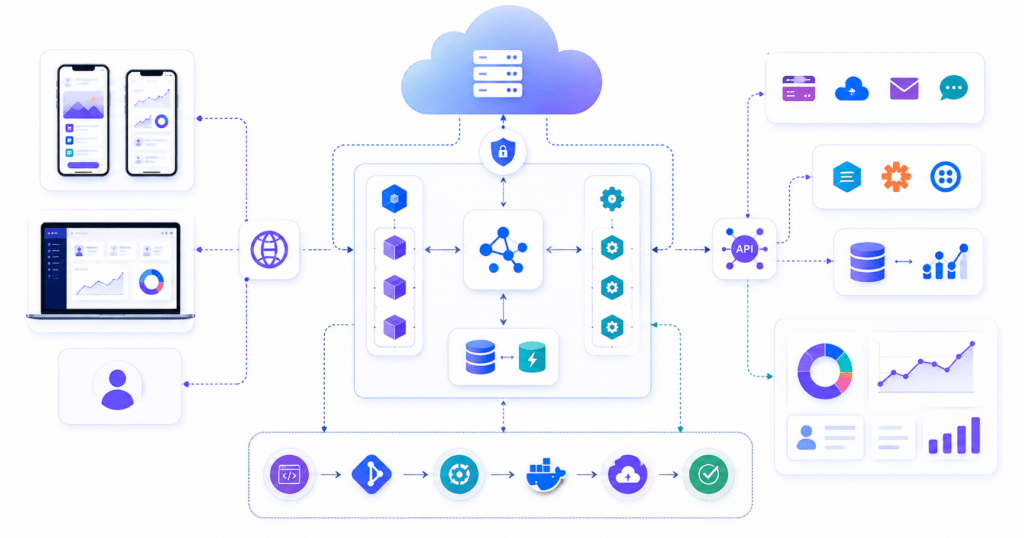
Choosing the right technology stack is one of the most important decisions in MVP development. For an 8-week launch, teams should prioritize technologies that enable rapid development, easy integrations, and future scalability.
A good MVP stack should support:
- Fast development so the product can launch within weeks, not months.
- Easy maintenance so the team is not buried in technical debt after launch.
- Simple integrations for payments, auth, messaging, and analytics.
- Future scalability so the product can grow once validation is complete.
- Reliable performance without forcing the team into over-engineered infrastructure.
Recommended Stack Approach
For most MVPs, a practical stack usually looks like this:
- Frontend: React Native or Flutter for faster cross-platform delivery
- Backend: Node.js or Python for flexibility and speed
- Authentication: Clerk, Auth0, or Supabase Auth
- Payments: Stripe
- Messaging and notifications: Resend, SendGrid, or Twilio
- Database: PostgreSQL or MongoDB
- Hosting: AWS, Google Cloud, or Vercel
- Analytics: PostHog or Mixpanel
- Error monitoring: Sentry
This approach helps teams avoid custom-building things that already exist and work well. Instead of spending weeks on authentication, billing, or deployment setup, the team can focus on the features that prove the product’s value.
Why This Matters
A modern MVP stack should reduce friction, not create it. If the architecture is too complex, the launch will slow down and the team will lose momentum. If the stack is too rigid, future changes become expensive.
The best stack for an MVP is the one that helps the team ship quickly, test the market, and improve the product based on real user feedback.
Security Considerations for MVP Development
One of the biggest mistakes startups make is treating security as a post-launch concern. While an MVP is designed to validate ideas quickly, ignoring basic security practices during development can create costly problems later. Retrofitting security controls after launch often increases development costs, delays future releases, and can damage customer trust.
The goal of an MVP is not to implement enterprise-grade security from day one, but to establish a secure foundation that can scale as the product grows.
When building an MVP, teams should prioritize a few essential security measures from the very beginning:
- Implement secure authentication and authorization using trusted solutions such as Auth0, Clerk, or Supabase Auth.
- Protect user data by encrypting sensitive information both in transit and at rest.
- Enforce role-based access control (RBAC) to ensure users can access only the features and information relevant to their roles.
- Maintain activity and audit logs to track important user actions and simplify troubleshooting.
- Choose secure cloud infrastructure providers such as AWS, Google Cloud, or Azure that offer built-in security and monitoring capabilities.
Integrating these practices early helps startups maintain customer trust and scale confidently.
For startups operating in regulated industries such as healthcare, fintech, or insurance, additional compliance requirements should be considered early in the planning phase to prevent delays during future growth and enterprise onboarding.
The Build-Measure-Learn Loop
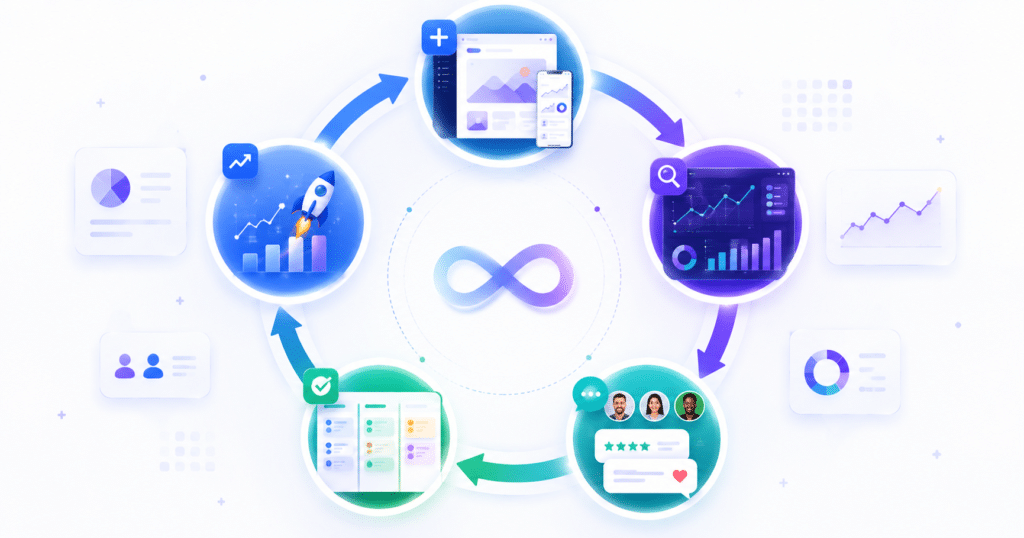
Once the MVP app is deployed, the product journey transitions into the iterative validation phase. Technical teams must avoid the trap of immediately writing new features based on internal assumptions. Instead, the post-launch roadmap must be driven entirely by user interaction data, feedback loop metrics, and structural stability indicators.
- Analyze Real-World Drop-Off Points: Use tracking tools to identify where users drop out of the primary conversion funnel. High abandonment rates during onboarding highlight usability friction that must be addressed immediately.
- Conduct Direct User Validation: Maintain direct communication with early adopters to understand their challenges and identify which aspects of the application deliver the most value.
- Prioritize the Engineering Backlog: Use the post-launch feedback to re-evaluate the backlog of Should-Have and Could-Have features. High-yield requests that directly improve user retention or willingness to pay must be prioritized over aesthetic enhancements.
- Manage and Resolve Technical Debt: Address any minor architectural shortcuts taken to meet the 8-week launch timeline. Optimizing database query performance, refining error handling, and securing API endpoints are vital to preparing the application for broader market scaling.
How Vedhas Helped Launch a Scalable Digital Wealth Management Platform
A structured MVP approach is not just a theoretical framework—it is the process Vedhas Technology Solutions uses to help startups and growing businesses launch digital products faster while minimizing development risk.
Case Study: Gfolio
Gfolio is a digital gold and silver wealth platform focused on simple investing, gifting, and SIP-style savings. Its product experience includes buying gold and silver, gifting digital gold instantly, tracking live prices, and monitoring a portfolio dashboard. Vedhas Technology Solutions can use Gfolio as an example of how a focused MVP can combine a clear core offer with a clean, trust-driven user journey.
Results Achieved
- Accelerated the launch of a user-friendly digital wealth platform.
- Enabled seamless digital gold and silver investment experiences.
- Enhanced user engagement through SIP-based savings and gifting capabilities.
- Created a scalable product foundation for future growth and feature expansion.
This project demonstrates an important principle of successful MVP development: startups do not need to launch with every planned feature. By partnering with an experienced MVP development team such as Vedhas Technology Solutions, businesses can prioritize essential functionality, assess market demand quickly, and build a strong foundation for long-term growth.
Mitigating Risk Through Agile Execution
Delivering an MVP app development in 8 weeks is not about cutting corners or deploying half-baked prototypes. It is about applying strict scope discipline, utilizing modern, high-velocity technology stacks, and partnering with an engineering team that understands how to build compliant, secure, and performant systems from the very first deploy.
By executing a structured, parallel-path development process, startups can validate their business assumptions in the real market, preserve valuable capital runway, and build an investor-ready technology foundation designed to support long-term enterprise growth.
Ready to Launch Your MVP in 8 Weeks?
Vedhas Technology Solutions helps founders and decision-makers turn ideas into testable products with a clear, structured launch plan. If you are planning an MVP and want the right mix of speed, scope, and scalability, Vedhas can help you shape the roadmap. Learn how modern engineering practices can reduce infrastructure costs.
to discuss your product idea, feature priorities, and launch timeline.
Frequently Asked Questions
How much does it cost to develop an MVP app?
The cost of MVP app development depends on factors such as feature complexity, platform requirements, third-party integrations, and the development team’s location and expertise. Defining a clear scope early helps keep costs under control.
Should I build my MVP in-house or outsource development?
The right approach depends on your internal capabilities, timeline, and budget. Many startups outsource MVP development to accelerate launch, access specialized expertise, and avoid the cost of hiring a full in-house team.
What happens after an MVP is launched?
After launch, teams should analyze user behavior, gather customer feedback, prioritize new features, and continuously improve the product based on real market insights.
How do I know if my MVP is successful?
An MVP is considered successful if it validates key business assumptions and demonstrates measurable user engagement, customer interest, or willingness to pay.
Can AI tools speed up MVP app development?
Yes. AI-assisted development tools can accelerate coding, testing, documentation, and prototyping. However, human oversight remains essential to ensure quality, security, and scalability.
What should founders prepare before starting MVP development?
Founders should clearly define the problem they want to solve, identify their target audience, outline core features, and establish measurable success criteria before development begins.