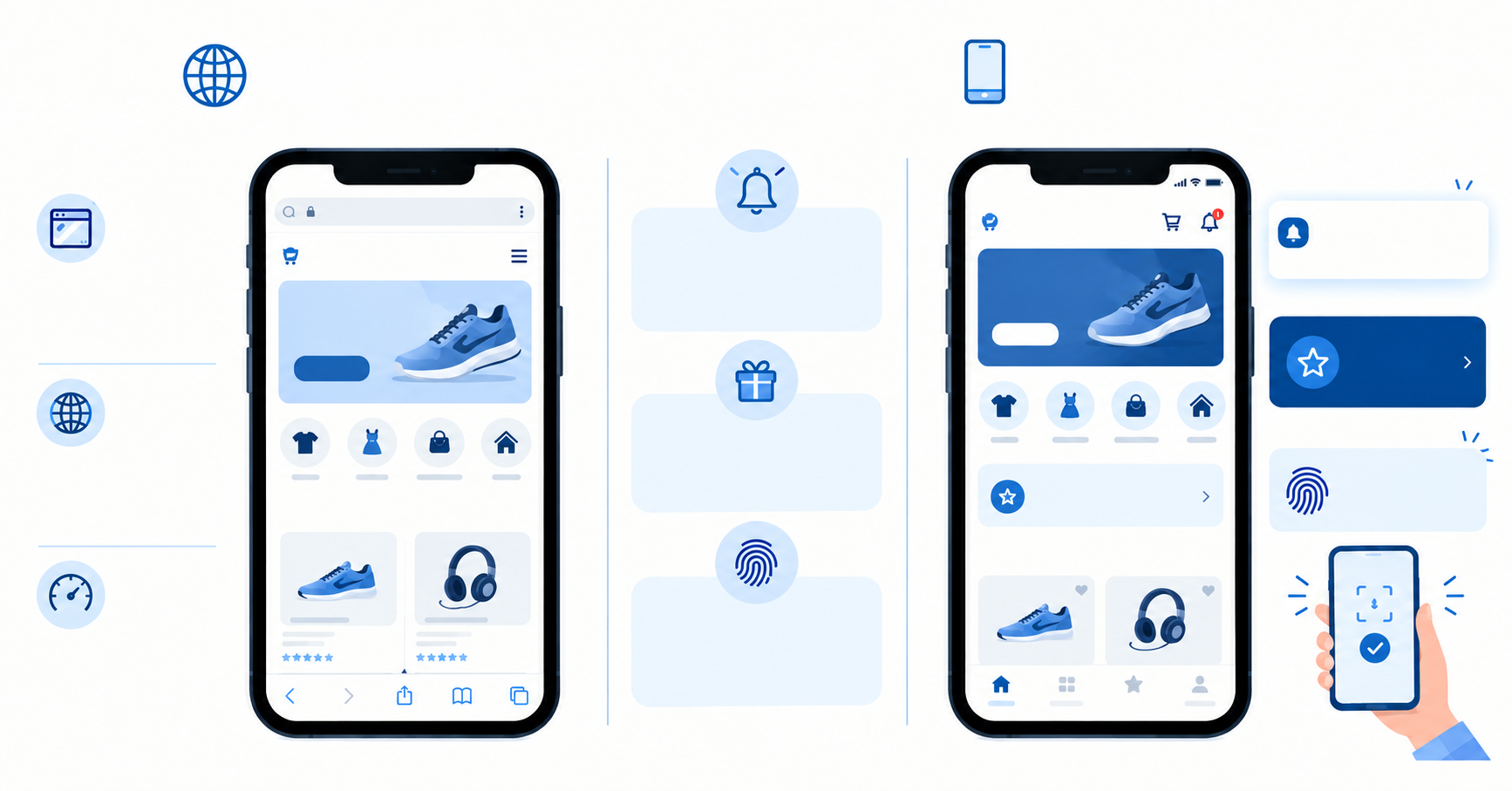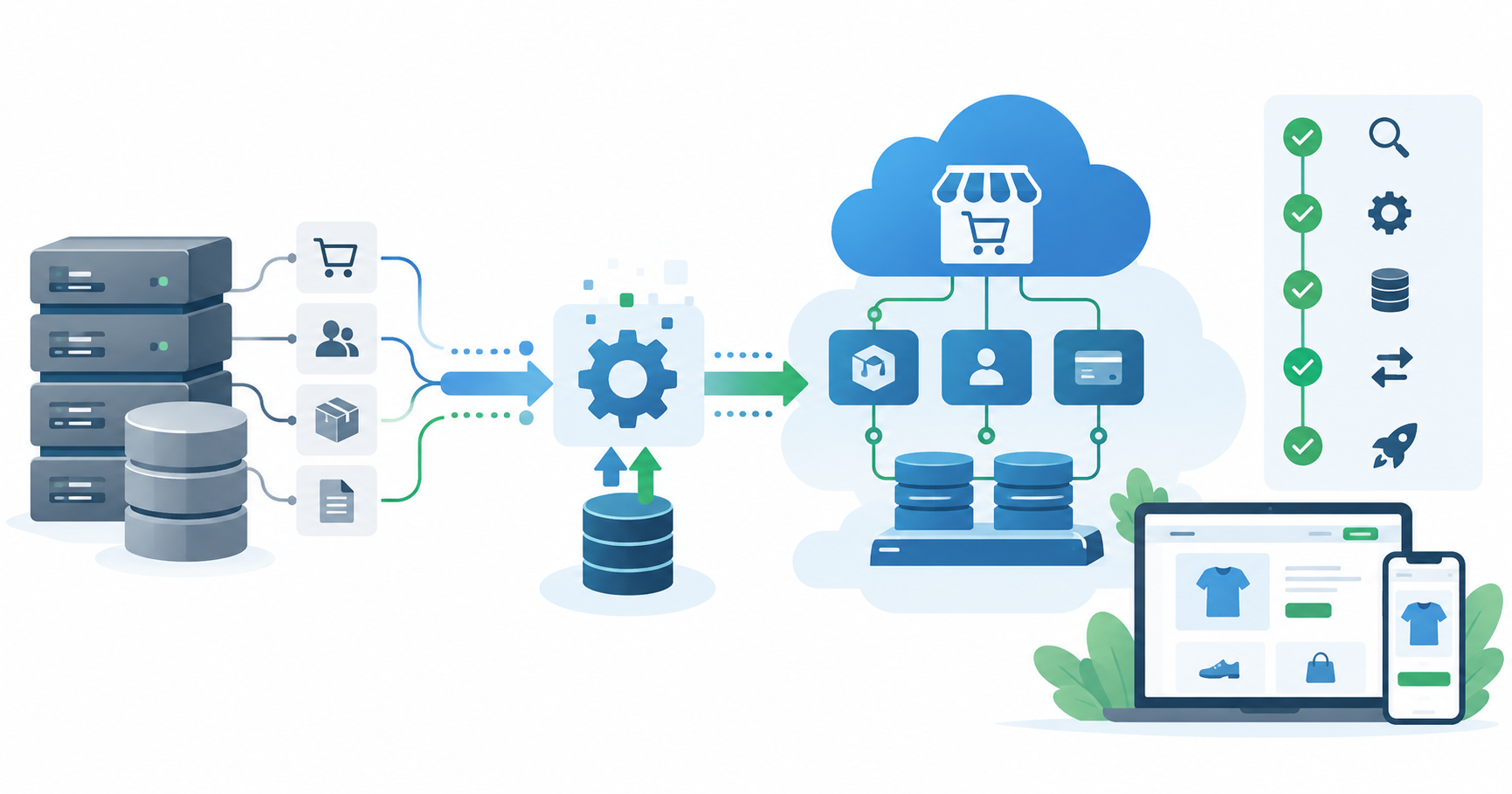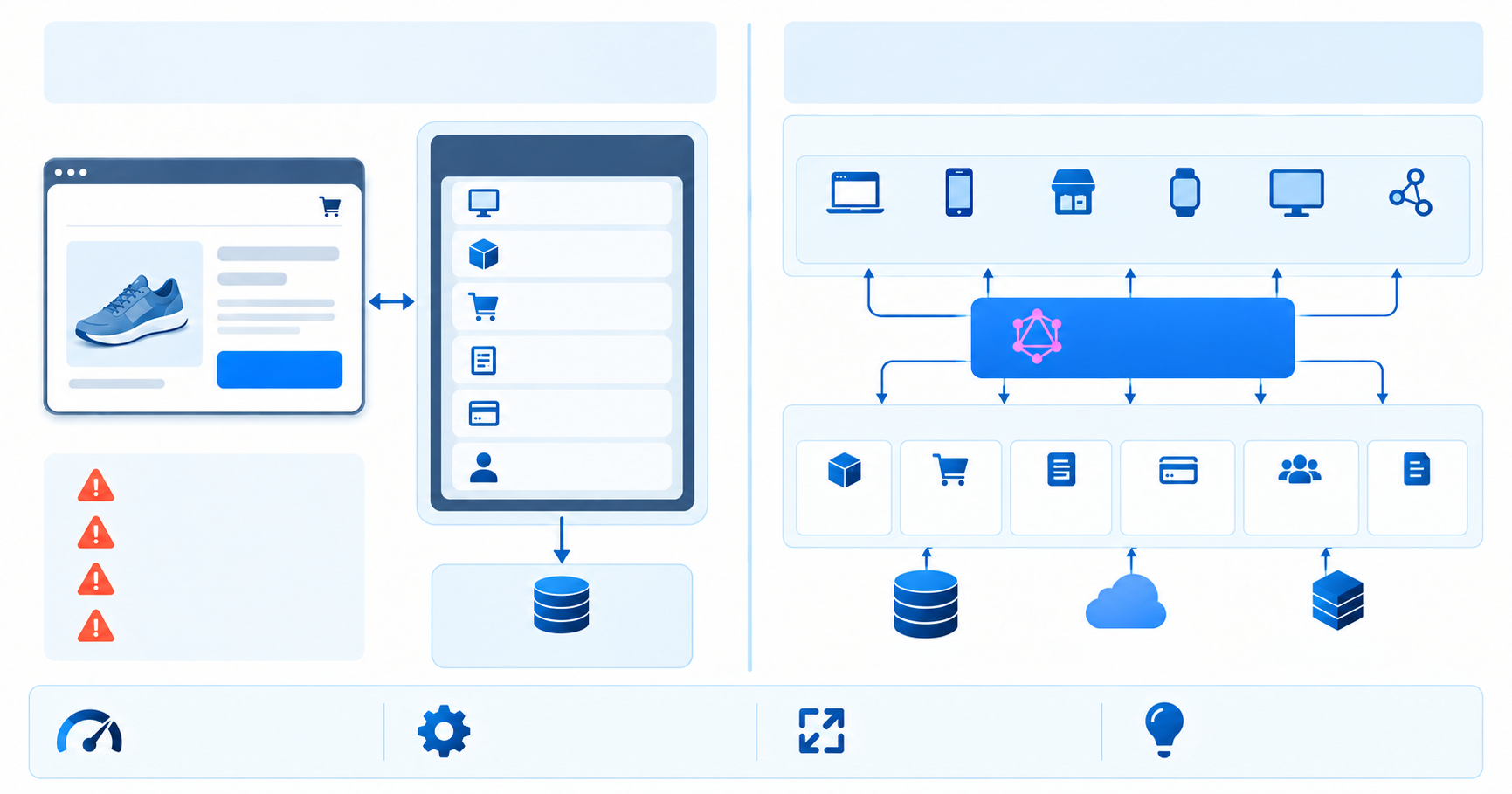
Key Takeaways
- Direct Verdict: For standard business applications, cross-platform frameworks (Flutter or React Native) save 30% to 40% in upfront development budgets and 25% to 35% in annual maintenance compared to dual native builds. Native development saves money only when an app depends on low-level hardware integration, AR/VR spatial computing, or custom 3D graphics engines.
- Time-to-Market Advantages: Cross-platform teams ship Minimum Viable Products (MVPs) in 14 to 20 weeks; dual-team native projects average 24 to 36 weeks — a 40% faster release cycle.
- Outsourcing & SOW Impact: Single-codebase architectures reduce vendor lock-in risk, simplify maintenance contracts, and cut QA regression cycles in half.
- Performance Realities: Modern cross-platform engines deliver smooth 60–120 FPS native user experiences for 95% of enterprise SaaS, e-commerce, healthcare, and workflow applications.
When evaluating cross platform vs native app development cost, the direct verdict is clear: for most business applications, cross-platform development (using Flutter or React Native) saves 30% to 40% in initial development budgets and 25% to 35% in annual maintenance compared to dual native builds (Swift for iOS and Kotlin for Android). Native development saves money only when the app requires deep low-level hardware access, AR/VR spatial computing, or high-performance 3D graphics integration. In this guide, we break down arithmetically consistent total cost of ownership (TCO), regional pricing by delivery model, vendor evaluation criteria, and exact technical thresholds to help executives and technical outsourcing buyers make an informed mobile stack decision.
Cross Platform vs Native Development at a Glance
The summary table below provides an executive-level comparison of cross-platform frameworks against dual native engineering tracks across cost, timeline, and key operational metrics. All cost figures are derived from the billable-hour model detailed in the next section, with final ranges rounded to the nearest $5,000. These are illustrative modeling ranges — not fixed quotes. Actual vendor pricing varies by project complexity, team seniority, and contract structure.
| Decision Metric | Cross-Platform (Flutter / React Native) | Native (iOS Swift + Android Kotlin) | Executive Verdict |
|---|---|---|---|
| Upfront MVP Cost — US Onshore | 60,000–105,000 | 120,000–180,000 | Cross-Platform (30%–40% initial savings) |
| Upfront MVP Cost — Hybrid Delivery | 30,000–65,000 | 60,000–110,000 | Cross-Platform (Balanced cost & oversight) |
| Upfront MVP Cost — Offshore Team | 15,000–40,000 | 30,000–70,000 | Cross-Platform (Max capital efficiency) |
| Average Time-to-Market | 14–20 Weeks | 24–36 Weeks | Cross-Platform (~40% faster) |
| Annual Maintenance Overhead | 15%–20% of initial dev cost | 25%–30% of initial dev cost | Cross-Platform (Single-repo updates) |
| Code Reusability | 85%–95% shared codebase | 0% (independent Swift/Kotlin repos) | Cross-Platform (Synchronized feature parity) |
| End-User UX & Performance | 60–120 FPS (smooth for 95% of apps) | 120 FPS (full hardware access) | Tie (Indistinguishable for business apps) |
| Deep Hardware & AR/VR Access | Requires custom native bridge plugins | Direct access to native SDKs | Native (Essential for BLE, IoT, DSP) |
Analyzing Cross Platform vs Native App Development Cost
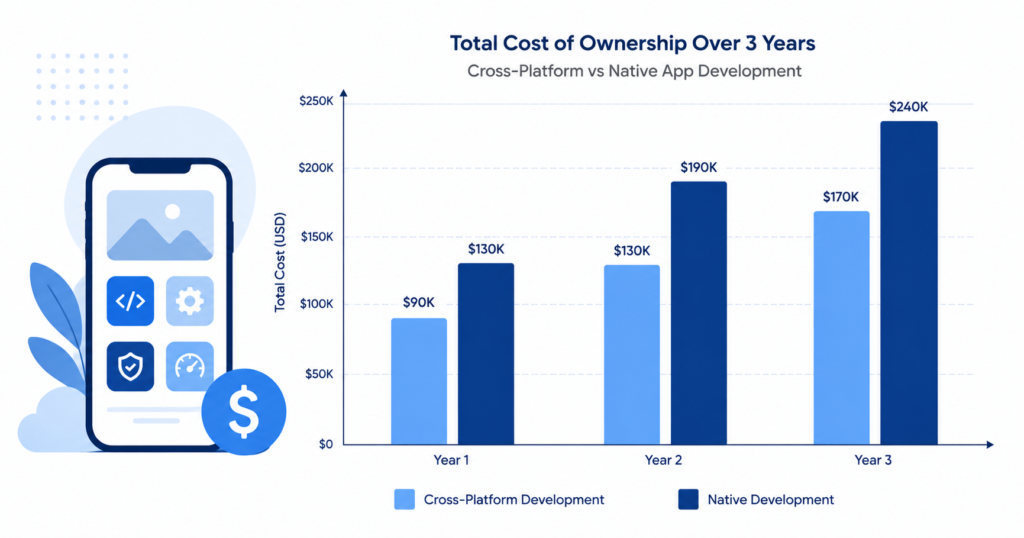
To understand why cross-platform development delivers consistent financial savings, decision-makers must look beyond individual hourly rates and evaluate total billable-hour consumption across the full development lifecycle — architecture, UI engineering, integrations, QA, and deployment.
1. Why Native Development Costs More: The Dual-Track Model
Choosing native development requires funding two parallel engineering efforts rather than one. An iOS application requires engineers specializing in Swift, SwiftUI, and Xcode; the Android application requires a separate team in Kotlin, Jetpack Compose, and Android Studio. These two tracks cannot meaningfully share code, and the operational consequence is additive overhead throughout the entire project:
- Project Management: Separate backlogs, diverging sprint velocities, platform-specific bug queues, and asynchronous release coordination.
- UI/UX Execution: Two independent component systems to maintain — Apple Human Interface Guidelines for iOS, Google Material Design 3 for Android.
- Quality Assurance: Duplicate test plans, separate device matrices, and doubled regression cycles for every release.
Cross-platform frameworks collapse this into a single engineering track. Business logic, API integrations, state management, and navigation are written once and deployed to both platforms. Aggregated industry benchmarks consistently indicate this structural reduction in total effort lowers upfront development expenditure by 30% to 40% without compromising end-product quality.
2. Time-to-Market Acceleration and Speed-to-Revenue
Because cross-platform frameworks share 85% to 95% of business logic across iOS and Android, development timelines compress significantly compared to dual native builds:
- Cross-Platform MVP: A unified team can design, develop, QA, and launch to both app stores in 14 to 20 weeks.
- Dual Native MVP: The same feature scope requires 24 to 36 weeks, driven by asynchronous team progress, environment-specific bugs, and duplicate code review and sign-off cycles.
Launching 10 to 16 weeks earlier matters commercially — earlier market validation, earlier revenue, and earlier iteration cycles based on real user behavior. For guidance on structuring initial release budgets, consult our MVP Development Cost Guide 2026.
3. Regional Pricing Realities — Verified Cost Models
All cost figures in this article are derived from a single consistent methodology: billable hours × hourly rate = exact result, rounded to the nearest $5,000. The assumptions are stated explicitly so technical buyers can audit the arithmetic against real vendor proposals.
Billable-hour assumptions for a standard medium-complexity business MVP:
- Cross-platform (onshore / hybrid): 500–700 billable hours across design, development, integrations, QA, and deployment.
- Cross-platform (offshore): 600–900 hours — a 20% to 29% overhead buffer applied to the base range to reflect asynchronous communication, additional iteration loops, and documentation requirements.
- Native dual-track (onshore / hybrid): 1,000–1,200 billable hours — two teams with partially overlapping discovery and architecture phases.
- Native dual-track (offshore): 1,200–1,560 hours — the same 20% to 30% overhead applied to the native base range (1,000 × 1.20 = 1,200; 1,200 × 1.30 = 1,560).
Applying the arithmetic (all ranges rounded to the nearest $5,000):
US Onshore Agency (120–150/hr):
- Cross-Platform: 500 hrs × 120=60,000 → 700 hrs × 150=105,000 → 60,000–105,000
- Native Dual-Track: 1,000 hrs × 120=120,000 → 1,200 hrs × 150=180,000 → 120,000–180,000
Hybrid Delivery (60–90/hr — US scoping and PM, offshore engineering):
- Cross-Platform: 500 hrs × 60=30,000 → 700 hrs × 90=63,000 → 30,000–65,000
- Native Dual-Track: 1,000 hrs × 60=60,000 → 1,200 hrs × 90=108,000 → 60,000–110,000
Dedicated Offshore Team (25–45/hr):
- Cross-Platform: 600 hrs × 25=15,000 → 900 hrs × 45=40,500 → 15,000–40,000
- Native Dual-Track: 1,200 hrs × 25=30,000 → 1,560 hrs × 45=70,200 → 30,000–70,000
These ranges are consistent across the overview table, this section, and the FAQ. All figures represent illustrative modeling assumptions for a standard business MVP — your actual vendor quote will vary based on feature complexity, team seniority, and contract terms. For a comprehensive view of how developer rates affect broader project scoping, explore our main guide on Mobile App Development Cost.
Long-Term Maintenance ROI and SOW Economics
Industry research consistently shows initial development accounts for only 20% to 35% of a software product’s total lifetime cost — maintenance makes up the rest, with some studies putting it as high as 70% to 90% of total cost of ownership for complex, actively maintained applications. Over a 3- to 5-year operational lifecycle, ongoing maintenance — OS version upgrades, security patches, third-party SDK updates, and feature additions — constitutes the majority of spending.
1. Single-Repository Maintenance Efficiency
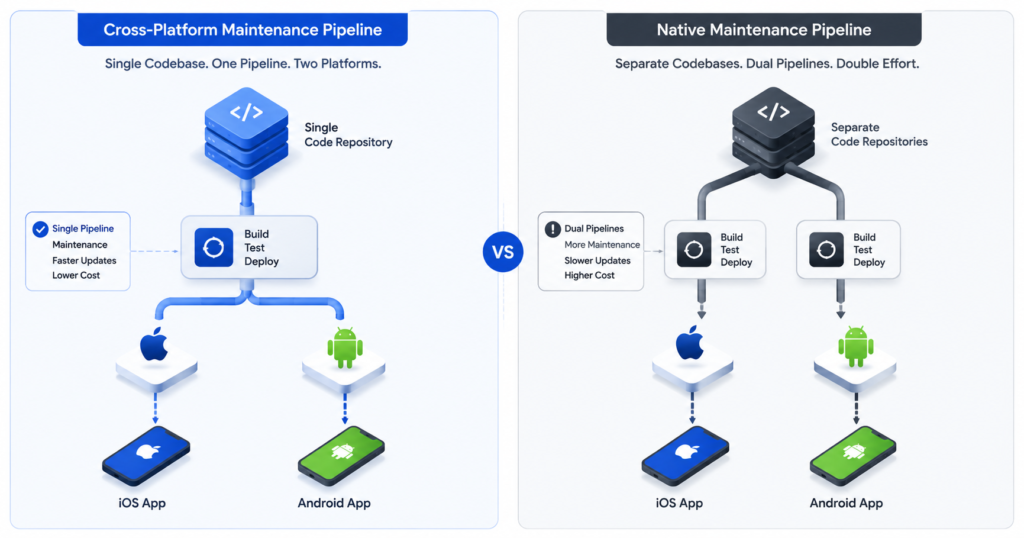
Every OS update, SDK change, or feature release in a native dual-track project requires two separate engineering responses — one for the Swift codebase, one for the Kotlin codebase. Cross-platform development eliminates this duplication:
- Unified Bug Fixes: Resolving a business logic error in the shared Flutter (Dart) or React Native (TypeScript) layer automatically closes the issue on both iOS and Android.
- Synchronized Releases: Feature updates ship simultaneously to the Apple App Store and Google Play, eliminating platform “feature lag” where one OS audience waits weeks or months for parity.
- Streamlined QA Regression: Automated regression suites target a single shared codebase, cutting continuous integration and deployment (CI/CD) costs significantly each release cycle.
Native software maintenance averages 25% to 30% of initial development costs annually. Cross-platform maintenance drops to 15% to 20% of initial costs per year — a compounding savings advantage that grows larger each year the product remains in operation.
2. Statement of Work (SOW) and SLA Implications for Buyers
Framework selection directly shapes contractual terms for outsourced mobile development:
- Lower Retainer Thresholds: Cross-platform maintenance retainers require fewer dedicated developer hours per month because one engineer resolves issues and ships updates across both platforms simultaneously.
- Reduced Vendor Lock-In: A cross-platform codebase in Flutter (Dart) or React Native (TypeScript) is significantly easier to transition to a new vendor or bring in-house than two specialized native codebases requiring simultaneous Swift and Kotlin expertise.
- Simpler SLA Structures: SLA response commitments for critical bug fixes are more straightforward to meet and audit in a single-repo environment versus two environment-specific codebases requiring parallel diagnosis.
Organizations looking to scale mobile engineering capacity without doubling headcount can hire a Flutter developer or hire a React developer to join an existing team without funding two separate native roles.
Technical Outsourcing Buyer’s Guide: Evaluating Vendors and Stack Risks
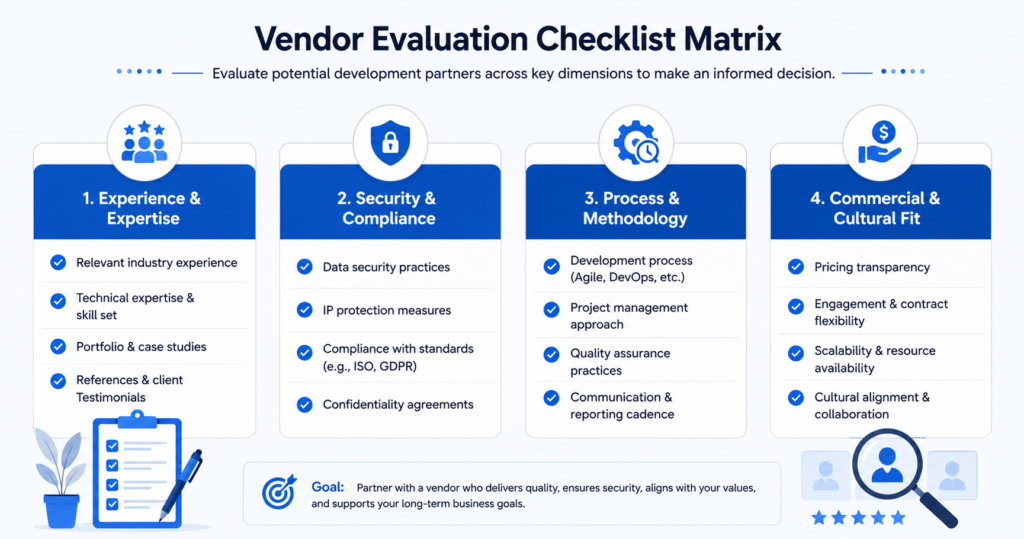
For engineering managers, product owners, and procurement leaders, choosing a mobile development partner requires evaluating technical execution risks alongside financial proposals. Cross-platform development offers strong cost advantages, but vendor quality variation is real.
1. Four Questions to Ask Vendors Before Signing
Before executing a Statement of Work for a mobile application project, require prospective vendors to address these operational questions explicitly:
Q1: “How do you manage third-party plugin dependencies?” Red flag: Vendors relying on obscure, unmaintained community packages for core capabilities (authentication, payments, file storage) create security risks and upgrade friction. Good answer: The vendor uses officially maintained, enterprise-backed packages (such as Flutter’s core ecosystem or React Native’s community-maintained libraries) and writes custom native bridge code for anything proprietary rather than patching on unmaintained plugins.
Q2: “Does your team have native Swift and Kotlin capability?” Red flag: A pure cross-platform team with no ability to write native modules when OS-level customization is required. Good answer: Cross-platform specialists are backed by native iOS and Android engineers who can write custom native modules when the framework’s out-of-the-box bridge is insufficient.
Q3: “How is Intellectual Property (IP) transfer handled in the SOW?” Buyer guidance: Look for an explicit IP assignment clause in the contract ensuring that all custom code, native bridge modules, configuration scripts, and application logic are fully transferred to your company upon final payment. Some agencies retain rights to reusable internal component libraries by default — this is worth negotiating explicitly rather than assuming transfer is automatic.
Q4: “How do you handle OS-specific UI compliance?” Good answer: The vendor applies platform-appropriate navigation patterns — Cupertino-style navigation for iOS, Material Design 3 for Android — to ensure each platform feels native to its users rather than visually identical regardless of OS conventions.
2. Code Quality and QA Standards to Require
A common risk in outsourced mobile development is receiving a working app built on disorganized, non-modular code that accumulates technical debt within months. Require your vendor to demonstrate:
- Clean Architecture Principles: Business logic decoupled from UI views — using BLoC or Provider in Flutter, Redux or Zustand in React Native — making future feature additions and handoffs tractable.
- Automated QA Coverage: Unit, integration, and UI regression suites that run on every pull request. Engaging dedicated quality assurance services during development prevents post-launch app store rejections and negative user reviews at launch.
Performance Realities and Real-World Enterprise Case Studies
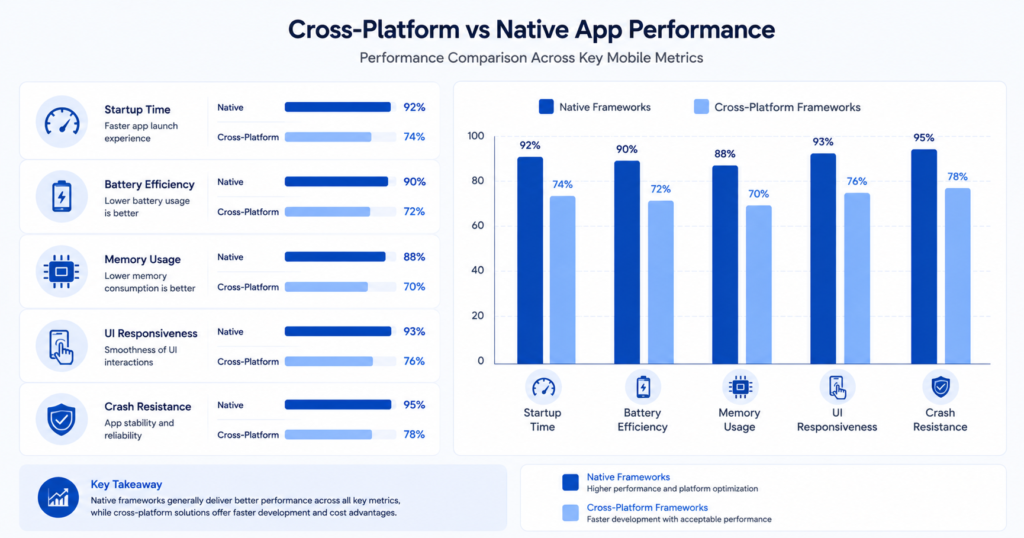
A common concern for evaluating executives is whether cross-platform applications feel slower than native software to end users. While early hybrid web-wrapper tools (Cordova, PhoneGap) did suffer from sluggish DOM-rendered interfaces, modern cross-platform frameworks are architecturally different — and the performance gap for standard business applications has effectively closed.
1. Will Your Users Notice a Difference?
For 95% of commercial business applications, the answer is no.
Modern cross-platform frameworks render graphics directly via the device GPU or draw platform-native host controls with synchronous, non-bridged communication. The rendering latency that characterized older hybrid tools does not exist in Flutter or React Native’s current architectures. For enterprise portals, e-commerce storefronts, booking platforms, healthcare applications, and workflow tools, end users cannot distinguish the experience from a natively built equivalent.
The cases where performance remains a native-only concern — heavy 3D rendering, real-time audio signal processing, or sub-millisecond hardware communication — are covered in the section below.
2. Verified Enterprise Case Studies
Major global organizations use cross-platform frameworks at scale, validating their production-readiness:
- Google Pay: Rebuilt its flagship payments application using Flutter. According to Google’s published engineering case study, the refactored codebase shrank from approximately 1.7 million lines of code to 1.1 million lines, while Google’s team estimated 60% to 70% savings in cross-platform engineering labor on an ongoing maintenance basis.
- Shopify: Converted its main merchant mobile application to React Native, reporting substantial cross-platform code sharing between iOS and Android builds while maintaining responsive UI performance across thousands of device configurations.
- Instagram (Meta): Integrated React Native into its existing native application core, enabling product teams to ship features across platforms faster with minimal impact on interface responsiveness.
For a detailed technical comparison of these two frameworks, read our analysis of Flutter vs React Native.
When Native Development Is Truly Required
Cross-platform frameworks provide compelling financial advantages for the large majority of commercial applications. But recommending cross-platform unconditionally is a strategic mistake — there are specific technical scenarios where native development is necessary, and choosing the wrong stack for those use cases leads to expensive architectural rewrites.
Native development (Swift for iOS, Kotlin for Android) is justified under these conditions:
- Low-Latency Hardware & IoT Integration: Applications communicating with custom hardware via Bluetooth Low Energy (BLE), specialized USB peripheral protocols, NFC chip manipulation, or continuous background sensor sampling — for example, medical monitoring devices or industrial IoT equipment. Cross-platform bridge plugins exist for common BLE use cases but erode cost savings when the integration is complex or proprietary.
- High-End 3D Graphics, Gaming & AR/VR: Applications requiring real-time 3D rendering, spatial computing, augmented reality (Apple ARKit / Google ARCore), or immersive experiences that leverage Apple visionOS. These require direct GPU API access that cross-platform engines do not expose.
- Deep OS System Extensions: Applications customizing OS-level behavior — background audio digital signal processing (DSP), custom VPN protocol drivers, or system-wide security extensions — that require unrestricted access to platform APIs on day one of each new iOS/Android release.
If your application does not fit these categories, choosing native development over cross-platform increases initial budgets and ongoing maintenance costs without delivering any user-facing benefit.
Common Pitfalls in Mobile Budgeting and Stack Selection
- Over-Engineering Simple Business Apps Natively: Assuming “enterprise-grade” requires native development is a costly misconception. Building standard CRUD applications, customer portals, or e-commerce storefronts natively doubles both initial development spend and annual maintenance overhead without producing any user-perceptible performance gain. This is one of the more common and avoidable sources of mobile budget overrun.
- Ignoring Plugin Dependency Health in Cross-Platform Projects: Relying on obscure, unmaintained open-source plugins for core capabilities — payments, authentication, file access — creates security vulnerabilities and painful upgrade cycles with every major OS release. Evaluate plugin maintenance status, community adoption, and sponsorship before building production dependencies on community packages.
- Confusing Web-Wrapper Hybrids with Compiled Cross-Platform Frameworks: Older hybrid tools (Cordova, Ionic, PhoneGap) wrap HTML and JavaScript inside an embedded browser, producing the sluggish rendering performance that many decision-makers associate with “cross-platform.” Flutter and React Native compile to native ARM instructions and render via platform-native graphics layers — a fundamentally different architecture with fundamentally different performance characteristics.
Frequently Asked Questions (FAQ)
How much money can cross-platform app development save compared to native?
Cross-platform app development saves 30% to 40% on initial development costs and 25% to 35% on annual maintenance compared to dual native builds. By sharing 85% to 95% of business logic across iOS and Android in a single codebase, companies eliminate duplicate engineering, QA, and maintenance overhead.
Does cross-platform development compromise mobile app performance?
No — for standard business, e-commerce, SaaS, and healthcare applications, modern cross-platform frameworks deliver 60–120 FPS rendering indistinguishable from native software. Performance remains a native-only concern for specific use cases: low-latency hardware integration, AR/VR, and high-end 3D graphics.
Is Flutter cheaper to develop than React Native?
Development costs for Flutter and React Native are generally comparable. Both achieve 85% to 95% code sharing across iOS and Android. Cost differences depend on developer hourly rates, team expertise, and ecosystem match rather than framework licensing — Flutter often offers faster UI assembly thanks to its built-in widget library, while React Native allows existing JavaScript teams to transition rapidly.
How much faster can a cross-platform app launch compared to native?
Cross-platform apps launch approximately 40% faster. A medium-complexity MVP built with Flutter or React Native typically reaches the App Store and Google Play in 14 to 20 weeks, while the equivalent dual native build requires 24 to 36 weeks due to parallel team coordination, environment-specific debugging, and duplicate release processes.
When should a company choose native development over cross-platform?
Choose native (Swift/Kotlin) when your application requires: low-latency hardware communication (BLE, custom IoT sensors), heavy 3D graphics or AR/VR spatial computing, real-time audio/video digital signal processing, or deep OS-level system extensions. For all other commercial application types, cross-platform delivers equivalent user experience at substantially lower cost.
How do regional delivery models affect mobile app development budgets?
Using the billable-hour model detailed in this guide — 500–700 hours for a cross-platform MVP and 1,000–1,200 hours for dual native (onshore/hybrid), with a 20–30% hour overhead applied for offshore — the cost ranges by delivery tier are: US onshore (120–150/hr): 60,000–105,000 cross-platform vs. 120,000–180,000 native. Hybrid (60–90/hr): 30,000–65,000 vs. 60,000–110,000. Offshore (25–45/hr): 15,000–40,000 cross-platform vs. 30,000–70,000 native. All figures are illustrative modeling ranges rounded to the nearest $5,000 — actual quotes vary by complexity and team seniority.
How does cross-platform development affect long-term maintenance contracts?
Cross-platform development simplifies outsourced maintenance SOWs by centralizing bug fixes, OS updates, and feature additions in a single repository. Monthly retainer hours are lower because one engineer resolves issues across both platforms simultaneously. Vendor lock-in risk is also reduced — a Flutter or React Native codebase is easier to transition than two specialized native repositories requiring simultaneous Swift and Kotlin expertise.
Making the Right Mobile Development Investment
When evaluating cross platform vs native app development cost, the financial evidence is consistent: for the vast majority of commercial applications, cross-platform development delivers maximum return on investment. Initial budgets are 30% to 40% lower, time-to-market is 40% faster, and annual maintenance overhead is 25% to 35% less — all without compromising the end-user experience that business applications require.
Native development remains the right answer for hardware-intensive, AR/VR, and high-end graphics applications. For everything else — enterprise workflow tools, SaaS platforms, e-commerce, healthcare portals, booking systems — cross-platform development is the more capital-efficient path by a meaningful margin.
At TechVedhas, we partner with startups, growing mid-market companies, and global enterprises to design, build, and scale high-impact mobile solutions. Whether you need full-cycle development or targeted team scaling, we deliver transparent, production-ready engineering.
- Ready to scope your mobile development budget? Get a Project Estimate today.
- Looking to expand your engineering capacity? Hire a Flutter Developer or Hire a React Developer.
- Explore our end-to-end capabilities on our mobile app development services page.