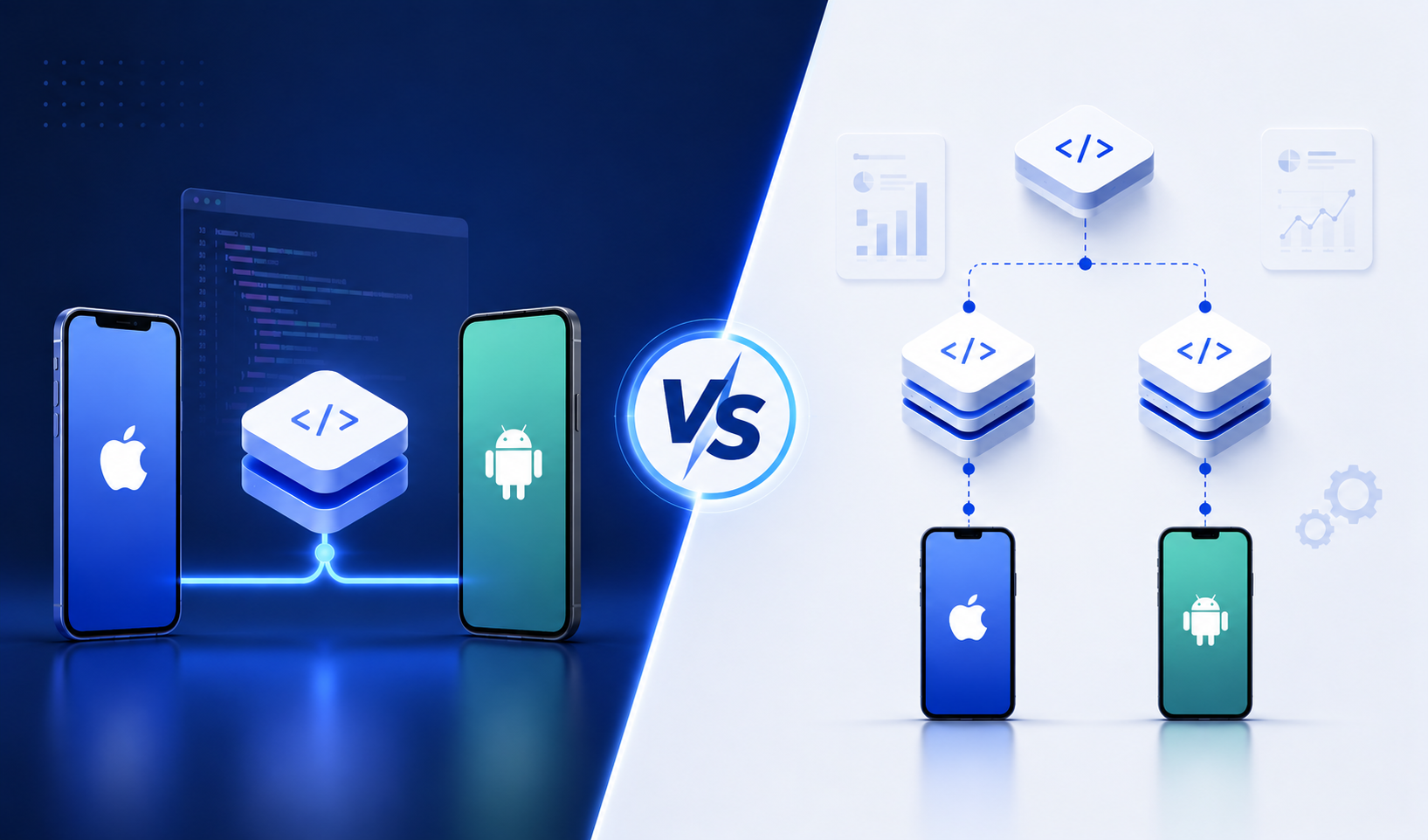
Choosing the right mobile framework in 2026 is a strategic decision. Businesses face high stakes: selecting the wrong technology stack can lead to bloated costs, missed deadlines, and an inflexible product. Cross-platform development has become a mainstream mobile strategy. Flutter and React Native are both mature, officially supported frameworks, so the real decision now comes down to cost, performance, scalability, hiring, and maintainability. The debate between Flutter and React Native remains central for CTOs and founders. For organizations evaluating Flutter vs React Native in 2026, the decision extends beyond development frameworks and into long-term business strategy. This guide compares both frameworks on critical factors – cost, performance, scalability, hiring, security, and ROI – to help you make an informed decision aligned with your business goals.
If you’re comparing Flutter vs React Native in 2026, the following recommendations can help narrow the decision quickly.
Quick Takeaways for Decision-Makers
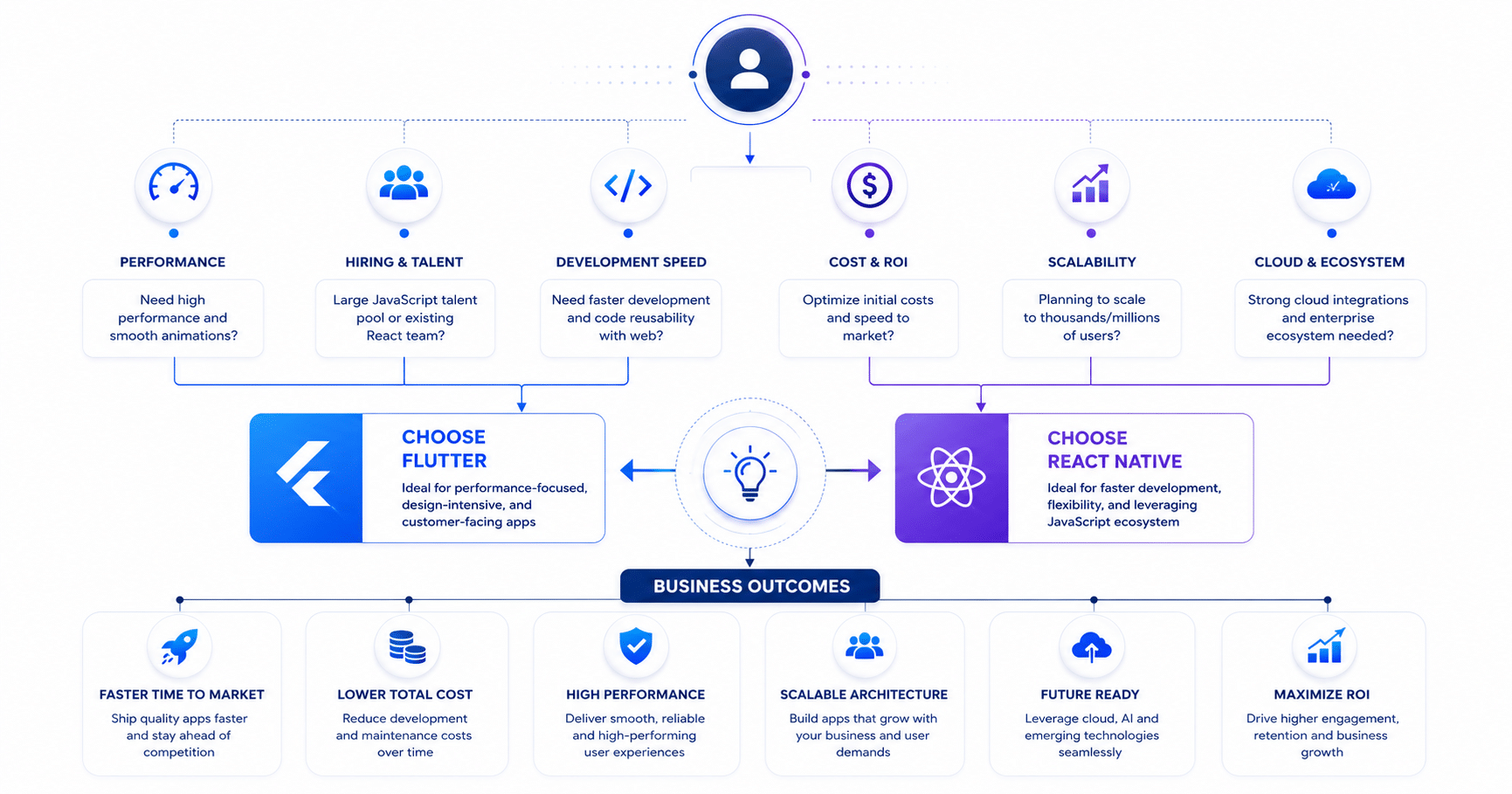
- Choose React Native if you already have a React/JavaScript team and need faster hiring, quicker development, or web-to-mobile code reuse. It’s ideal for business applications, dashboards, and internal enterprise tools.
- Choose Flutter if performance, design consistency, and user experience are top priorities. It works particularly well for fintech, e-commerce, media, and customer-facing applications with complex UI requirements.
- Cost & ROI: React Native often reduces initial development costs due to the larger JavaScript talent pool and faster onboarding. Flutter may require a higher upfront investment but can lower long-term maintenance costs through a unified codebase and stable ecosystem.
- Scalability & Maintenance: Both frameworks are enterprise-ready. React Native’s modern architecture improves performance and native integration, while Flutter delivers consistent performance and easier cross-platform maintenance. Success ultimately depends on sound architecture and engineering practices.
- Platform Reach: Flutter supports mobile, web, desktop, and embedded devices from a single codebase. React Native offers strong mobile capabilities and extends to web and desktop through the React ecosystem. Both are backed by mature communities and proven enterprise adoption.
- Security & Compliance: Flutter and React Native can both meet enterprise security and compliance requirements, including HIPAA and GDPR, when implemented using proper development and governance practices.
- Future Readiness: AI-assisted development, cloud-native architectures, modular design systems, and over-the-air updates are shaping the future of both ecosystems. With strong backing from Google and Meta, Flutter and React Native remain well-positioned for long-term innovation and enterprise adoption.
Why the Right Framework Matters in 2026
Choosing a mobile framework is a strategic business decision that directly impacts development speed, costs, scalability, and long-term product success. As user expectations and technology continue to evolve, organizations need a framework that can support both current goals and future growth.
Time-to-Market
React Native often enables faster project delivery due to the large availability of JavaScript developers. Organizations looking to accelerate product launches often leverage our Mobile App Development Services to reduce time-to-market while maintaining quality. Flutter may require initial Dart learning, but its shared codebase and developer tools help accelerate feature development.
For founders and product leaders, time-to-market is often one of the most important factors when selecting a mobile development framework.
Performance & User Experience
Flutter delivers excellent performance through native compilation and its Impeller rendering engine, ensuring smooth animations and consistent UI across platforms. Flutter’s UI philosophy is closely aligned with principles outlined in the Material Design system, helping teams create consistent and intuitive user experiences. React Native has significantly improved performance with Hermes and the new Fabric architecture while maintaining a more native platform experience.
Beyond performance benchmarks, organizations should also evaluate long-term user experience consistency and platform maintainability.
Maintainability & Technical Debt
Flutter’s unified codebase and tightly integrated ecosystem can reduce maintenance effort and technical debt over time. React Native offers greater flexibility but often requires closer management of third-party dependencies and framework updates. In enterprise environments, maintenance strategy often has a greater impact on ROI than initial development costs.
Scalability
Organizations comparing Flutter or React Native for scalable mobile apps will find that both frameworks can support enterprise-scale architectures and growing user bases when backed by experienced mobile app development teams. React Native excels in projects requiring deep native integrations and large development teams, while Flutter performs exceptionally well in graphics-intensive and customer-facing applications.
Ecosystem & Enterprise Adoption
Backed by Google and Meta respectively, Flutter and React Native both benefit from strong communities, extensive tooling, and proven enterprise adoption. Leading organizations across industries rely on these frameworks, making both reliable long-term technology investments. The growing adoption of both frameworks further strengthens the Flutter vs React Native in 2026 debate among enterprise technology leaders.
A deeper Flutter vs React Native in 2026 comparison requires evaluating cost, scalability, maintenance, and long-term ROI.
Strategic Analysis: Cost, Scalability, and Maintainability
When evaluating Flutter or React Native for enterprise app development, decision-makers must weigh scalability, security, hiring availability, and long-term maintenance costs. Understanding these trade-offs is essential for making the right investment.
The React Native vs Flutter for product development discussion often starts with upfront costs, but total ownership costs are equally important.
Cost and Total Ownership
Development Budget: React Native typically has lower initial development costs due to the large JavaScript talent pool and easier hiring. Flutter developers may command higher rates, increasing upfront investment. Beyond initial development costs, organizations should evaluate long-term business value, maintenance effort, and ROI.

Maintenance & TCO: Over time, Flutter often delivers lower total ownership costs. A single codebase simplifies updates and maintenance, while React Native may require additional effort to manage platform-specific components and native module upgrades.
ROI & Productivity: Both frameworks significantly reduce development effort compared to native apps. Organizations should evaluate ROI over multiple years rather than focusing solely on initial development and launch costs. Faster releases can accelerate revenue generation and market growth.
Hidden Costs: Advanced features such as AR, VR, or custom hardware integrations may require native development regardless of framework choice. Training, dependency management, and future upgrades should also be included in cost projections.
Performance and Scalability
Runtime Performance: Flutter offers excellent rendering performance through native compilation and the Impeller engine. React Native has narrowed the gap with Hermes and its bridge-less architecture, delivering substantial performance improvements for most business applications.
The choice between Flutter or React Native for scalable mobile apps often depends on whether performance consistency or ecosystem flexibility is the higher priority.
Scalable Architecture: Both frameworks support enterprise-scale architectures through modular design and reusable components. The right framework choice often depends on how an organization plans to scale teams, products, and infrastructure over time.
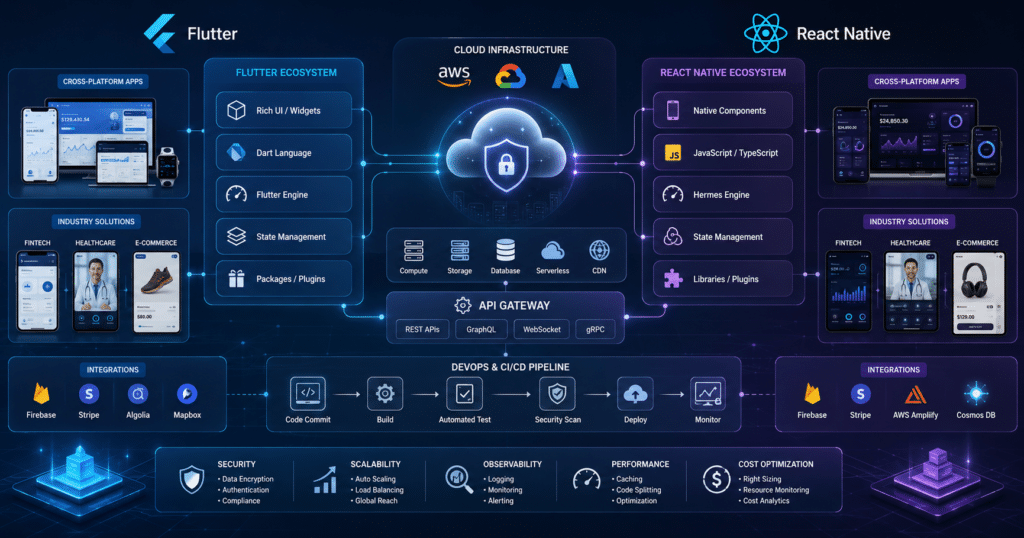
Hosting & CI/CD: Both frameworks integrate well with modern DevOps practices, automated testing, cloud builds, and over-the-air updates. From a DevOps perspective, both are strong options when considering Flutter vs React Native in 2026 for large-scale digital products.
Hiring, Team, and Talent Availability
Talent Pool: React Native benefits from the vast JavaScript ecosystem, making hiring easier in many markets. Flutter’s talent pool continues to grow but remains smaller in comparison.
Hiring availability can directly influence delivery timelines, team scalability, and overall project costs.
Onboarding: Teams with React experience can often adopt React Native faster. Flutter requires learning Dart but offers a streamlined and consistent development experience once teams are onboarded.
Productivity: Both frameworks provide modern tooling, hot reload, and strong developer experiences. Flutter can reduce platform-specific testing efforts, while React Native enables greater alignment with existing web teams. This is why framework evaluations should consider QA efficiency and maintenance effort alongside development speed.
Security, Compliance, and Technical Debt
Security: Both frameworks can meet enterprise security requirements when supported by proper coding standards, dependency management, and security testing.
Compliance: Flutter and React Native are both used in regulated industries such as healthcare, fintech, and banking. Organizations should evaluate encryption, authentication, and compliance capabilities based on their specific requirements.
Technical Debt: Long-term success depends on maintaining clean architecture, minimizing platform-specific complexity, and regularly modernizing applications to prevent accumulating technical debt.
Cloud & DevOps Readiness: Both frameworks work well with modern cloud-native environments, CI/CD pipelines, monitoring tools, and feature management platforms. Flutter teams commonly leverage services such as the Firebase platform, while React Native teams often integrate with platforms like AWS Amplify to accelerate cloud-native application development. Organizations should ensure their framework choice aligns with long-term cloud, modernization, and growth strategies.
For enterprise organizations, compliance requirements often influence framework selection as much as performance considerations.
To simplify the Flutter vs React Native in 2026 decision, the table below compares both frameworks across the factors that matter most to enterprise leaders.
Flutter or React Native for Enterprise App Development: Feature Comparison
| Aspect | Flutter (Google) | React Native (Meta/Facebook) |
|---|---|---|
| Language | Dart (statically typed) | JavaScript/TypeScript (popular) |
| Rendering | Skia/Impeller – custom GPU engine (consistent UI) | Native UI components (via new Fabric renderer) |
| Performance | High (AOT compiled); excellent animation/jank reduction | Good (Hermes and New Architecture improve startup performance, responsiveness, and native interoperability) |
| Ecosystem & Libraries | Growing (strong UI widget library, Firebase) | Very large (many npm packages, mature tools) |
| Platform Reach | iOS, Android, Web, Windows, macOS, Linux, Embedded | iOS, Android, (Web via React, Desktop via community like RNW) |
| Developer Tools | Rich IDE support (VSCode/Android Studio); DevTools (widget inspector) | Mature tooling (Flipper, Chrome/Edge debugger, Expo CLI) |
| Hot Reload/Push Updates | Hot reload on code changes; OTA via Shorebird/FlutterFire | Hot reload; OTA via CodePush/Expo |
| UI Consistency | Excellent (same UI on all platforms) | Variable (uses native widgets; may need extra libraries for parity) |
| Learning Curve | Moderate (Dart is easy for C/Java devs) | Lower for JS developers (largest global talent pool) |
| Integration with Web | Improving (Flutter Web in stable use) | Strong (can often reuse React code across web/mobile) |
| Enterprise Readiness | Trusted by Toyota, BMW, Alibaba, GM, etc | Proven in Facebook, Shopify, Uber, Walmart, etc. |
In short, Flutter excels when you need pixel-perfect design, complex animations, and a single-team strategy (one codebase for all targets). React Native shines when you leverage web expertise, need the largest hiring pool, or must integrate deeply with existing native stacks. It’s common for large orgs to use both: e.g. RN for internal tools and Flutter for customer-facing apps, balancing each framework’s strengths.
Common Pitfalls and Mistakes to Avoid
One of the most common mistakes in a React Native vs Flutter for product development evaluation is focusing solely on short-term development speed. Even experienced teams slip up. Many teams entering a Flutter vs React Native in 2026 evaluation focus heavily on technical features while overlooking business objectives. Here are mistakes that increase risk and cost:
- Ignoring Long-Term Strategy: Choosing a framework solely on hype or a short-term project need. Without aligning with your 3–5-year roadmap, you risk a costly platform migration later. Always evaluate technical debt implications at the start.
- Overestimating Cross-Code Reuse: Assuming 100% code reuse or identical behavior across platforms. In practice, differences in OS UX (navigation patterns, hardware quirks) still require some separate handling. Failing to plan for this can cause surprise delays.
- Neglecting Native Integrations: Both Flutter and RN allow native modules, but teams sometimes underestimate the effort to maintain them. A common mistake is not allocating resources for native plugin updates after OS upgrades, leading to stalled features.
- Skipping Performance Profiling Early: Not profiling UI/JS performance can let janky UI or memory issues slide until late. Use tools like Flutter DevTools or React Native Performance Monitor early and often.
- Inadequate QA on Real Devices: Testing only in emulators or single OS version misses real-world issues (e.g. Android fragmentation, iOS gesture differences). Plan for diverse device testing with real-device clouds.
- Neglecting Developer Training: Assuming developers can pick up the framework without ramp-up can lead to poor code quality. Invest in training on best practices (e.g., state management in Flutter, React Hooks in RN).
- Ignoring Security Best Practices: Mobile security is often overlooked. Ensure you enforce code signing, secure storage (Keychain/Keystore), and up-to-date cryptography libraries. Both frameworks allow deep vulnerabilities if mishandled (e.g. insecure web views).
- Choosing the Wrong Tool for the Task: For example, using cross-platform for very lightweight utilities where native UI is trivial, or using it for apps that need bleeding-edge platform features not exposed through plugins.
- Vendor Lock-In and Skill Drain: Over-relying on a single consulting firm or a few developers can create bottlenecks. Mitigate by spreading knowledge: have code reviews, pair programming, and documentation.
- Mismanaging OTA Updates: Code-pushing critical bug fixes bypassing app store review can backfire if not carefully controlled (especially under strict compliance rules). Use OTA judiciously.
Avoid these pitfalls by taking a balanced, well-planned approach: involve cross-functional stakeholders (dev, QA, security, product), and treat framework selection as part of a broader digital transformation strategy, not just a dev meeting agenda.
Best Practices for Choosing and Scaling the Right Mobile Framework
The most successful organizations treat mobile framework selection as a strategic business decision rather than a technical framework exercise. To maximize the value of your framework investment, follow these proven practices:
- Align Technology with Business Goals: Choose Flutter for UI consistency and lower long-term maintenance. Choose React Native if leveraging existing React expertise and accelerating delivery are top priorities.
- Validate Before You Commit: Build a pilot or MVP to evaluate performance, development speed, and team productivity before making a long-term decision.
- Prioritize Scalable Architecture: Implement modular, maintainable architectures from the start to simplify future growth, feature expansion, and team collaboration.
- Streamline Development Workflows: Adopt CI/CD pipelines, automated testing, code quality checks, and modern deployment tools to improve productivity and release reliability.
- Monitor and Optimize Performance: Use tools like Firebase Crashlytics or Sentry to identify performance issues, crashes, and bottlenecks before they impact users.
- Stay Updated: Regularly upgrade frameworks and dependencies to benefit from performance improvements, security patches, and new platform capabilities.
- Build Security into the Process: Incorporate security reviews, secure storage solutions, and dependency management practices throughout the development lifecycle.
- Design for Future Flexibility: Keep platform-specific logic isolated and maintain a modular codebase to reduce future migration and modernization challenges.
- Focus on User Experience: Whether you choose Flutter or React Native, prioritize performance, accessibility, and a seamless user experience across devices.
- Seek Expert Guidance: Framework decisions can have long-term business implications. Partnering with experienced mobile consultants can help reduce risk, avoid technical debt, and align technology choices with growth objectives.
The future of cross-platform mobile development will increasingly be influenced by AI-assisted development, cloud-native architectures, and enterprise modernization initiatives.

Future-Proofing Your Mobile Technology Investment
Several trends will influence the future of cross-platform app development beyond 2026.
AI-Driven Development
AI will play an increasingly important role in modern cross-platform development, helping teams improve productivity and accelerate delivery. AI is becoming deeply integrated into modern development workflows. Flutter is advancing AI-assisted coding and design capabilities, while React Native benefits from innovations such as the React Compiler. AI can accelerate development, testing, and debugging, but human expertise remains essential for quality and security.
Modular Architectures
Reusable components, design systems, and modular architectures are becoming standard. Both Flutter’s widget-based approach and React Native’s component model support scalable, maintainable applications that can evolve with business needs.
Cloud-Native Experiences
Mobile apps are becoming more connected to cloud services, analytics, serverless functions, and edge computing. Flutter and React Native both provide strong integrations with modern cloud ecosystems, making cloud strategy an important factor in framework selection.
Evolving Platforms
Apple and Google continue to introduce new platform requirements and capabilities. Organizations should prioritize frameworks that quickly adapt to OS updates and emerging technologies to reduce future migration risks.
Beyond Mobile
Flutter offers mature support for web, desktop, and embedded platforms, while React Native continues expanding across web and desktop environments. Businesses with multi-platform ambitions should consider how their framework choice aligns with future expansion plans.
Ecosystem Growth and Security
Although alternatives like Kotlin Multiplatform and .NET MAUI are gaining attention, Flutter and React Native remain the dominant cross-platform frameworks. At the same time, growing privacy regulations and security demands are driving both ecosystems to introduce stronger built-in protections and compliance capabilities.
Frequently Asked Questions
Which is better for enterprise app development in 2026: Flutter or React Native?
Neither framework is universally better. React Native is ideal for organizations with existing React expertise and faster hiring needs, while Flutter is often preferred for performance, UI consistency, and long-term maintainability. The right choice depends on your business goals and growth strategy.
Is Flutter or React Native more cost-effective for long-term app development?
React Native often has lower upfront development costs due to its larger talent pool. Flutter can reduce long-term maintenance costs through its unified codebase and consistent UI architecture. Businesses should evaluate total cost of ownership rather than initial development costs alone.
Which framework offers better scalability for growing businesses?
Both Flutter and React Native can support enterprise-scale applications. Flutter is often favored for performance-intensive apps, while React Native works well for large teams and React-based ecosystems. Scalability depends more on architecture and engineering practices than the framework itself.
How does hiring availability compare between Flutter and React Native?
React Native generally has a larger talent pool because it uses JavaScript and TypeScript. Flutter’s developer community is growing rapidly, but experienced Flutter developers may be harder to find in some regions.
What is the biggest mistake companies make when choosing between Flutter and React Native?
The biggest mistake is focusing only on short-term development needs. Successful organizations consider scalability, maintenance costs, hiring challenges, technical debt, and long-term business goals before making a framework decision.
How Vedhas Technology Solutions Can Help
Whether you are evaluating React Native vs Flutter for product development, planning a modernization initiative, or scaling an existing application, expert guidance can significantly reduce risk. Choosing Flutter or React Native is a complex decision. At Vedhas Technology Solutions, we’ve guided numerous mid-size enterprises through similar crossroads. Our specialists understand both the business and engineering sides of mobile strategy. We can help you:
- Assess your product requirements, user base, and market goals.
- Analyze cost implications, scalability needs, and ROI for each option.
- Prototype features in both frameworks to inform a data-driven choice.
- Architect a robust solution that minimizes technical debt and aligns with your enterprise roadmap.
- Staff and train your teams on best practices or even augment with our expert mobile developers (full-stack, Flutter, React Native, and QA engineers).
When you partner with Vedhas, you get a transparent, strategic approach: one integrated team managing your entire mobile roadmap (from UI/UX to backend and maintenance). We’re committed to your success — you’ll always know the status and ROI of your project.
Ready to future-proof your mobile strategy?
with our experts to explore which framework fits your vision and budget. Let Vedhas help you avoid costly missteps and deliver a superior mobile experience.
Which Framework Should Your Business Choose in 2026?
In this Flutter vs React Native in 2026 comparison, both frameworks prove to be strong choices for enterprise mobile development, with the best choice depending on business priorities rather than technology alone. React Native offers faster development, easier hiring, and strong web ecosystem support, while Flutter excels in UI consistency, performance, and long-term maintainability. For companies deciding between Flutter or React Native for scalable mobile apps, architecture quality often matters more than the framework itself.
Businesses should prioritize long-term business objectives rather than short-term development preferences when selecting a mobile framework.
Organizations should evaluate factors such as scalability, development costs, team expertise, and growth goals before making a decision. React Native is ideal for rapid market entry, whereas Flutter is better suited for businesses prioritizing premium user experiences and future scalability. Ultimately, success depends on aligning the framework with business objectives, supported by a solid architecture, efficient processes, and the right technology partner, such as Vedhas Technology.