What You Need to Know
To structure B2B blog posts for AI Overviews and Perplexity, use question-based H2 headings, place a direct 40 – 60 word answer immediately below each heading, keep paragraphs short and factual, and back every claim with a named, verifiable source.
Generative engines extract self-contained passages rather than reading full pages – so every section has to work as a standalone answer.
This blog walks through how to optimize blog posts for Google AI Overviews – from heading structure and answer placement to schema markup – using the same format these engines are already rewarding.
Why Does Blog Structure Matter for AI Overviews and Perplexity?
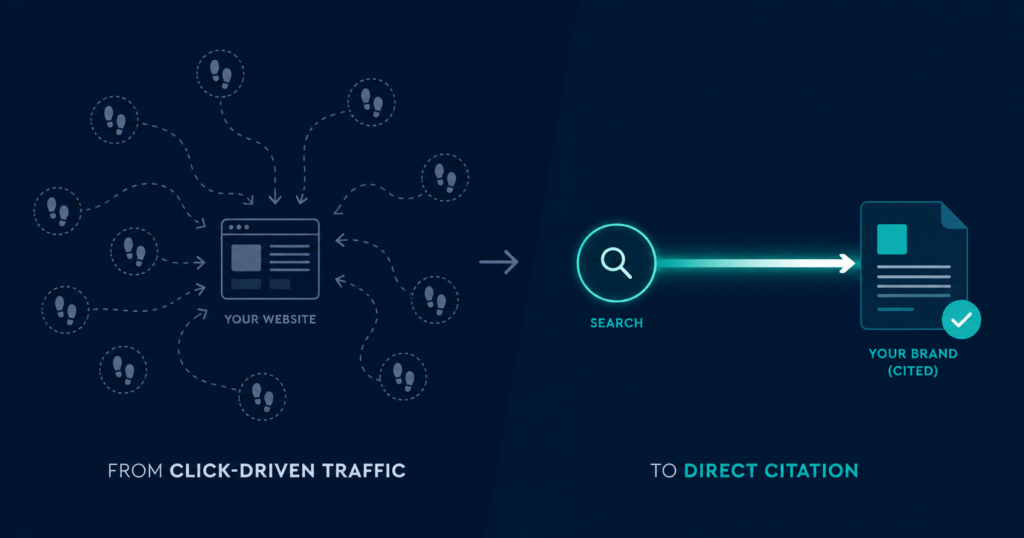
Structure matters because AI Overviews, Perplexity, and ChatGPT Search don’t rank whole pages the way classic search did – they extract short, self-contained passages and cite the source, and most of the resulting searches never produce a click at all. According to SparkToro’s 2026 clickstream analysis, roughly two-thirds of U.S. Google searches now end without a click to any website. Bain & Company’s research on B2B search behavior found click-through rates falling by as much as 30% in categories including B2B software since AI-generated summaries became the default. Pew Research has gone further, finding that when an AI Overview appears, users click through to a cited source only about 1% of the time.
Read plainly, that data looks like bad news for content marketing. Read correctly, it’s a redefinition of the goal – the only lever left is whether your brand is the one named inside the answer. For a CTO or founder researching a vendor, that moment now happens earlier in the buying journey than a website visit ever did, often before a prospect opens a tab.
This is why blog structure has stopped being a cosmetic SEO detail and become a distribution decision. A page can rank respectably on traditional metrics and still be invisible in AI-generated answers, simply because nothing on it is written as a clean, extractable answer.
How Do AI Overviews and Perplexity Decide What to Cite?
They use passage ranking: instead of scoring a page as a single unit, retrieval systems break it into sections, score each one independently for relevance and clarity, and then synthesize a final answer from the highest-scoring passages across multiple sources – not necessarily the highest-ranking page overall. A single well-written 50-word paragraph inside an otherwise average article can get cited. A brilliant insight buried inside a 400-word block of unstructured prose usually won’t.
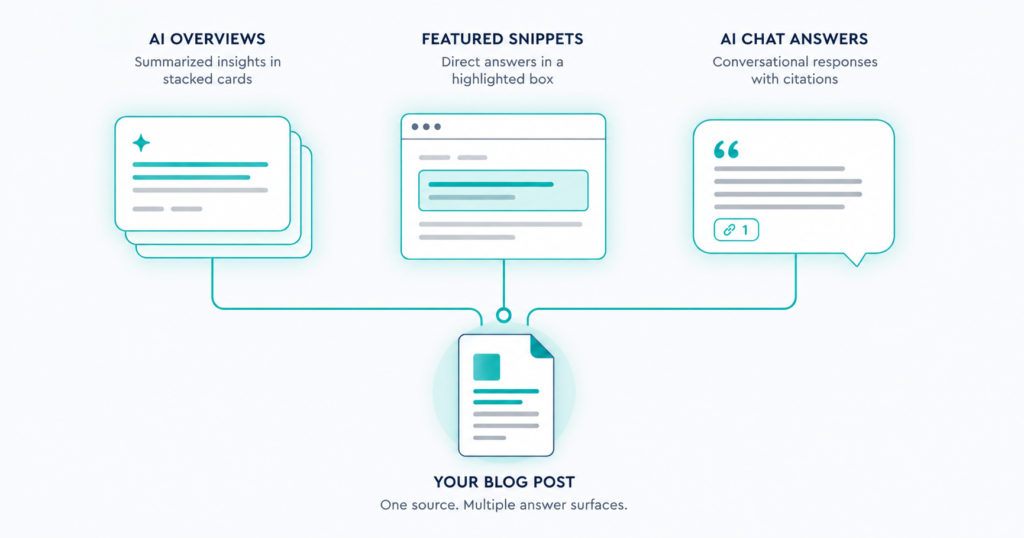
Practically, this means your blog post isn’t one asset competing for one ranking – it’s a set of independently retrievable answers, each competing on its own for its own query. Some publications call this Generative Engine Optimization (GEO), but Google has been clear the underlying fundamentals haven’t changed: useful content, crawlability, and page experience still form the foundation. What’s new is that extractability now sits on top of those fundamentals as its own requirement.
AI Overview vs. Featured Snippet vs. Perplexity Citation: What’s the Difference?
A featured snippet pulls one passage from one page and displays it above the organic results; an AI Overview synthesizes passages from several sources into a single generated summary with inline citations; a Perplexity citation works similarly to an AI Overview but is generated independently of Google’s index, often favoring sources with clear sourcing and recent publication dates. All three reward the same underlying structure – direct answers, clear headings, short paragraphs – but they aren’t the same feature, and optimizing for one doesn’t automatically win the others.
The practical implication for a B2B blog: don’t write for “the algorithm.” Write every section so it could survive being lifted out of context, attributed to your brand, and shown next to two or three competitors’ answers. That’s the actual test, whichever engine ends up doing the lifting.
How to Structure B2B Blog Posts for AI Overviews and Perplexity (Step-by-Step)
To structure B2B blog posts for AI Overviews, follow a strict hierarchy: the H1 states the primary topic and long-tail keyword, a bolded direct-answer summary sits immediately below it, every H2 is phrased as a real question, and each H2 gets its own bolded answer before any supporting detail follows. Here is the blueprint:
→ Bolded direct-answer summary (40–60 words)
H2: Question-Based Natural Language Query
→ Bolded direct-answer summary
H3: Specific sub-topic or technical detail
H3: Supporting data / comparison table
H2: Second Question-Based Query
→ Bolded direct-answer summary
H2: Frequently Asked Questions
A few rules make the difference between a page that gets extracted cleanly and one that doesn’t:
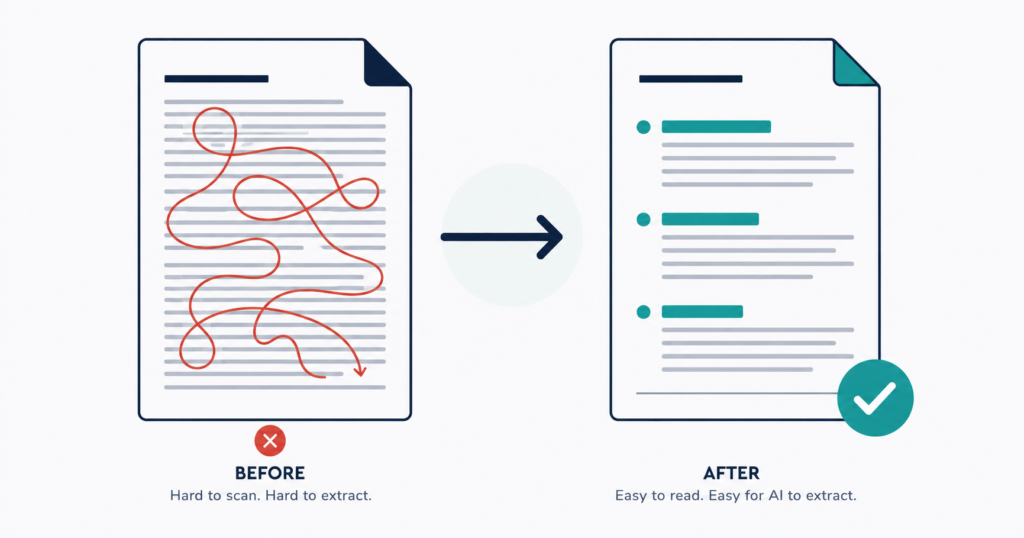
- Answer first, explain second. State the conclusion in the first sentence of a section. Support it afterward. Extraction models weight the opening sentence of a passage heavily, so burying the answer in sentence four costs you the citation even if the content is accurate.
- One idea per section. If an H2 is trying to answer two different questions, split it into two H2s. A section that answers “what” and “why” and “how” simultaneously is harder to lift cleanly than three sections that each answer one thing.
- Keep paragraphs to two or three sentences. Long, multi-clause paragraphs are harder for extraction systems to isolate without pulling in irrelevant surrounding context.
- Name real entities. Instead of “a popular cloud platform” or “a leading CRM,” write “Google Cloud Platform” or “HubSpot.” Specific, named entities are what let a model verify a claim against other sources – vague phrasing gives it nothing to cross-reference.
- Put the number in the sentence, not just the chart. If you’re citing a statistic, state it in prose (“roughly two-thirds of searches end without a click”) rather than only in a table, since passage extraction favors readable sentences over visual data.
What Content Formats Get Cited Most Often?
Tables, numbered steps, bullet lists, and short definitional paragraphs get cited more consistently than long narrative prose, because they’re already segmented into the kind of discrete, self-contained units that extraction models are built to lift. A comparison table answering “X vs. Y” is close to pre-formatted for an AI Overview. A numbered how-to list maps almost directly onto a step-by-step answer box.
That doesn’t mean prose has no place – the reasoning and context around a claim still matters for trust and depth. It means every major claim in a B2B post should have at least one structured counterpart nearby: a table, a list, or a short definition box that restates the point in isolatable form.
How Long Should Each Section Be for AI Extraction?
There’s no fixed word count, but the pattern that performs consistently is a 40–60 word direct answer immediately under each heading, followed by 100–250 words of supporting detail per H2 section. Sections much shorter than that rarely contain enough substance to establish authority; sections much longer tend to blend multiple ideas together, which makes clean extraction harder.
Total post length should follow the topic’s actual complexity rather than a target word count set in advance. A narrow, well-scoped topic covered thoroughly in 1,200 words will often out-perform a padded 3,000-word post on the same subject, because every added section that doesn’t sharpen the answer dilutes the passages that do.
Consistency matters just as much as individual sections. One well-structured answer won’t compensate for an article that’s difficult to scan elsewhere. AI systems evaluate pages as collections of extractable passages, so maintaining the same answer-first format, logical hierarchy, and concise writing throughout the post increases the likelihood of multiple sections being cited instead of just one.
Common Mistakes That Keep B2B Blog Posts Out of AI Overviews
The most common mistakes are burying the answer under a narrative introduction, using vague section headers instead of questions, mixing multiple claims into one paragraph, and citing statistics without a named, checkable source. Each of these individually reduces a section’s extractability; together, they usually mean a post never gets pulled into a generated answer, no matter how accurate the underlying information is.
A few specific patterns worth checking your own content against:
- The “story-first” open. Leading with a multi-paragraph narrative before answering the title’s question pushes the actual answer below the fold, for both human skimmers and extraction models.
- Vague, non-question headers. Headings like “Our Approach” or “Key Considerations” carry no query-matching signal.
- Unsourced statistics. A number with no attribution is a liability, not an asset – it can work against a page if it contradicts a properly sourced figure elsewhere.
- Reused round numbers. The same convenient statistic showing up attached to two unrelated claims usually means it was invented for effect, and technical readers notice.
- No FAQ section. FAQs are directly extractable, since they’re already phrased as question-and-answer pairs. Skipping one leaves an easy citation opportunity on the table.
Do You Need Special Schema Markup for AI Overviews?
No – Google’s own AI features documentation states there is no special schema required for AI Overviews or AI Mode. Structured data should be added when it accurately reflects the visible page content, and it primarily helps with rich-result eligibility broadly, not as an AI Overview-specific requirement.
That said, valid, accurate schema is still worth implementing, because it removes ambiguity for any crawler – search or AI – trying to parse your page. Two schema blocks are useful on a technical B2B blog post like this one: standard Article or BlogPosting schema for the piece itself, and a separate FAQPage schema if the post includes a genuine FAQ section. Keep them as independent JSON-LD blocks rather than nesting one inside the other – nesting a FAQPage inside an Article‘s mainEntity property is non-standard and may fail validation in Google’s Rich Results Test.
// json

{
  "@context": "https://schema.org",
  "@type": "BlogPosting",
  "headline": "How to Structure B2B Blog Posts for AI Overviews and Perplexity",
  "description": "A practical guide for B2B founders, CTOs, and product leaders on structuring blog content for citation in Google AI Overviews and Perplexity.",
  "author": {
    "@type": "Organization",
    "name": "Vedhas Technology Solutions LLC",
    "url": "https://techvedhas.com"
  }
}
// json
{
"@context": "https://schema.org",
"@type": "FAQPage",
"mainEntity": [
{
"@type": "Question",
"name": "How do I structure a blog post for AI Overviews?",
"acceptedAnswer": {
"@type": "Answer",
"text": "Use question-based H2 headings, place a direct 40–60 word answer immediately below each one, keep paragraphs short, and support claims with named sources or data."
}
}
]
}Always run structured data through Google’s Rich Results Test before publishing – don’t assume a schema block is valid just because the JSON itself is well-formed.
How to Optimize Blog Posts for Google AI Overviews
Search your own target keyword in Google, read the AI Overview that appears, and compare its structure to your post – if a lower-quality competitor is cited and you aren’t, the gap is almost always structural, not informational. This single test is one of the fastest ways to diagnose a page, because it shows you exactly what format Google is currently rewarding for that specific query.
A quick checklist to run against any existing post:
- Does the H1 or opening line answer the title’s implied question within the first two sentences?
- Is there a bolded, self-contained answer directly under every H2?
- Could each H2 section be read in isolation and still make sense to someone with no other context?
- Are statistics attributed to a named source with a year?
- Is there a genuine FAQ section, and does it use FAQPage schema?
- Would a comparison table or numbered list communicate any section’s key point more directly than the current paragraph does?
Posts that fail two or more of these checks are typically the ones losing citations to shorter, less comprehensive competitors – not because the information is worse, but because the format doesn’t give an extraction model anything clean to lift.
How Do You Measure Whether a Blog Post Is Getting Cited?
There’s no single dashboard yet that reliably reports AI Overview or Perplexity citations the way Google Search Console reports rankings, so measurement currently relies on a mix of manual checks and indirect signals. Google announced Search Generative performance reporting inside Search Console in mid-2026, but as of this writing it’s rolling out gradually and isn’t available to every property yet.
Until it reaches your account, three practical checks work reasonably well:
- Manual query testing. Search your target long-tail keywords directly and note whether an AI Overview appears and whether your domain is among the cited sources. Repeat monthly for priority keywords, since AI Overview inclusion changes more often than traditional rankings.
- Perplexity’s citation view. Ask Perplexity the same question your post answers and check whether your domain appears in its source list – Perplexity shows citations more transparently than Google does.
- Branded search and direct traffic trends. A rise in branded search or direct traffic can signal that people saw your brand in an answer and searched for it separately rather than clicking through.
None of these are precise substitutes for a proper analytics report, and any team relying heavily on AI-search visibility should treat this as a temporary measurement gap rather than a permanent one – the tooling is actively catching up to the behavior shift.
How Does Vedhas Approach Content Structure for AI Search Visibility?
Vedhas Technology Solutions treats blog structure as a joint responsibility between content strategy and engineering, not a copywriting task handled in isolation, since passage extraction depends as much on the CMS and schema behind a post as on the writing itself. Every post moves through an answer-first outline before drafting begins, so the question-based headings and direct answers described in this guide are planned upfront rather than retrofitted later.

Before publishing, posts go through a technical pass – schema validation, page-speed checks, and a section-level readability review. Published posts are also flagged for review on that same six-to-twelve-month cadence, so claims don’t go stale and quietly lose citations to newer sources.
Want a similar structural audit run on your own blog? Talk to our team.
Frequently Asked Questions
How long should a blog post be to get cited in AI Overviews?
There’s no fixed target – see the section-length guidance above. What predicts citation is whether each section stands on its own as a complete answer, not the total page length.
Does FAQ schema guarantee an AI Overview citation?
No. Schema helps machines parse content correctly, but it doesn’t guarantee inclusion. Citation still depends on content quality, clarity, freshness, and how directly a passage answers the query.
How often should this kind of content be updated?
Review time-sensitive claims and statistics on a six-to-twelve-month cadence. AI Overviews weight freshness heavily on evolving topics, and an outdated figure is one of the fastest ways to lose a citation to a more recently published source.
Does this structure replace normal SEO?
No. It sits on top of standard SEO fundamentals – indexability, internal linking, page speed, and useful content. Google has stated that AI Overview eligibility follows the same core practices as regular search rather than a separate rulebook.
Is Generative Engine Optimization (GEO) a different discipline from SEO?
It’s better understood as an extension of SEO than a replacement for it – the technical foundations are shared, and GEO adds the answer-first, passage-level formatting this guide covers.
Do older blog posts need a full rewrite, or can they be edited in place?
Most existing posts don’t need a full rewrite. Restructuring the opening into a direct answer, converting a few headers into questions, and adding a short FAQ section is often enough to make a page more extractable without touching the rest of the content.