Key Takeaways
- The Short Answer: Most growing brands should start evaluating a move beyond Shopify once annual GMV crosses $8M–$10M — or sooner, if two or more of the 7 operational red flags below are already showing up.
- Standard Shopify excels for rapid time-to-market, standard direct-to-consumer (DTC) workflows up to roughly $3M in Gross Merchandise Volume (GMV); Shopify Plus extends that comfortably to around $15M for enterprise-SaaS needs (see matrix below).
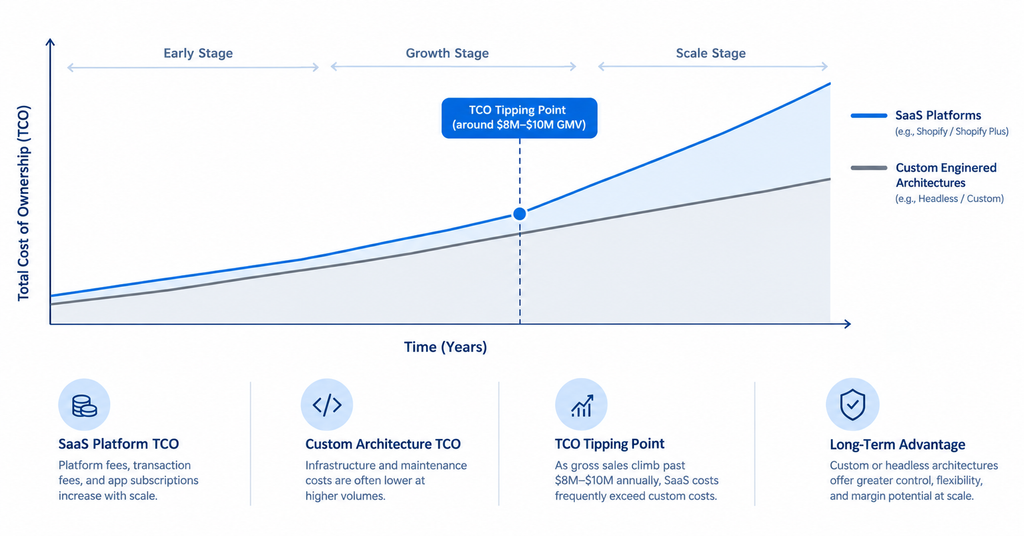
- The TCO Tipping Point: As gross sales climb past $8M–$10M annually, Shopify’s platform fees (0.20%–2.0% transaction cut, $2,300+/month base license) combined with $3,000–$8,000/month in specialized SaaS app subscriptions frequently exceed the infrastructure and maintenance cost of a proprietary custom or headless stack.
- 7 Signs It Is Time to Move Beyond Shopify: Severe checkout customization constraints, 300+ SKU variant/complex bundling limits, restrictive API rate limits (Shopify REST/GraphQL throttling), multi-ERP/WMS legacy synchronization bottlenecks, multi-region database isolation mandates, proprietary recurring billing models, and margin erosion caused by SaaS transaction penalties.
- The Hybrid Alternative (Headless Commerce): Brands that want to keep Shopify’s core checkout and order management while running a lightning-fast custom frontend (Next.js/React) can decouple the frontend to achieve sub-second Core Web Vitals and bespoke product configuration.
- Full Custom Commerce: Best suited for high-growth B2B brands, omnichannel retail networks, complex subscription platforms, and high-volume operations where full database, checkout, and pricing engine sovereignty delivers a decisive competitive edge.
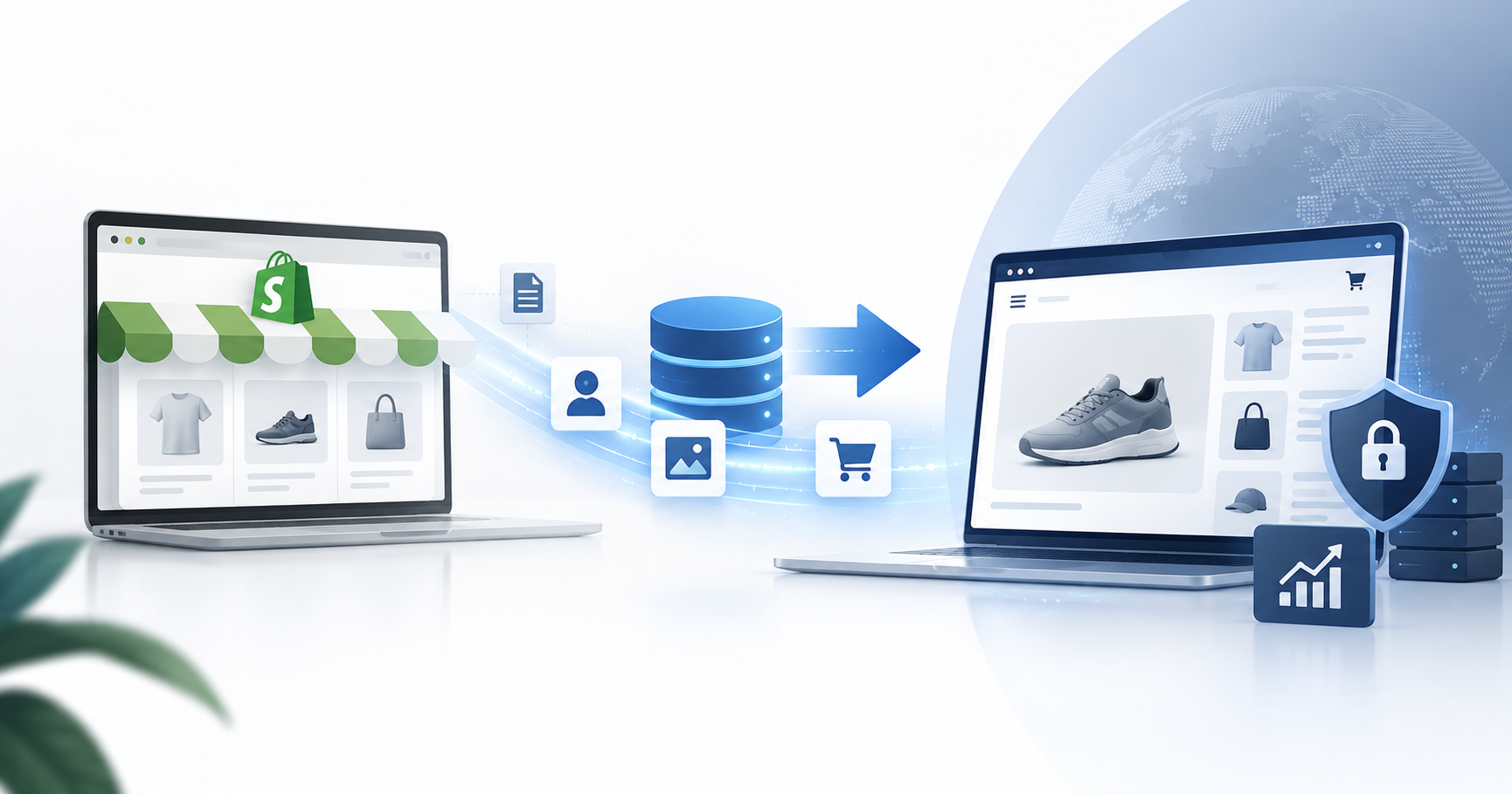
For early-stage direct-to-consumer businesses and mid-market retailers, Shopify is an undeniable powerhouse. It eliminates server management, provides bank-grade payment compliance, and allows founders to launch within days. However, when evaluating Shopify vs custom e-commerce, fast-growing brands inevitably encounter a rigid structural ceiling where off-the-shelf SaaS constraints actively bottleneck conversion rates, restrict enterprise ERP integrations, and erode gross margins.
At a Glance: Shopify vs. Shopify Plus vs. Custom E-Commerce
Before examining the architectural friction points, review this operational and financial matrix to compare the three primary commerce paradigms across critical enterprise dimensions:
| Architectural & Business Dimension | Standard Shopify (Advanced) | Shopify Plus (Enterprise SaaS) | Custom / Headless E-Commerce |
|---|---|---|---|
| Target Annual GMV | $250k – $3M | $2M – $15M | $8M – $100M+ |
| Base Platform Cost | $399 / month | $2,300+ / month, or 0.25% of monthly GMV above $1M (capped at $40K/month) — whichever is greater | Cloud hosting ($250–$1,800 / month) |
| Transaction & Gateway Fees | 0.6% (third-party) + card fees | 0.20% (third-party) + card fees | 0% platform fee; standard 1.5%–2.9% stripe/interchange |
| Average Monthly App Stack Cost | $800 – $2,500 / month | $2,500 – $10,000 / month | $0 (native internal microservices) |
| Checkout Customization | Extremely limited (standard template) | Moderate (Checkout Extensibility / UI Components) | 100% unrestricted (bespoke single-click, split-tender, PO) |
| Product Variant & SKU Hierarchy | 100 variants per product (requires workarounds) | 2,000 variants (via GraphQL API upgrades) | Infinite variants, dynamic bundling, dimensional matrices |
| Data Ownership & Database Access | Hosted multi-tenant; no direct SQL/NoSQL access | Hosted multi-tenant; restricted export/API access | Complete sovereignty (PostgreSQL, MongoDB, ElasticSearch) |
| API Rate Limits | 4 req/sec (REST), 200 cost/sec (GraphQL) | 20 req/sec (REST), up to 1,000 cost/sec (GraphQL) | Unlimited (governed only by internal infrastructure capacity) |
| Development & Time-to-Market | 2–4 weeks | 6–12 weeks | 12–24 weeks |
| Recommended Tech Stack | Liquid, Theme App Extensions | Liquid, Hydrogen/Remix, Shopify Scripts | Next.js, Node.js, .NET 10, Python, PostgreSQL, AWS/Azure |
What Makes Shopify the Initial Market Standard (and Where the Ceiling Lies)
Shopify dominates the retail landscape because it abstracts server architecture, PCI-DSS Level 1 compliance, and payment gateway orchestration into a user-friendly subscription. For businesses under $2 million in annual revenue, building a ground-up platform rarely makes economic sense.
However, Shopify’s greatest strength—its closed, multi-tenant walled garden—eventually becomes its primary operational liability.
- The Multi-Tenant Sandbox — Because millions of merchants share Shopify’s underlying compute resources, the platform enforces strict governance over what developers can execute. You cannot run background jobs on their database, you cannot modify underlying SQL schema, and you cannot tune server-level caching mechanisms for unique database queries.
- The Liquid Templating Constraint — Standard Shopify themes rely on Shopify’s proprietary Liquid rendering engine. While performant for basic catalogs, Liquid renders on Shopify’s servers prior to HTML delivery, preventing modern frontend optimizations like selective edge hydration, distributed streaming SSR, or granular micro-frontend architectures.
- Third-Party App Glue — To execute functionality outside Shopify’s core vision (such as advanced custom filters, wholesale pricing tiers, multi-carrier real-time shipping calculation, or custom loyalty rules), merchants must install third-party apps. Each app injects external JavaScript, adds third-party API dependencies, and introduces potential points of failure that degrade Core Web Vitals and drag down mobile conversion rates.
The Financial Tipping Point: Total Cost of Ownership (TCO) Breakdown
A common misconception among business leadership is that custom development is inherently more expensive than SaaS. At scale, the opposite is frequently true.
Shopify Annual TCO = Base Subscription + Revenue-Share Fees + Third-Party App Subscriptions + Custom Liquid Patching + Lost Conversion from Speed Latency
Consider a direct-to-consumer or multi-brand retailer processing $15,000,000 annually across 180,000 orders:
Scenario A: Running on Shopify Plus
- Base Platform Fee: Shopify Plus pricing is the greater of $2,300/month (3-year term) or 0.25% of monthly GMV above $1M, capped at $40K/month. At $15M/year (~$1.25M/month GMV), the ~$250K/month over the $1M threshold works out to ~$625/month under the 0.25% formula — well below the $2,300/month flat minimum, so the flat rate applies = $27,600/year.
- Third-Party Payment Gateway Fee (if not using Shopify Payments exclusively): 0.20% on $15M = $30,000/year
- Critical Enterprise App Stack:
- Advanced Search & Merchandising (Algolia/Klevu): $1,400/month
- Subscription Engine (Recharge/Smartrr): $600/month + 1% transaction fee
- Multi-Warehouse Inventory & ERP Sync: $1,200/month
- B2B Wholesale Portal Add-on: $800/month
- Loyalty, Reviews & Custom Rewards: $950/month
- Total App Stack: ~$5,000/month = $60,000/year
- Total Annual SaaS Recurring Cost: $117,600/year ($27,600 + $30,000 + $60,000), plus ongoing percentage-fee escalations as volume expands — note that above roughly $23M/year GMV, the 0.25%-of-excess formula overtakes the flat rate and becomes the operative base fee.
Scenario B: Custom / Headless Commerce on Modern Cloud Infrastructure
- Cloud Infrastructure Hosting (AWS / Azure / GCP): elastic containerized cluster (ECS/EKS or Azure Container Apps) with Redis caching and global CDN (Cloudflare Enterprise): ~$850/month = $10,200/year
- Direct Merchant Gateway (Stripe / Adyen / Chase Paymentech): wholesale interchange-plus pricing with 0% platform surcharge
- Internal Microservices: search, subscriptions, inventory, and B2B logic run as native microservices with zero per-transaction software taxes
- Ongoing Cloud Maintenance & Retainer: retained engineering support via staff augmentation or dedicated maintenance: ~$3,500/month = $42,000/year
- Total Annual Operational Cost: $52,200/year ($10,200 + $42,000)
Net Annual Operational Savings: ~$65,400/year ($117,600 − $52,200), which directly funds proprietary feature development, internal IP equity, and targeted digital marketing campaigns.
The 7 Critical Inflection Points: When to Move Beyond Shopify
How do engineering leaders and founders know when their brand has outgrown Shopify’s ecosystem? If your organization experiences two or more of the following 7 inflection points, replatforming to custom website development is an urgent strategic imperative.
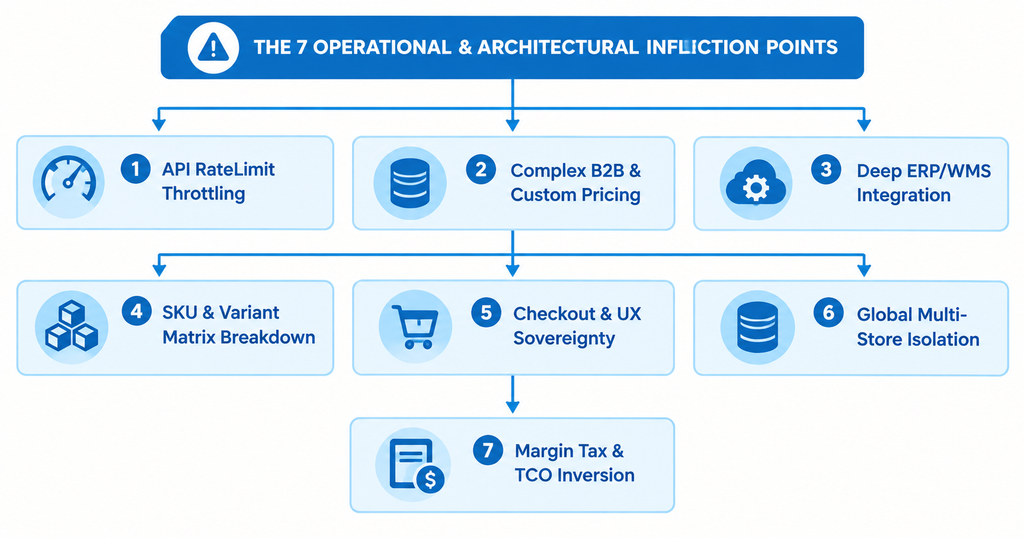
1. Severe API Rate-Limit Throttling During High-Volume Synchronization
Shopify throttles API calls through a leaky-bucket algorithm — 20 requests per second for Shopify Plus on REST endpoints, up to roughly 1,000 cost/sec on GraphQL (see the comparison matrix above). If your business operates complex omnichannel fulfillment where warehouse inventory, pricing updates, and POS orders must synchronize every 60 seconds across 20+ locations, these limits will cause queuing delays, phantom stockouts, and order drops during peak flash sales. Custom platforms allow you to architect event-driven message brokers (Apache Kafka, RabbitMQ, AWS SQS) that handle tens of thousands of concurrent inventory transactions without arbitrary third-party throttling.
2. Complex B2B Logic, Split-Tender Checkout, and Custom Invoicing
While Shopify Plus has introduced wholesale features, its core remains optimized for direct-to-consumer credit card transactions. If your enterprise requires:
- Granular client-specific tiered price books negotiated by contract
- Net-30/60 terms with corporate credit limit validation at checkout
- Multi-tier corporate account hierarchies with approval workflows
- Split-shipment routing from multiple localized fulfillment centers based on custom line-item rules
Forcing these workflows into Shopify requires extensive, fragile app bridging. Building on a custom backend provides direct database control to execute sophisticated B2B logic effortlessly.
3. Deep Integration with Custom ERPs, CRMs, and Legacy Infrastructure
Mid-market enterprises rarely operate in isolation. They run on SAP, Microsoft Dynamics 365, Oracle NetSuite, or proprietary legacy databases. When syncing data between Shopify and legacy infrastructure, middleware connectors frequently fail to map non-standard data types. By architecting a custom e-commerce solution on robust cloud infrastructure services, your engineering team builds tailored bidirectional ETL pipelines and REST/gRPC endpoints tailored to your exact corporate systems.
4. SKU Complexities, Dynamic Product Customizers, and Variant Ceilings
Shopify enforces a historic limit of 100 variants and 3 options per product (extended to 2,000 via GraphQL API, but still bounded by strict structural rules). If your business sells configurable products—such as modular furniture, industrial machinery parts, customized luxury goods, or custom medical equipment—you need nested variant attributes, dynamic price calculation algorithms, and real-time 3D configuration rendering. In a custom architecture, product modeling is completely unconstrained.
5. Conversion Rate Optimization (CRO) Ceiling and Checkout Sovereignty
Even on Shopify Plus, the checkout pipeline is heavily guarded. While Checkout Extensibility allows UI component placement, you cannot fundamentally alter the checkout sequence, introduce customized identity verification steps, integrate localized non-standard payment gateways without incurring penalties, or execute biometric multi-device auth flows. A fully custom headless checkout allows you to test revolutionary 1-click workflows, reducing cart abandonment and driving measurable conversion gains.
6. True Multi-Tenant Global Operations and Data Residency Mandates
If you operate internationally across the EU, Middle East, and North America, regulatory frameworks like GDPR and localized data protection laws may mandate specific data handling guarantees. Shopify Plus does offer an EU data-residency option (EU merchant data hosted in an Ireland data center) — but residency isn’t the same as sovereignty. As a US-headquartered company, Shopify remains subject to the US CLOUD Act regardless of which region physically hosts the data, meaning true immunity from foreign legal access isn’t available on the platform. A custom deployment on infrastructure you fully control allows you to spin up geographically isolated database instances with automatic currency localization and closes that sovereignty gap directly.
7. Margin Erosion from Recurring App Subscriptions and Percentage Taxes
When your brand reaches high transaction volume, paying 0.20%–2% of gross sales to your platform vendor in addition to payment processing fees becomes your largest single software expense. When combined with monthly app fees, that revenue drain is better reinvested into proprietary software assets that build long-term enterprise valuation.
Headless Commerce vs. Full Custom Build: Choosing the Right Path
Moving beyond Shopify does not necessarily require throwing away your entire backend on day one. Modern engineering provides two distinct replatforming paths:
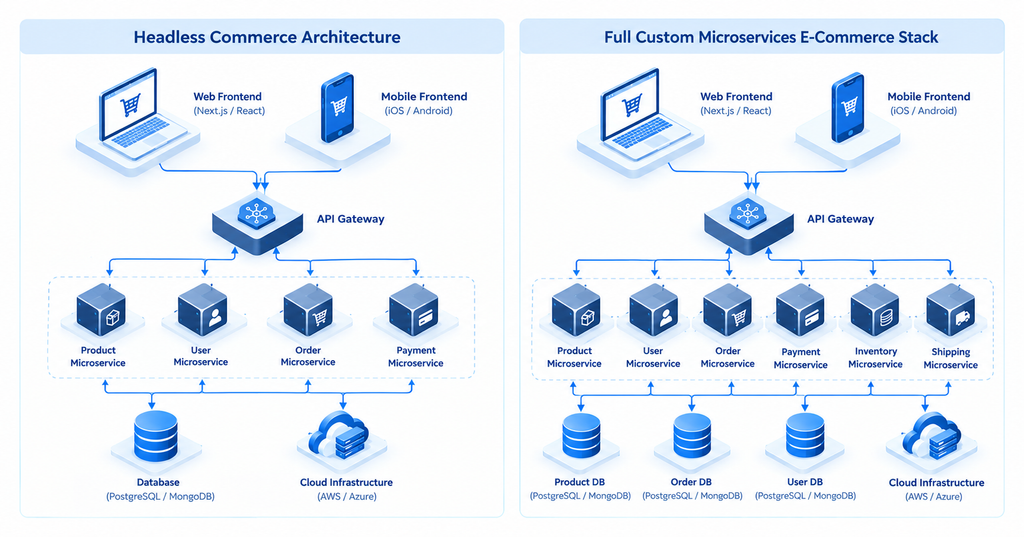
- Option 1: Headless Commerce (The Decoupled Middle Ground) In a headless architecture, you decouple the frontend presentation layer from the e-commerce backend. You build a blazing-fast custom frontend using Next.js, React, or Vue, while leveraging Shopify strictly as a headless commerce API engine for inventory and order processing. Best For: Brands making $3M–$8M GMV that want custom web design, sub-second page load times, dynamic storytelling, and omnichannel mobile app connectivity, but do not yet need to build a custom order management system. Key Benefit: Complete frontend freedom without having to manage payment compliance or re-engineer back-office fulfillment.
- Option 2: Full Custom Microservices Architecture (Complete Sovereignty) In a full custom build, your team engineers both the frontend and backend using enterprise frameworks (.NET 10, Node.js, Python, or Go) coupled with specialized headless commerce engines (such as Medusa.js, Saleor, commercetools) or a proprietary modular backend. Best For: Brands making $10M+ GMV, complex B2B enterprises, marketplaces, or businesses with non-standard billing and fulfillment models. Key Benefit: 0% platform revenue share, zero variant limits, bespoke database design, custom checkout pipelines, and complete ownership of company software IP.
In the $8M–$10M transition zone between these two options, either path can work — the right call depends on which specific bottleneck (frontend performance vs. backend/checkout constraints) is actually costing you conversions or margin today.
The Modern Custom E-Commerce Tech Stack Blueprint
When building a high-performance custom e-commerce platform, engineering teams avoid monolithic codebases in favor of modular, composable microservices. Below is the battle-tested enterprise architecture TechVedhas implements for scaling retail and B2B clients:
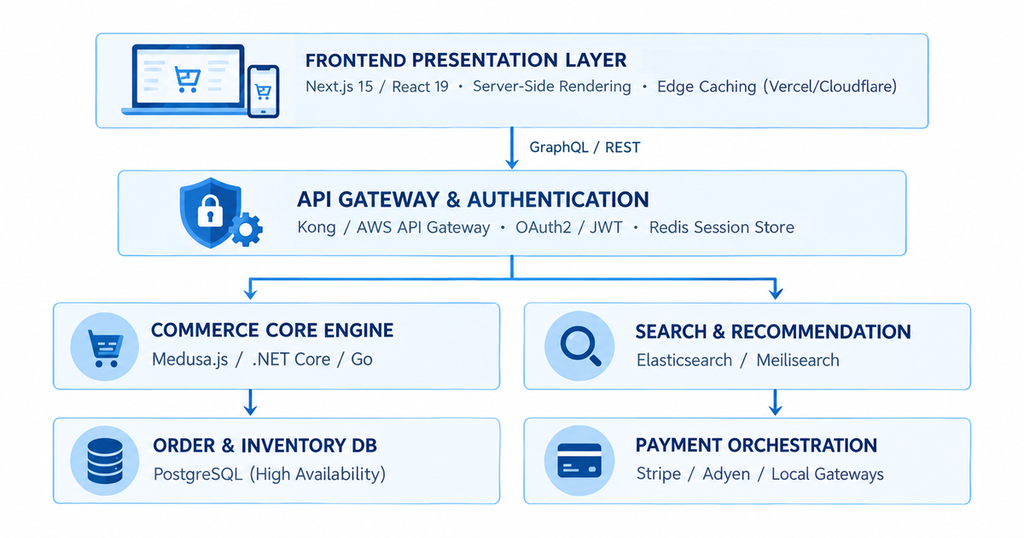
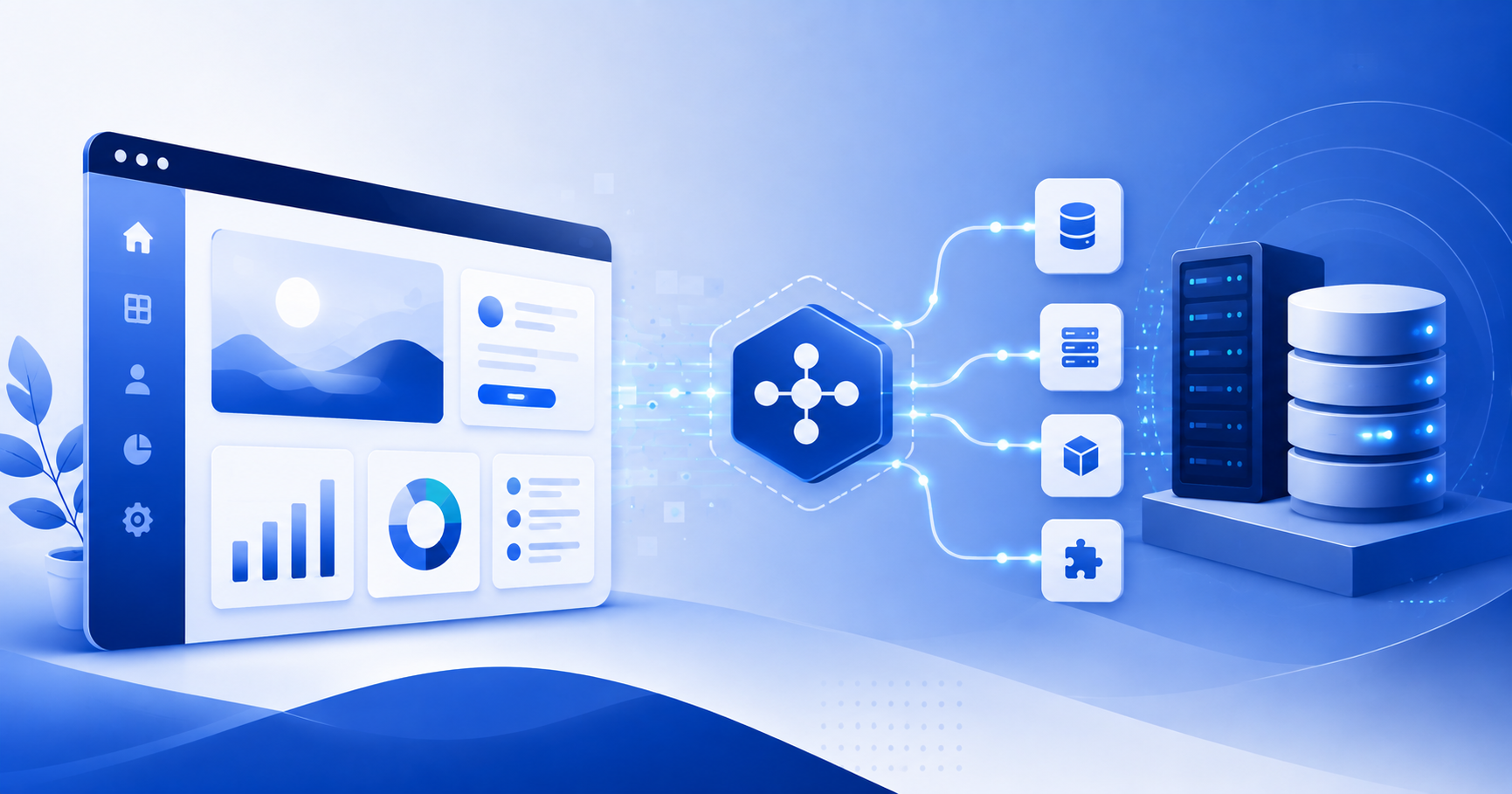
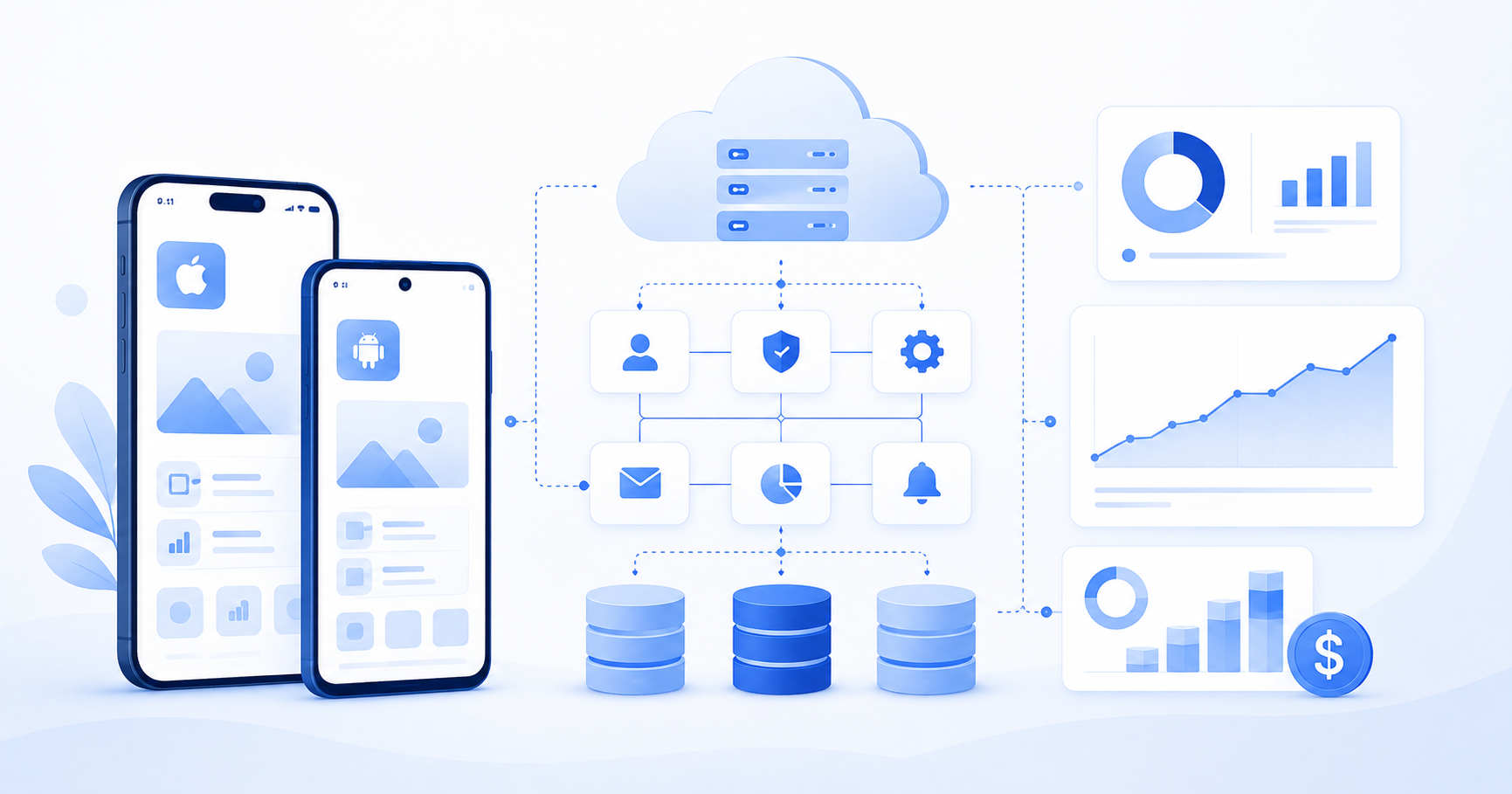
Core Architecture Components Frontend Presentation: React or Next.js with Tailwind CSS, utilizing Server Components for instant rendering and perfect 100/100 Core Web Vitals scores. Backend API Services: Node.js, Python, or .NET 10 microservices handling business logic, order state machines, and cart calculations. Database Layer: PostgreSQL with read-replicas for transaction processing, paired with Redis for sub-millisecond cart session caching. Search & Merchandising: ElasticSearch or Meilisearch cluster delivering instant typo-tolerant product filtering across millions of catalog items. Infrastructure & Hosting: Containerized deployment on AWS (ECS/EKS) or Azure, managed with automated CI/CD pipelines and infrastructure-as-code (Terraform).
Common Mistakes Brands Make When Migrating Off Shopify (and How to Avoid Them)
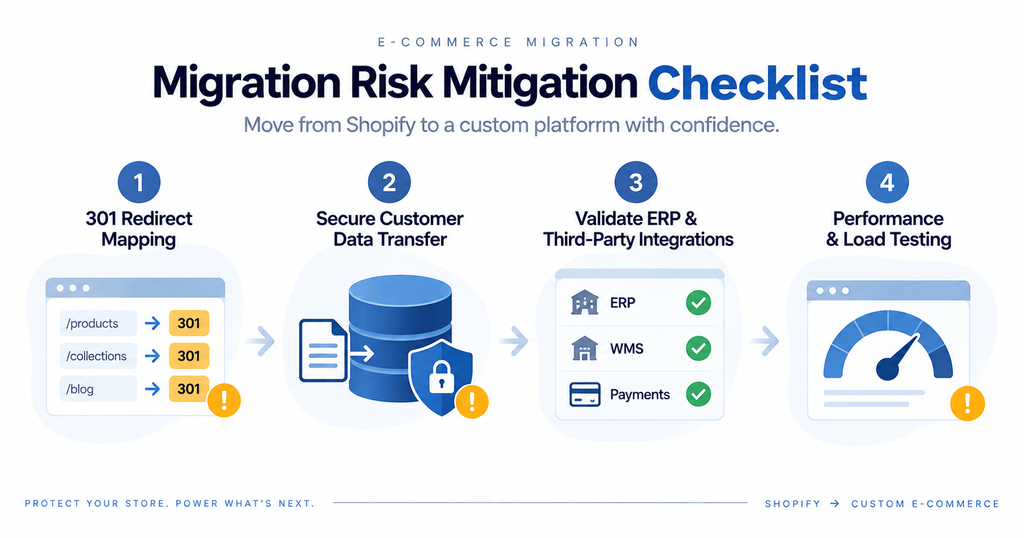
Replatforming is a major strategic transition. Avoiding these four fatal mistakes will protect your traffic, revenue, and customer experience during the cutover:
1. Over-Engineering Phase 1 (The “Build Everything at Once” Trap)
Merchants often attempt to reinvent every minor administrative widget in their custom MVP. The Solution: Focus Phase 1 exclusively on revenue-critical workflows: catalog performance, high-converting checkout, ERP/inventory synchronization, and core customer account features. Secondary internal admin tools can follow in continuous Agile sprints.
2. Neglecting 301 Redirect Mapping and SEO Equity Preservation
Shopify uses rigid URL structures (e.g., /products/product-name, /collections/collection-name). When switching to a custom platform, you will likely optimize your URLs to shorter, cleaner paths (e.g., /shop/category/product-name). Failing to implement exhaustive, 1-to-1 301 redirect mapping will obliterate years of accumulated organic search rankings. Review our guide on e-commerce web design tips to safeguard your search equity.
3. Mishandling Customer Password and Historical Order Data Migration
Shopify encrypts customer passwords using proprietary hashing algorithms that cannot be exported in plain text. If you perform a naive database migration, all existing customers will be locked out and forced to reset their passwords. The Solution: Implement a lazy-migration authentication hook. When a legacy customer logs in on the new custom platform, the system verifies their credentials against the legacy API once, captures the hash, and seamlessly migrates them to your new secure database without user friction. For broader data architecture best practices, consult our guide on cloud migration strategies.
4. Underestimating Payment Gateway Risk Management
Switching from Shopify Payments (which uses Stripe under the hood) to a standalone merchant account requires establishing your own merchant underwriting, chargeback dispute workflows, and fraud screening (e.g., Radar or Signifyd). Ensure your payment orchestration layer is tested with synthetic card testing and load testing well before public launch.
Frequently Asked Questions (FAQ)
At what revenue level should a brand consider leaving Shopify?
A growing brand should evaluate moving beyond Shopify when annual Gross Merchandise Volume (GMV) surpasses $8M–$10M, or when combined monthly app fees, revenue-share percentages, and checkout limitations exceed the cost of maintaining custom cloud infrastructure.
What is the primary difference between Shopify and custom e-commerce?
The primary difference is architecture: Shopify is a closed, multi-tenant software-as-a-service (SaaS) platform where the hosting, code, and database are controlled by Shopify, while custom e-commerce is a proprietary software application built on open frameworks (.NET, Node.js, React) giving your business 100% data ownership, custom business logic, and zero platform transaction taxes.
Can I keep Shopify’s backend while building a custom frontend?
Yes, this is known as Headless Commerce. You can build a bespoke, lightning-fast frontend using Next.js or React powered by Shopify’s Storefront GraphQL API for product browsing, cart, and checkout, while your backend syncs inventory, orders, and fulfillment through Shopify’s Admin API.
How long does it take to build a custom e-commerce platform?
A production-grade custom or headless e-commerce build typically takes 12 to 24 weeks depending on catalog complexity, B2B logic requirements, third-party ERP/CRM integrations, and custom checkout flows.
How much does custom e-commerce development cost?
For the scope of build described in this guide — ERP/CRM integration, custom checkout, and multi-region infrastructure — custom e-commerce builds typically range from $80,000 to $500,000+, with most mid-market builds landing between $120,000 and $250,000, plus ongoing cloud hosting costs between $250 and $1,800 monthly. Simpler builds without enterprise integrations can come in lower. For detailed breakdowns, refer to our comprehensive e-commerce app development cost guide.
Will moving from Shopify to custom e-commerce hurt my Google rankings?
Not if executed properly. By conducting a comprehensive 1-to-1 301 URL redirect map, preserving meta tags, and significantly boosting Core Web Vitals through a modern server-side rendered frontend, most brands experience significant organic ranking improvements post-migration.
How do custom platforms handle PCI compliance and security?
Custom e-commerce platforms maintain PCI-DSS compliance by tokenizing cardholder data through embedded payment components (such as Stripe Elements or Adyen Drop-in UI), meaning sensitive payment data never touches or stores on your local servers.
Can custom e-commerce handle high-traffic flash sales better than Shopify?
Yes. With custom cloud infrastructure on AWS or Azure configured with auto-scaling Kubernetes clusters and Redis caching, you can engineer dedicated queue systems and database read-replicas tailored specifically to your flash sale traffic without hitting third-party API rate caps.
Future-Proof Your Commerce Architecture with TechVedhas
Staying on a platform you have outgrown costs far more than software license fees—it costs conversion rates, operational agility, and customer loyalty.
Whether your brand requires a transition to a high-speed Headless Shopify frontend or a fully sovereign custom microservices e-commerce platform, TechVedhas provides the full-stack engineering expertise, cloud architecture, and data migration safeguards required for seamless execution.
Ready to evaluate your replatforming roadmap?
Explore our custom website development services, calculate your investment with our project estimation tool, or
with our principal software architects today.