Key Takeaways
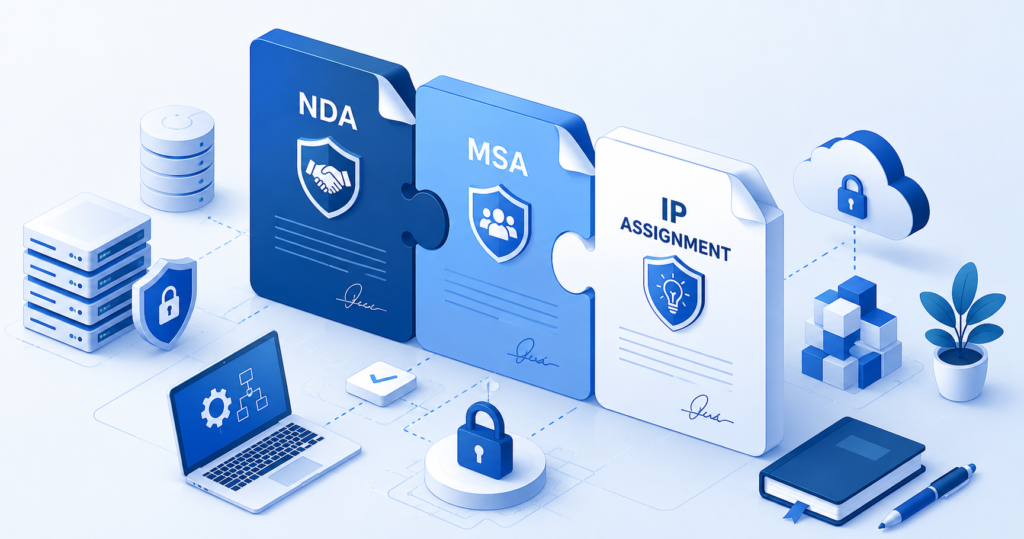
- Legal Defense: Achieving robust software outsourcing ip protection requires a three-tier legal contract architecture: a non-disclosure agreement (NDA), a master services agreement (MSA) with explicit work-made-for-hire provisions, and direct IP assignment clauses for all personnel.
- Repository Governance: Executive teams must retain full administrative ownership of version control system (VCS) repositories, enforcing role-based access control (RBAC), multi-factor authentication (MFA), and automated secrets scanning.
- Jurisdictional Reality: Cross-border software development contracts should mandate binding international arbitration under recognized frameworks (such as the International Chamber of Commerce or UNCITRAL) with clear choices of governing law.
- Jurisdictional Reality: Cross-border software development contracts should mandate binding international arbitration under recognized frameworks (such as the International Chamber of Commerce or UNCITRAL) with clear choices of governing law.
Establishing robust software outsourcing ip protection is a top priority for executives scaling development capacity without exposing proprietary algorithms, trade secrets, or client data to theft. As global engineering partnerships expand, technology leaders face legitimate anxieties regarding code repository ownership, copyright transfer, regulatory compliance, and cross-border enforcement.
Without structured legal and operational frameworks, software outsourcing can introduce liabilities—ranging from accidental open-source license contamination to outright misappropriation of proprietary code assets. This comprehensive executive guide outlines the contracts, repository architectures, international legal enforcement standards, and vendor audit workflows required to guarantee 100% IP ownership while leveraging external engineering talent.
At-a-Glance: The 4-Layer IP Defense Matrix for Software Outsourcing
Before structuring vendor contracts or onboarding engineering teams, executive teams should evaluate their IP governance across four distinct defense layers:
| Defense Layer | Core Objective | Key Deliverables / Controls | Risk Mitigated |
|---|---|---|---|
| 1. Contractual & Legal | Guarantee legal transfer of copyright and trade secret ownership | Bilateral NDA, Master Services Agreement (MSA), IP Assignment Clauses, SOW | Code theft, vendor ownership claims, breach of confidentiality |
| 2. Technical & Repository | Restrict unauthorized code access and prevent data extraction | Centralized git ownership, RBAC, VDI/DLP controls, secrets scanning | Repository hijacking, credential leak, source code exfiltration |
| 3. Regulatory & Compliance | Align offshore workflows with international privacy standards | GDPR, HIPAA, Defend Trade Secrets Act (DTSA), SOC 2 Type II compliance | Regulatory penalties, client data exposure, compliance audit failures |
| 4. Operational & Audit | Monitor ongoing developer activity and ensure clean offboarding | Background checks, developer NDAs, exit audits, OSS license scanning | Subcontracting risks, copyleft contamination, post-engagement data retention |
Legal Contracts for Software Outsourcing IP Protection
Legal contracts form the primary baseline of defense when partnering with external agencies, contractors, or staff augmentation providers. Relying on generic, off-the-shelf templates or vague agreements frequently leaves legal loopholes regarding copyright creation and trade secret transfer.
Master Services Agreement (MSA): Setting the Governance Foundation
The Master Services Agreement (MSA) is the umbrella contract governing the overarching business relationship between your enterprise and an external development agency. While individual Statements of Work (SOW) specify deliverables and timelines, the MSA establishes the legal parameters governing trade secrets, liability caps, and intellectual property.
Key clauses required in an enterprise MSA include:
- Explicit Definition of Work Product: Define “Work Product” broadly to encompass all source code, object code, documentation, system architectures, database schemas, API integrations, and UX/UI designs created during the engagement.
- Pre-Existing IP Exceptions: Clearly distinguish between the client’s proprietary assets, the vendor’s background IP (pre-existing frameworks or utility libraries), and third-party components. If a vendor incorporates pre-existing tools into your software, the MSA must grant an irrevocable, perpetual, royalty-free, worldwide license to modify and commercialize those components.
- Subcontracting Restrictions: Prohibit the external agency from assigning work to unvetted third-party subcontractors or freelancers without prior written approval. Unsanctioned subcontracting represents one of the leading causes of trade secret leakage in offshore development.
Non-Disclosure Agreements (NDA): Mutual vs. Unilateral Standards
A Non-Disclosure Agreement (NDA) must be executed prior to sharing initial project specifications, architecture documents, or codebase access with potential vendors.
While mutual NDAs are standard for initial discovery calls, executive teams should enforce unilateral or strict bilateral NDAs that specifically address:
- Definition of Confidential Information: Include technical specifications, algorithms, customer data, unreleased feature roadmaps, business logic, and security credentials.
- Duration of Obligations: Confidentiality obligations regarding standard business discussions typically last 3–5 years. However, trade secrets and proprietary source code must be protected in perpetuity or for as long as they remain non-public trade secrets under applicable law (such as the U.S. Defend Trade Secrets Act of 2016).
- Remedies for Breach: Mandate immediate injunctive relief and liquidated damages in the event of an unauthorized disclosure, bypassing the need to prove exact financial harm before securing an emergency court order.
Work-Made-For-Hire & IP Assignment Clauses: Guaranteeing Complete Ownership
Under copyright law in many jurisdictions (including the United States under 17 U.S.C. § 101), software code created by an independent contractor or external agency does not automatically qualify as a “work made for hire” unless explicitly designated as such in a written agreement signed by both parties.
To guarantee complete ownership transfer:
- Dual-Protection Framing: Draft the clause to state that all work product is considered a “work made for hire.” Concurrently, include a fallback assignment clause stating: “To the extent any Work Product does not qualify as a work made for hire, Vendor hereby irrevocably assigns and transfers all right, title, and interest, including copyrights, patents, and trade secrets, to Client.”
- Present Assignment Phrasing: Ensure the language executes an immediate assignment (“Vendor hereby assigns…”) rather than a future promise to assign (“Vendor agrees to assign…”). The U.S. Court of Appeals for the Federal Circuit has ruled that future promises require additional transfer instruments upon completion, creating significant legal exposure if vendor relationships deteriorate.
- Individual Developer Back-to-Back Agreements: Verify that the agency maintains signed, legally binding IP assignment and confidentiality agreements with every individual developer assigned to your project before work commences.
Repository Security and Code Ownership Best Practices
Legal protection must be paired with technical containment. Leaving full administrative control of version control repositories in the hands of an external agency exposes your organization to repo hijacking, accidental deletion, and credential leakage. When evaluating engineering practices, modern teams frequently audit whether tools like vibe coding and AI generators are safe for production software—making technical repository controls even more critical.
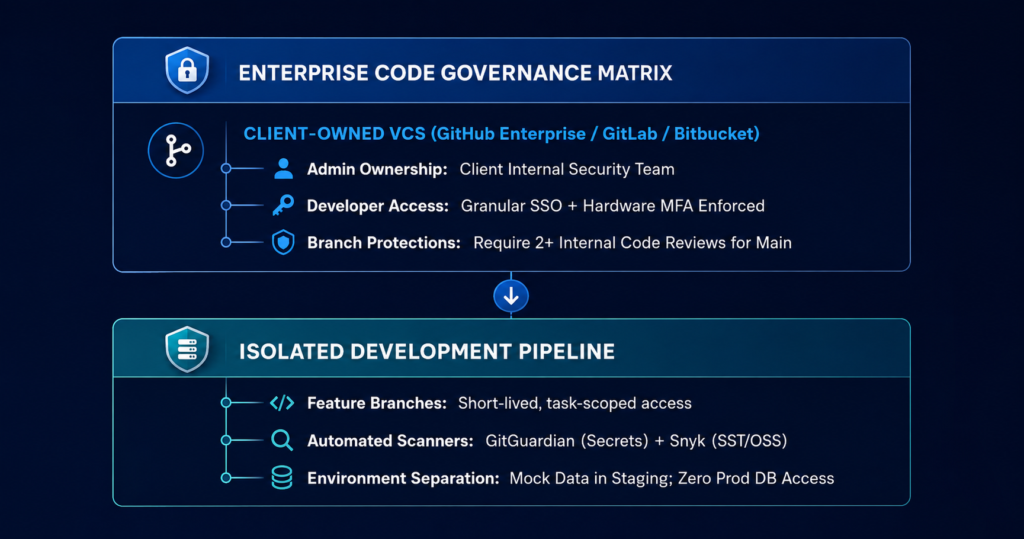
Centralized Version Control & Granular Access Controls (RBAC)
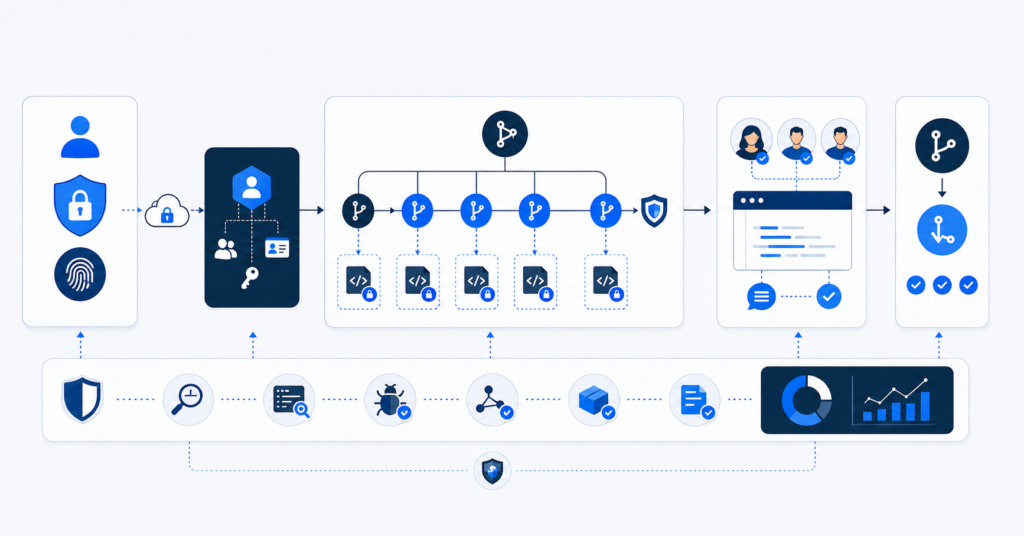
- Client-Owned Repositories: Never permit an external agency to host your codebase on their personal GitHub, GitLab, or Bitbucket accounts. Create the repository under your organization’s enterprise account and invite vendor developers as external contributors or temporary organization members.
- Principle of Least Privilege: Grant developers access only to the specific repositories required for their assigned modules. Limit administrative privileges exclusively to internal engineering leaders.
- Multi-Factor Authentication (MFA) & Single Sign-On (SSO): Enforce hardware-based or authenticator-app MFA across all developer accounts. Where possible, route developer login through your enterprise Identity Provider (IdP) using SAML/OAuth to enable instant access revocation upon developer offboarding.
Source Code Obfuscation, Feature Branching, and Environment Isolation
- Short-Lived Feature Branches: Enforce feature-branch workflows where external developers commit code to isolated branches. Merge permissions to
mainorproductionbranches must be strictly restricted to internal technical leads. - Database Anonymization: Never grant external agency teams access to live production databases containing real user Personally Identifiable Information (PII). Supply sanitized, synthetic datasets for local development and staging environments.
- Secrets Management: Mandate the use of centralized secret managers (such as HashiCorp Vault, AWS Secrets Manager, or Azure Key Vault) with automated scanning tools like GitGuardian or Trufflehog integrated into CI/CD pipelines to block hardcoded API keys or credentials from entering git history.
Managing Open-Source Licenses & Copyleft Dependencies
Accidental incorporation of “copyleft” open-source software (OSS) licenses—such as the GNU General Public License (GPL v2/v3) or Affero GPL (AGPL)—can legally obligate your company to release its entire proprietary codebase to the public domain.
To prevent open-source contamination:
- License Compliance Policy: Establish an explicit open-source governance policy within your software project timeline and budget specification. Prohibit strong copyleft licenses while permitting permissive licenses (e.g., MIT, Apache 2.0, BSD).
- Automated Dependency Scanning: Require CI/CD pipelines to run automated Software Composition Analysis (SCA) tools (such as Snyk, FOSSA, or OWASP Dependency-Check) on every pull request to catch unauthorized OSS packages before code is merged.
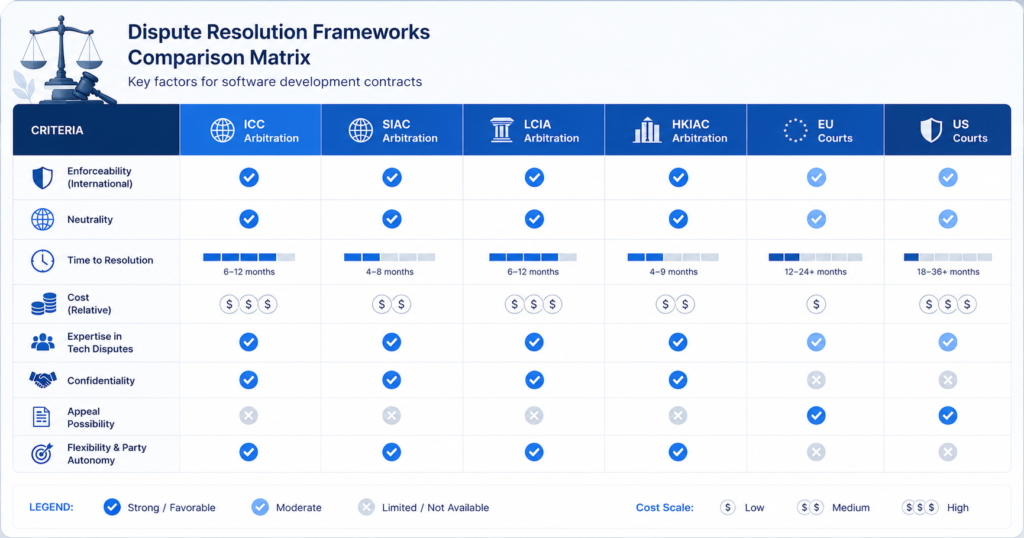
International Legal Enforcement Standards and Jurisdictional Realities
Executing contracts is only effective if those contracts can be legally enforced across international boundaries. Outsource destinations—ranging from India and Eastern Europe to Latin America—operate under distinct legal frameworks and judicial timelines.
Cross-Border Dispute Resolution: Arbitration vs. Foreign Litigation
Litigating a contract breach in foreign domestic courts can be prohibitively expensive, time-consuming, and subject to jurisdictional challenges. Executive teams should specify binding international arbitration as the exclusive dispute resolution mechanism in their MSAs.
- Recognized Arbitration Forums: Designate established international bodies, such as the International Chamber of Commerce (ICC), the International Centre for Dispute Resolution (ICDR), or the Singapore International Arbitration Centre (SIAC).
- The New York Convention: Over 170 countries are signatories to the 1958 Convention on the Recognition and Enforcement of Foreign Arbitral Awards (The New York Convention). Arbitral awards issued in a member state are recognized and enforceable in foreign domestic courts with minimal judicial review, making cross-border enforcement realistic.
- Choice of Law and Seat: Specify a neutral or favorable governing law (e.g., Delaware, New York, or English Law) and name a convenient arbitration seat.
Intellectual Property Treaties: Berne Convention & WIPO Standards
International IP protection relies on foundational global treaties administered by the World Intellectual Property Organization (WIPO):
- The Berne Convention: Guarantees that copyrights created in one member country (e.g., India or Poland) are automatically recognized in all other 180+ member nations without requiring formal local registration.
- TRIPS Agreement: The Trade-Related Aspects of Intellectual Property Rights agreement sets minimum standards for trade secret and copyright enforcement across WTO member states.
Compliance Frameworks: GDPR, Defend Trade Secrets Act, and Local Data Laws
Software outsourcing projects handling sensitive consumer or medical data must maintain compliance with international regulatory frameworks:
- Defend Trade Secrets Act (DTSA): Provides federal jurisdiction in U.S. courts for trade secret misappropriation linked to interstate or foreign commerce, allowing victims to seek ex parte seizure orders under extreme circumstances.
- GDPR & Data Transfer Agreements: If offshore developers process European citizen data, your MSA must incorporate Standard Contractual Clauses (SCCs) and a Data Processing Agreement (DPA) compliant with GDPR Article 28. Organizations managing medical applications can reference specialized compliance roadmaps, such as our guide to HIPAA security rule changes and modernization.
Operational Security & Vendor Vetting Protocols
Legal contracts set rules, but operational security ensures compliance on a day-to-day basis. Vetting vendor procedures before signing contracts mitigates risk prior to writing a single line of code.
Background Checks, Developer NDAs, and Employee Mobility Restrictions
- Pre-Employment Screening: Ensure your MSA requires the vendor to conduct background checks, criminal record verification, and educational validation for all developers assigned to your project.
- Individual Non-Competes and NDAs: Confirm that local labor laws support non-solicitation and non-disclosure obligations. In jurisdictions where non-compete clauses are restricted, focus enforcement on non-solicitation of clients and strict trade secret protection.
- Dedicated Team Isolation: For high-security projects, require the agency to maintain physically or logically isolated workspace environments where assigned engineers do not work concurrently on competing client accounts.
Data Loss Prevention (DLP) and Secure Virtual Desktop Infrastructure (VDI)
For highly sensitive enterprise systems, preventing raw source code or data from ever touching local developer hardware is the ultimate risk control:
- Virtual Desktop Infrastructure (VDI): Deploy cloud-hosted workstations (e.g., AWS WorkSpaces, Azure Virtual Desktop) restricted to corporate networks. Offshore engineers access code exclusively through secure streaming sessions, with local USB copying, printing, and clipboard extraction disabled.
- Endpoint Data Loss Prevention (DLP): Install DLP agents on managed developer hardware to block uploads to unauthorized cloud storage providers (Dropbox, Google Drive) or personal messaging tools.
Exit Strategies & Seamless Offboarding Audits
Risk does not end when a project finishes or a contract expires. Establish a formalized offboarding checklist within your vendor governance workflow:
- Immediate Revocation of Credentials: Terminate identity provider accounts, git access, cloud console keys, and VPN profiles within 60 minutes of developer rotation or contract termination.
- Data Destruction Certificates: Require executive sign-off on a formal Certificate of Data Destruction, confirming that all local caches, temporary build artifacts, and staging instances containing proprietary code have been permanently wiped.
- Final IP Assignment Confirmation: Execute a final confirmatory assignment document acknowledging that all financial obligations have been satisfied and all IP ownership rights remain 100% with your enterprise.
5 Critical IP Protection Mistakes Executive Teams Make When Outsourcing
Even experienced technical leaders fall into contractual and operational traps when outsourcing software development. Avoid these five common pitfalls:
- Relying on Generic Templates Without Local Jurisdiction Clauses: Standard legal templates downloaded from the internet rarely account for cross-border enforcement or international arbitration. A template drafted exclusively for domestic U.S. employment law may prove completely unenforceable against an offshore agency operating in a foreign jurisdiction.
- Delaying IP Assignment Signing Until Project Completion: Never wait until final payment or product deployment to execute IP assignment clauses. If a dispute arises mid-project, an agency holding un-assigned code assets can use your IP as leverage to demand additional payments or inflated fee structures.
- Granting Full Administrative Repo Rights to Agency Accounts: Allowing agency project managers or developers to hold administrative ownership over version control organizations creates severe operational risk. If the relationship terminates abruptly, an agency can lock your internal engineering team out of your own repository.
- Overlooking Third-Party Open Source License Contamination: Failing to automate software composition analysis (SCA) can quietly introduce copyleft GPL packages into your codebase. By the time an M&A due diligence team or corporate auditor scans your software, untangling contaminated dependencies can require costly code rewrites.
- Failing to Audit Vendor Subcontracting Practices: Mid-sized agencies occasionally win development bids and silently outsource modules to unvetted third-party freelancers to maintain margins. Without strict MSA prohibitions and regular code commit audits, your proprietary technical architecture could be exposed to unknown individuals.
Frequently Asked Questions About Software Outsourcing IP Protection
Who legally owns software code written by an offshore development agency?
Unless specified otherwise in a signed written contract, copyright laws in many jurisdictions grant initial ownership to the creator (the external agency or developer). To secure full ownership, your contract must include explicit “work-made-for-hire” provisions and a present IP assignment clause transferring all copyrights, patents, and trade secrets to your company upon creation.
Is a Non-Disclosure Agreement (NDA) enforceable internationally?
Yes, NDAs are legally enforceable internationally, provided they are structured correctly. To ensure practical enforcement across borders, contracts should mandate binding international arbitration under recognized treaties like the New York Convention rather than relying solely on foreign domestic court litigation.
How can I verify that an agency isn’t using subcontracted developers on my project?
Require your agency to sign a Master Services Agreement that strictly prohibits unauthorized subcontracting. Operationally, verify developer identities through Single Sign-On (SSO) authentication, conduct regular git commit log audits, and mandate attendance at daily agile standups to confirm team composition.
What is the difference between background IP and work product IP?
Background IP refers to pre-existing software frameworks, libraries, or tools that an agency owned prior to your project. Work Product IP consists of the unique source code, designs, and documentation created specifically for your company. Your contract must grant you 100% ownership of Work Product IP and a perpetual, royalty-free license to any embedded background IP.
How do I protect proprietary data when providing offshore teams staging access?
Never provide offshore development teams access to live production databases containing real customer PII. Supply anonymized, synthetic, or scrubbed data environments for development and testing. Implement cloud-based Virtual Desktop Infrastructure (VDI) to prevent local file downloads.
What open-source software (OSS) licenses pose the greatest risk to proprietary code?
Strong “copyleft” licenses—such as GNU General Public License (GPL v2/v3) and Affero GPL (AGPL)—pose the greatest risk because they require any derivative work to be released open-source under the same terms. Permissive licenses like MIT, Apache 2.0, and BSD are generally safe for commercial use.
What happens to my IP if an outsourcing agency files for bankruptcy?
If your contracts execute an immediate, present assignment of IP rights upon creation and you host the codebase within your own enterprise version control system, the code remains your exclusive property and is protected from the agency’s creditors.
How can I ensure seamless IP transfer upon contract termination?
Include an offboarding audit clause in your MSA. Require the agency to revoke all system credentials, sign a confirmatory IP assignment certificate, deliver all final source repositories and documentation, and execute a formal Certificate of Data Destruction for any temporary local environments.
Securing Your Enterprise IP Without Sacrificing Development Velocity
Maximizing your software outsourcing ip protection does not require sacrificing the agility and cost advantages of global engineering partnerships. By combining a bulletproof legal foundation—anchored by custom NDAs, comprehensive MSAs, and explicit IP assignment clauses—with client-owned repository governance, automated dependency scanning, and international arbitration provisions, executive teams can scale development velocity with total peace of mind.
At TechVedhas, we operate under transparent, enterprise-grade IP protection protocols. All engineering engagements feature client-owned git repositories, strict NDA governance, dual-layer IP assignment, and ISO/SOC 2-aligned data security controls.
Ready to scale your software engineering with 100% IP security?
with our technical leaders, or explore our transparent engagement options on our staff augmentation service page to get an exact, risk-managed project estimation in 24 hours.