Why AI Mandates Are Colliding With Your Infrastructure
A silent operational crisis is unfolding across the corporate landscape — and most boards haven’t named it yet. While leadership mandates the immediate deployment of generative AI and agentic workflows to capture market share, the underlying infrastructure of the typical enterprise is actively working against those mandates.
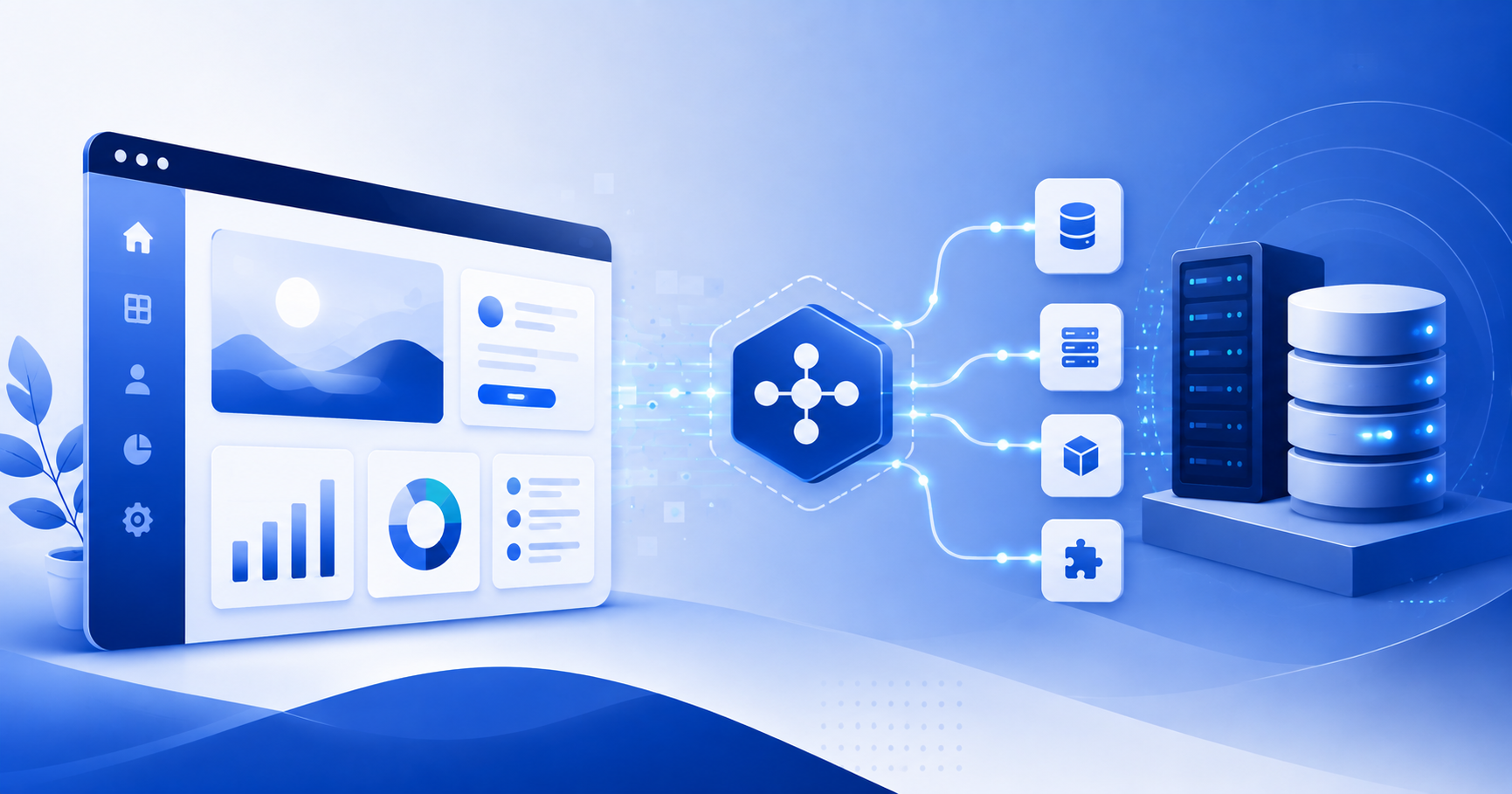
Here’s the uncomfortable reality: 80% of enterprises are running software architectures that cannot support modern AI. Decades-old monolithic applications, rigid databases, and brittle integrations aren’t just slowing things down — they’re creating a structural ceiling that no software patch can lift. This is the core challenge of legacy infrastructure modernization for AI adoption — and it’s one that 80% of enterprises are currently failing. The moment you try to connect an AI engine to a legacy core system, you hit three walls at once: data you can’t access in real time, codebases too fragile to extend, and infrastructure too slow to meet the latency demands of machine learning models.
This isn’t an IT backlog problem. It’s a valuation problem. Organizations that cannot operationalize AI are already being priced differently by investors, partners, and customers — and the gap is widening every quarter.
And the pressure isn’t coming from AI adoption alone.
The regulatory clock is also running. The U.S. Department of Health and Human Services has finalized amendments to the HIPAA Security Rule, with mandatory enforcement of updated cybersecurity controls targeted for late 2026. The single most important change: the old “addressable” classification — which allowed enterprises to document why they hadn’t implemented a given control — is gone. Multi-factor authentication, end-to-end encryption at rest and in transit, and documented 72-hour system restoration are now strictly required, not optional.
Enterprises running legacy codebases that can’t support these integrations don’t just face a compliance gap. They face penalties, breach liability, and reputational exposure — all at once.
The question the rest of this piece will help you answer is a simple one: Is your infrastructure one of the 80%?
The Real Cost of Doing Nothing
Let’s put a number on the problem before we talk about solutions.
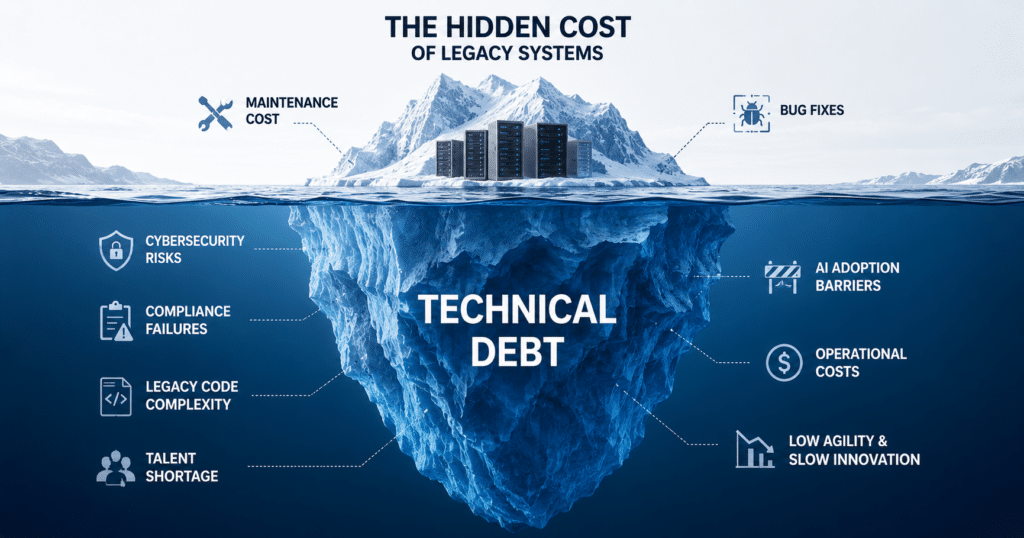
Research from the Consortium for Information & Software Quality (CISQ) indicates that 62% of U.S. firms still rely on legacy software — and maintaining it consumes between 72% and 80% of the average enterprise IT budget, according to Gartner. Read that again: for every dollar your organization designates for technology, as little as twenty cents is available for innovation, competitive differentiation, or AI adoption. The remaining eighty cents goes toward keeping aging systems alive.
At scale, this isn’t inefficiency. It’s structural self-sabotage. CISQ estimates that U.S. enterprises lose approximately $370 billion annually to technical debt — not million, billion. The federal government, per the U.S. Government Accountability Office (GAO), spends roughly 80% of its $100 billion IT budget on operating and maintaining existing systems, leaving almost nothing for the infrastructure that would actually move the needle.
| Metric | Figure | Source |
|---|---|---|
| U.S. firms still relying on legacy software | 62% | Saritasa, 2025 |
| Enterprise IT budget consumed by maintenance | 72–80% | Gartner |
| Accumulated U.S. technical debt | ~$1.52 trillion | CISQ, 2022 |
| Projected global modernization market by 2030 | $52.46 billion | Grand View Research |
The talent problem compounds the financial one.
According to Lightcast’s 2025 labor market analysis, engineers with modern AI and cloud skills now command a 28% salary premium over those without — nearly $18,000 more per year. That gap is widening every quarter as demand accelerates. On the other side of that equation sits your legacy maintenance team: a shrinking pool of engineers whose skills are increasingly rare, increasingly expensive to retain, and impossible to backfill at scale. The developers who built these systems and hold the institutional knowledge to keep them running are retiring. What gets left behind is highly fragile, largely undocumented software that no one on the current team fully understands. That’s not a technology risk. That’s a business continuity risk.
The result is a talent squeeze from both ends — you’re overpaying to maintain systems that are simultaneously preventing you from attracting the engineers who could modernize them.
Is Your System One of the 80%? Five Signs Your Infrastructure Isn’t AI-Ready
The statistics in the previous section describe an industry-wide problem. What follows helps you determine whether that problem is yours.
These signals don’t require an architectural audit to recognize. They show up in delayed roadmaps, stalled projects, and conversations your engineering leads are probably already having — just not always framing as a modernization problem.
Signal 1: Your AI pilots keep promising but never delivering.
The demos worked. But when it came time to connect the model to your actual systems — your CRM, your ERP, your transaction database — the integration failed, produced unreliable outputs, or required so much manual data preparation that the business case collapsed. The model wasn’t the problem. The infrastructure it needed to connect to was.
Signal 2: Your data team spends more time moving data than using it.
If your analysts are spending most of their time extracting and cleaning data before they can do anything useful with it, your data layer is the bottleneck. Legacy architectures that lock data inside siloed databases don’t just slow down your analytics team — they make meaningful AI adoption functionally impossible.
Signal 3: Your cloud migration happened, but the benefits didn’t.
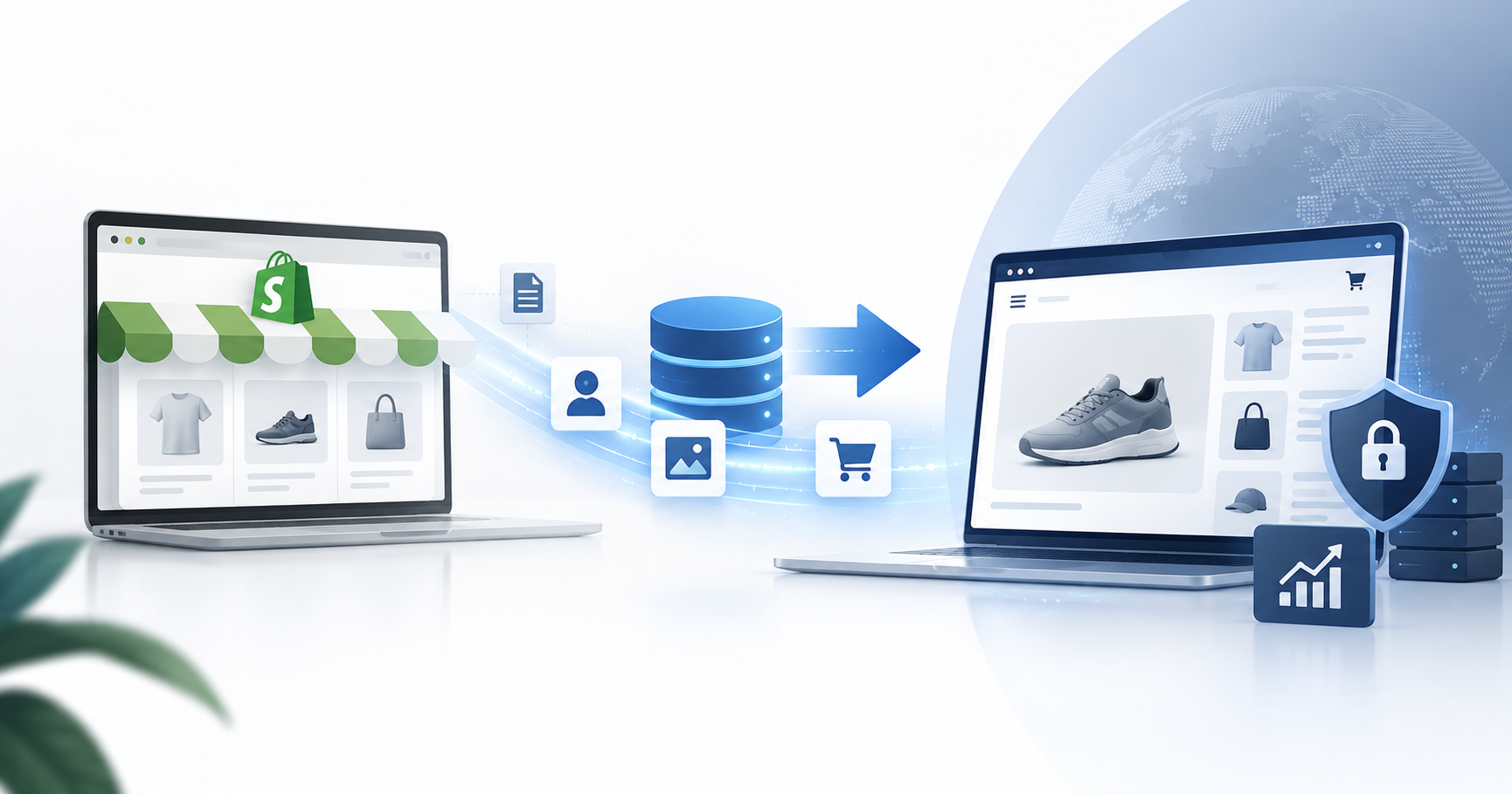
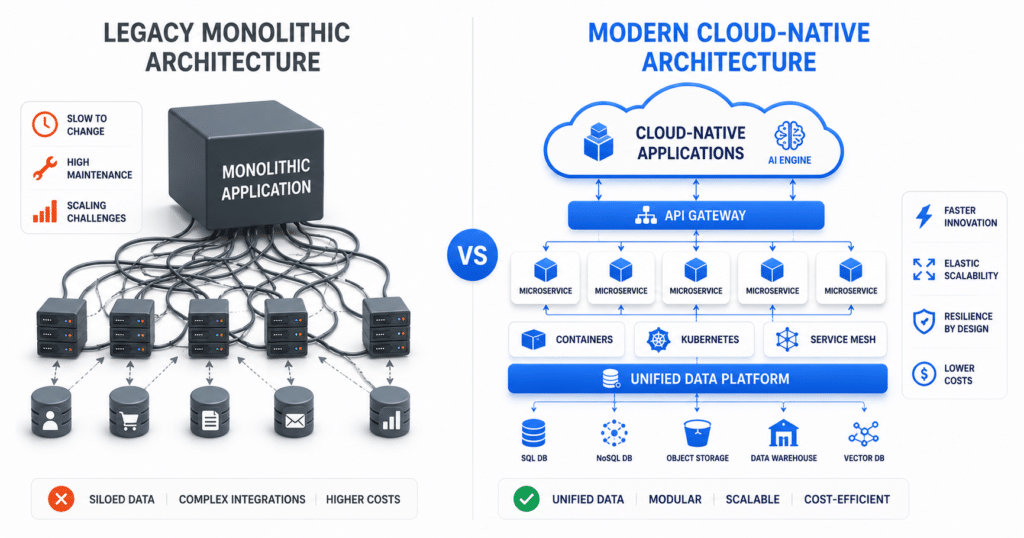
If you moved to the cloud but your architecture is still monolithic — the same tightly coupled codebase, now running on a cloud-hosted VM instead of an on-premise server — you lifted and shifted the problem, not solved it. Cloud hosting is not cloud-native, and that distinction determines whether AI workloads can actually run on your infrastructure.
Signal 4: Every integration project breaks something unexpected.
A change in one module breaks something in another. An API update requires weeks of regression testing. If this pattern is familiar, your architecture is too brittle to support the rapid iteration AI adoption requires. You can’t build on a foundation that punishes change.
Signal 5: Your compliance posture relies on documentation, not enforcement.
If your approach to security compliance involves documenting why certain controls aren’t implemented rather than technically enforcing them, the 2026 regulatory changes will make that position untenable. Legacy systems that can’t natively support MFA, encryption, and automated backup restoration don’t just create compliance gaps — they create liability.
If two or more of these describe your organization, your infrastructure is likely in the 80%. The enterprises that successfully modernize don’t start with the most advanced systems — they start by identifying the gap clearly before it becomes a crisis. The next section outlines exactly what the paths forward look like.
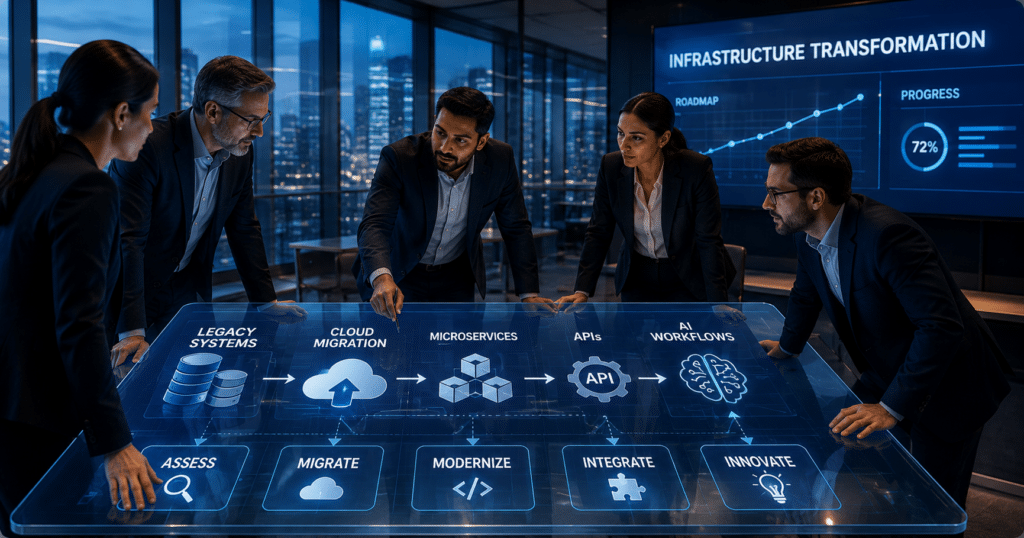
Four Paths to AI-Readiness: Which One Fits Your Situation?
The most common reason enterprises stall on modernization isn’t budget or willpower — it’s the assumption that it means rewriting everything from scratch. It doesn’t. There are four proven paths, and the right one depends on your current stack, your timeline, and how directly your legacy systems are blocking AI adoption.
Option A: Rehost — “Lift and Shift”
Move existing applications to a cloud-hosted environment with minimal modification. Nothing about the application changes — only where it runs. You gain cloud hosting economics but none of the performance or AI-readiness benefits that come from deeper modernization.
Right for you if: Your immediate priority is exiting on-premise infrastructure quickly, and deeper modernization is planned for a later phase.
Option B: Replatform — “Lift and Shape”
Migrate to the cloud with targeted optimizations — switching to a managed database service, containerizing specific workloads, or adopting a cloud-native runtime. Core application logic stays intact, but the infrastructure around it becomes significantly more capable.
Right for you if: Your application logic is sound but your infrastructure is the bottleneck, and you want real performance gains without the cost of a full overhaul.
Option C: Refactor — “Optimize for What’s Next”
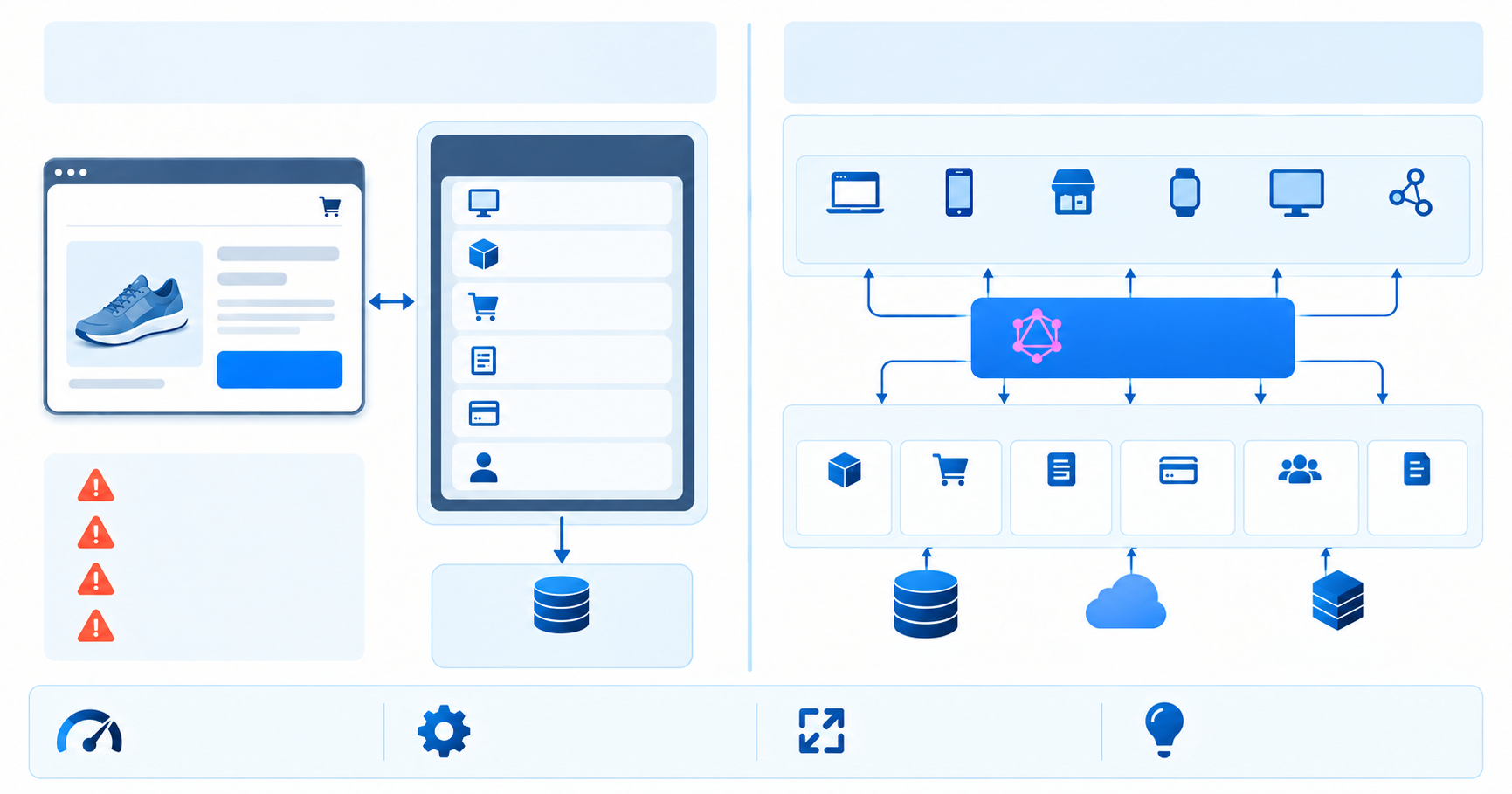
This is where real AI-readiness begins. You decompose monolithic applications into microservices, migrate data to unified platforms like Snowflake or Google BigQuery, and wrap legacy core logic in modern API layers that AI systems can actually connect to. Your business logic is preserved — but restructured into an architecture that supports real-time data pipelines and scales on demand.
Right for you if: AI adoption is a board-level priority but your pilots keep failing because they can’t reach clean data or integrate with core systems.
Option D: Rebuild — “Greenfield”
Build a new system from the ground up while running the legacy system in parallel during transition. The highest-investment path — but for systems that are genuinely beyond remediation, it’s the only option that delivers a clean foundation.
Right for you if: Your legacy system has no living documentation, the engineers who built it are gone, and every attempted integration triggers cascading failures.
How to choose
Most enterprises apply different options to different systems simultaneously. A non-critical internal tool gets rehosted. A customer-facing platform gets refactored. A compliance system built over fifteen years gets rebuilt. Three questions drive the decision:
- How directly is this system blocking your AI roadmap?
- What is the true annual cost of keeping it as-is — in maintenance, talent premium, and lost capability?
- What does failure look like if the modernization is disruptive?
If you’re unsure where your systems fall, that uncertainty itself is a signal. The enterprises that modernize successfully don’t start with a vendor — they start with an honest architectural audit.
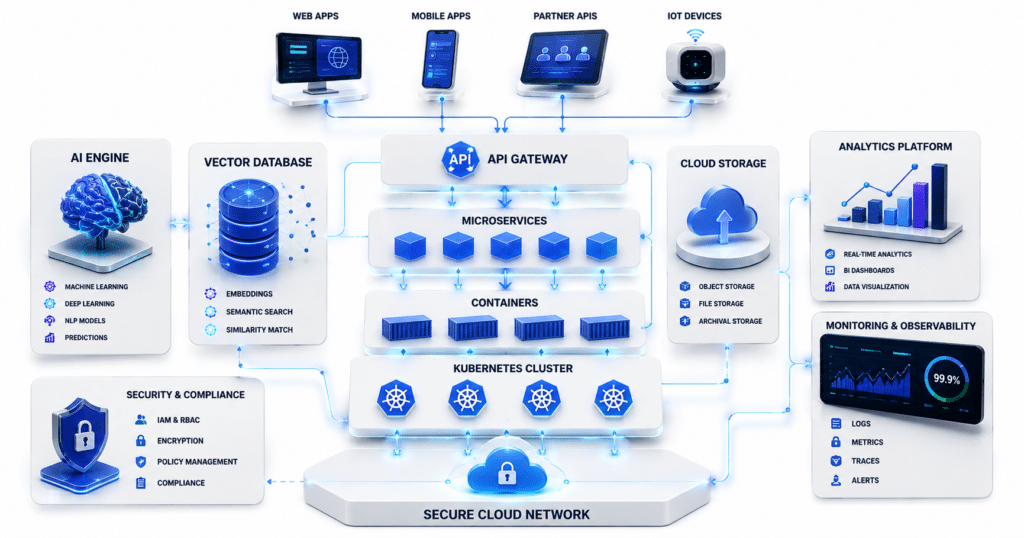
What Legacy Infrastructure Modernization for AI Adoption Actually Delivers
Speed and cost aren’t abstract benefits of modernization — they’re measurable, and the numbers are significant enough to belong in a board conversation, not just an engineering review.
Enterprises that have migrated from legacy monolithic architectures to modern cloud-native frameworks using modern compiled runtimes are reporting three concrete outcomes:
- Deployments that are 60% faster. Legacy systems running traditional compilation methods take anywhere from 100 to 300 milliseconds to start up a single service. Modern infrastructure brings that under 20 milliseconds. In environments where hundreds of services need to spin up simultaneously to handle real-time AI requests, that gap translates directly into user-facing latency and cloud compute costs — every millisecond at scale is money.
- Cloud infrastructure costs cut by half. Organizations migrating to modern application frameworks report CPU utilization dropping by 50%, and the number of virtual machines required decreasing by 60–70%. Fewer machines running more efficiently means your cloud bill shrinks materially — often enough to self-fund the next phase of modernization.
- AI workloads that actually run. Legacy runtimes carry memory overhead that makes them incompatible with the high-throughput, low-latency demands of machine learning inference. Modern compiled applications reduce RAM consumption by 40–60%, which means AI models can be served at scale without the infrastructure choking under the load.
These aren’t theoretical projections. They are benchmarked outcomes from production migrations — the kind your engineering team can validate and your CFO can model against your current cloud spend.
The deeper point is this: modernization isn’t a cost center. For most enterprises still running legacy infrastructure, it is the highest-ROI infrastructure investment available — because it simultaneously reduces operating costs, unblocks AI adoption, and removes the talent premium you’re currently paying to keep old systems alive.
The 2026 Compliance Deadline: A Hard Stop for Legacy Infrastructure
Modernization isn’t only being driven by AI ambition and cost pressure. For a growing number of industries, it is being mandated by regulators — and the deadlines are no longer flexible.
The most immediate and concrete example is the updated HIPAA Security Rule, finalized by the U.S. Department of Health and Human Services and targeting mandatory enforcement in late 2026. But the broader pattern applies across healthcare, financial services, government contracting, and any enterprise handling sensitive data at scale. Regulators across these sectors are converging on the same expectation: that security controls are technically enforced, not just documented.
What’s actually changing in 2026
The single most significant shift in the updated HIPAA Security Rule is the elimination of the “addressable” classification. Under the previous framework, organizations could document why a specific security control wasn’t implemented and remain compliant. That flexibility is gone. The following controls are now strictly mandatory — not best practices, not recommendations:
- Enforced multi-factor authentication across all users accessing systems that contain protected health information — no exceptions for legacy interfaces or internal tools.
- End-to-end encryption for data in transit and at rest, covering database storage, file systems, and all system backups.
- 72-hour system restoration capability, with tested and documented proof that critical systems and lost data can be recovered within that window following an incident.
- Active vendor verification, requiring written annual confirmation that every technology partner has fully implemented these same controls — a signed BAA alone is no longer sufficient.
- Annual penetration testing and biannual vulnerability scans, with evidentiary audit logs and role-based access controls maintained as ongoing operational requirements.
Why legacy infrastructure fails this test
Most legacy codebases were not built with these controls as foundational requirements — they were built in an era when security was often layered on after the fact, or documented rather than enforced. Retrofitting MFA, encryption at rest, and automated backup restoration onto a monolithic system is technically possible, but it is expensive, fragile, and frequently incomplete. A managed cloud environment built on modern infrastructure handles most of these requirements natively — access logging, automated backups, encrypted storage, and role-based access are default capabilities, not custom builds.
For healthcare organizations and any enterprise operating in a regulated environment, the 2026 deadline reframes modernization from a strategic investment into a compliance requirement with a fixed date. The question is no longer whether to modernize systems that can’t meet these standards. It’s whether you do it on your own timeline or under regulatory pressure.
What to Look for in a Modernization Partner
Not all modernization engagements deliver the same outcome. The difference usually comes down to how the partner approaches the engagement — before a single line of code is written.
Four criteria separate partners worth working with from those who leave you with a partially modernized system and a larger bill:
- They start with discovery, not proposals. A credible partner won’t quote a solution before understanding your architecture. The first phase should always be a structured audit — mapping dependencies, identifying compliance gaps, and establishing a realistic baseline.
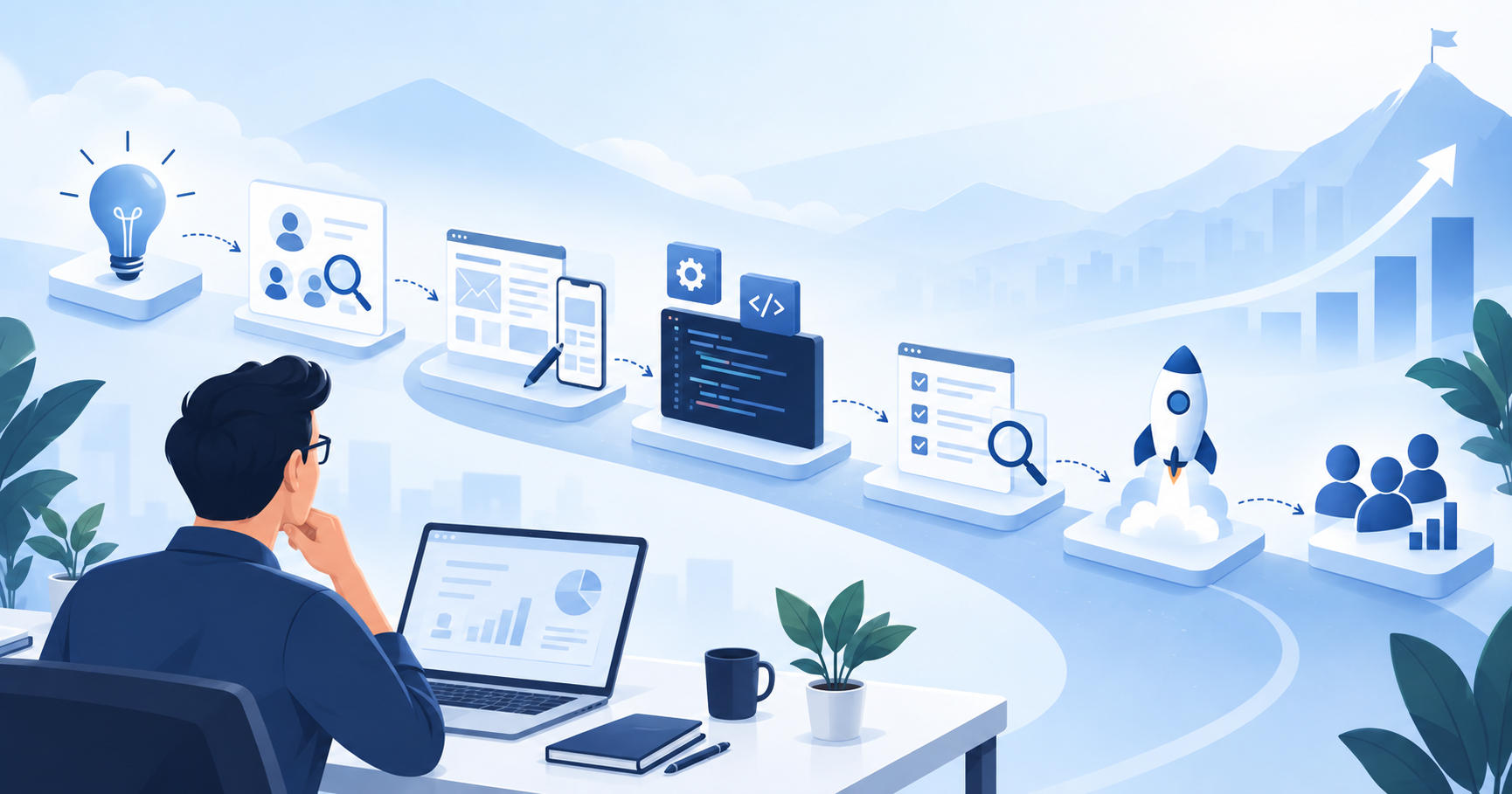
- They work in phases with defined exits. Look for discrete phases — discovery, technical design, quality testing, and post-deployment support — with clear deliverables at each stage that give you the option to pause or reassess.
- They commit to SLAs, not just timelines. A timeline is a projection. An SLA is a commitment — with accountability if critical response thresholds aren’t met.
- Their pricing is transparent upfront. Vague pricing signals vague delivery. Partners who are clear about costs before engagement begins signal a delivery model structured enough to be predictable.
How Vedhas Approaches Modernization
Vedhas Technology Solutions is an official Google Cloud Partner with over eight years of experience in enterprise-scale modernization across healthcare, e-governance, and B2B services.
Every engagement begins with a structured Infrastructure Readiness Assessment — mapping your existing architecture, identifying compliance gaps, and establishing a modernization baseline before any solution is proposed. Delivery follows the four-phase model above, with weekly progress communication throughout. Core capabilities include cloud infrastructure migration, data governance, HIPAA-compliant system design, and mission-critical deployment — making modernization the center of what Vedhas does, not a side offering.
Key Takeaways
If you’ve read this far, here’s what matters most:
- Legacy architectures aren’t just inefficient — they are structurally incompatible with the AI tools your competitors are already deploying.
- The financial cost of inaction is compounding: 72–80% of your IT budget is likely being consumed by maintenance, leaving almost nothing for the modernization that drives growth.
- The 2026 regulatory changes across healthcare, financial services, and government contracting remove compliance flexibility that legacy teams currently rely on. The deadline is fixed.
- Modernization doesn’t require a risky all-at-once rewrite. Four proven paths exist — and the right one depends on your current stack, not a vendor’s preference.
- The enterprises winning with AI right now didn’t start with better models. They started with cleaner data layers, faster infrastructure, and APIs that actually connect their systems.
The next step isn’t a massive commitment. It’s an honest assessment of where your infrastructure stands today.
Frequently Asked Questions
How long does a typical legacy modernization project take?
The timeline depends on the complexity of your systems and the modernization approach. Smaller applications may take a few months, while enterprise-wide transformations can be completed in phases over several months to minimize business disruption.
Can legacy systems be modernized without disrupting daily business operations?
Yes. Many organizations modernize incrementally by migrating or upgrading applications in phases while keeping critical business systems operational throughout the process.
What industries benefit the most from legacy infrastructure modernization?
Industries such as healthcare, financial services, manufacturing, retail, logistics, and government benefit significantly because they rely on secure, scalable, and data-intensive systems to support growth, compliance, and AI initiatives.
What is the first step before starting a legacy modernization initiative?
The first step is conducting a comprehensive infrastructure assessment to identify technical debt, application dependencies, security gaps, and opportunities for modernization. This helps prioritize investments and reduce implementation risks.
How much does legacy infrastructure modernization typically cost?
Costs vary based on the number of applications, their complexity, and the modernization strategy. A phased approach often helps organizations spread investment over time while achieving measurable business value at each stage.
Your 2026 Deadline Is Closer Than Your Roadmap Suggests
Here’s why that assessment can’t wait. AI adoption timelines are compressing, the 2026 compliance deadline is fixed, and the cost of maintaining legacy infrastructure compounds every quarter you wait.
The enterprises that will be in the strongest position twelve months from now aren’t the ones who started with the biggest budgets — they’re the ones who started with an honest assessment of where they actually stand. That assessment is the hardest thing to do objectively from the inside.
If you already know your infrastructure has gaps and want to understand what a modernization engagement looks like for your organization, book a direct consultation with the Vedhas engineering team — a focused conversation about your architecture, your timeline, and a realistic path forward.
Legacy modernization is no longer a backend IT initiative. It is the foundational decision that determines whether your organization can compete in an AI-driven market, meet the regulatory demands of 2026, and stop hemorrhaging budget on infrastructure that actively works against your strategy. The cost of waiting is no longer theoretical — it is measurable, compounding, and increasingly difficult to reverse. The best time to start was two years ago. The next best time is now.