Overview
Most SaaS products fail before launch — not because the idea was wrong, but because of avoidable execution errors. The seven saas product development mistakes covered here — from over-engineering before validation to neglecting onboarding UX — are the ones that drain runway and kill momentum fastest. Read this before you write a single line of code or sign a development contract.
You have a SaaS idea that solves a real problem. You have a budget. You are ready to build. The mistake most non-technical founders make next is assuming development is the hard part. It is not. The hard part is making the right decisions before and during development — decisions that determine whether your product reaches paying customers or stalls out in an endless rebuild cycle.
SaaS Product Development at a Glance: 7 Mistakes and Their Cost
Use this table to orient yourself before diving in. Every mistake below comes with an identifiable symptom, a predictable cost, and a point in the build cycle where it typically strikes.
| Mistake | Primary Risk | When It Hurts Most |
|---|---|---|
| Over-engineering before validation | Wasted runway on features no one uses | Pre-launch |
| Hiring the cheapest developer | Poor code quality, hidden rework costs | Mid-build |
| Poor or missing scope documentation | Scope creep, budget overruns, delivery delays | Throughout build |
| Ignoring mobile responsiveness | Lost users, poor conversion, SEO penalties | Post-launch |
| Neglecting customer onboarding UX | High churn in first 30 days despite good product | Post-launch |
| Skipping the MVP and building full product | Six-figure spend on a market-rejected product | Pre-launch |
| Treating security as a post-launch problem | Data breaches, compliance failures, lost enterprise deals | Any stage |
Mistake 1: Over-Engineering Before Validation
The instinct to build the best possible version of your product from day one is understandable. The problem is that “best possible” at the idea stage almost always translates to “most expensive and slowest to ship.”
This is the most common trap first-time SaaS founders fall into. It looks like this: a founder hires a team, spends four to six months building a full-featured platform with custom dashboards, role-based permissions, advanced reporting, and a mobile app — and then discovers that the core workflow users actually need was something far simpler.
According to CB Insights’ widely cited analysis of startup post-mortems, 42% of failed startups name “no market need” as a primary reason for their failure (CB Insights). The majority built extensively before testing whether anyone would pay for what they created.
What It Costs You
Every feature you build before validating demand is a liability. Engineering time, QA cycles, and infrastructure costs compound quickly. A feature set that took 12 weeks to build may need to be partially dismantled when early user feedback reveals a different workflow is needed — adding another 6–8 weeks of rework on top of a budget already under strain.
What to Do Instead
Identify your single core value-generating action — the one thing your SaaS does that makes a user’s problem disappear. Build that, and only that, first. Validate it with 10–20 real users before expanding. This is not about shipping a broken product; it is about shipping a focused one that proves demand before you invest in depth.
Mistake 2: Picking the Cheapest Freelance Developer
Budget pressure is real. But treating developer selection as a pure cost-minimization exercise is one of the most expensive decisions a non-technical founder can make — because the consequences appear months later, not upfront.
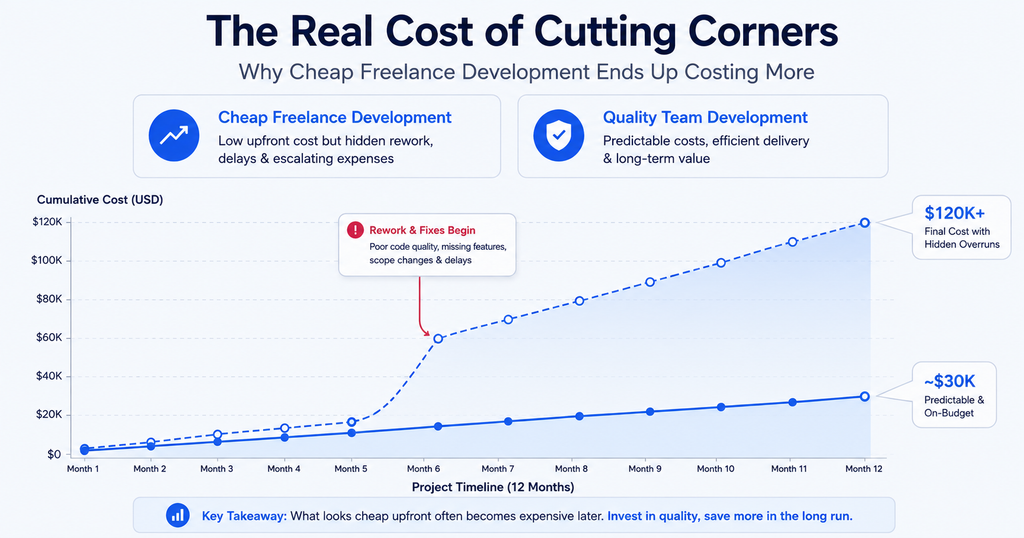
The pattern is consistent: a founder finds a developer on a freelance marketplace at 15–25/hour, and six months later a different team is needed to audit and partially rewrite the codebase before the product can scale or pass a security review. The recovery engagement routinely exceeds the original development spend.
Why Cheap Developers Cost More
At TechVedhas, we regularly receive projects where a founder’s first team has delivered working code — but not maintainable code. Without sound architecture decisions, code review standards, or documentation practices, the codebase becomes brittle: it breaks under real-world load, cannot be handed to a new developer without significant re-onboarding, and fails security audits when enterprise contracts are on the table.
The hidden costs accumulate fast: debugging cycles, delayed launch, early user loss, and the full recovery engagement bill. In our experience, these combined costs typically run two to three times the original development budget — making the “cheap” hire the most expensive decision in the project’s history.
What to Look For Instead
Evaluate developers on architecture decisions, communication clarity, and delivery track record — not hourly rate alone. Ask to see documented code samples and prior SaaS products they have shipped to production. If you are not technical enough to assess code quality yourself, engage a fractional CTO or independent technical advisor for the vetting process before you sign. A slightly higher rate from a team with a verified SaaS delivery record is consistently cheaper than a low-cost engagement that compounds debt with every sprint.
Mistake 3: Poor Scoping and Missing Documentation
“We will figure it out as we go” is not a development methodology — it is a budget leak with a delayed fuse.
Poor scoping is the quiet driver behind the majority of software project overruns. When a SaaS product enters development without a written functional specification, every ambiguity becomes a negotiation point. Developers interpret vague requirements differently. Feature boundaries shift mid-sprint. Deadlines extend. Costs climb — and no single decision caused it.
The Scope Creep Trap
Scope creep — the gradual addition of features and requirements beyond the original agreed scope — is almost always a scoping failure, not a development failure. It happens when there is no written definition of what is in and what is explicitly out of the build. Every “small addition” costs real engineering time, and the cumulative drift can double a development budget before anyone identifies the pattern.
PMI’s Pulse of the Profession report found that organizations waste an average of 11.4% of their total investment due to poor project performance — with inadequate requirements documentation among the top contributing factors (PMI, 2020).
What a Proper Scope Document Looks Like
A functional specification for a SaaS product should define: all user roles and their permissions, every user flow described step by step, each screen and its expected behavior, third-party integrations required, performance thresholds, and explicit exclusions — what will not be built in this phase. This document becomes the contract between you and your development team and the reference point that prevents “I thought that was included” disputes throughout the engagement.
For context on how scope decisions directly affect timeline and overall project cost, see our analysis of software project timeline and budget factors.
Mistake 4: Ignoring Mobile Responsiveness
Mobile devices now account for more than 60% of global web traffic, according to StatCounter Global Stats (2024). If your SaaS product is not fully functional on mobile, you are immediately inaccessible to a majority of the internet — including the decision-makers who evaluate tools and approve budgets on their phones between meetings.
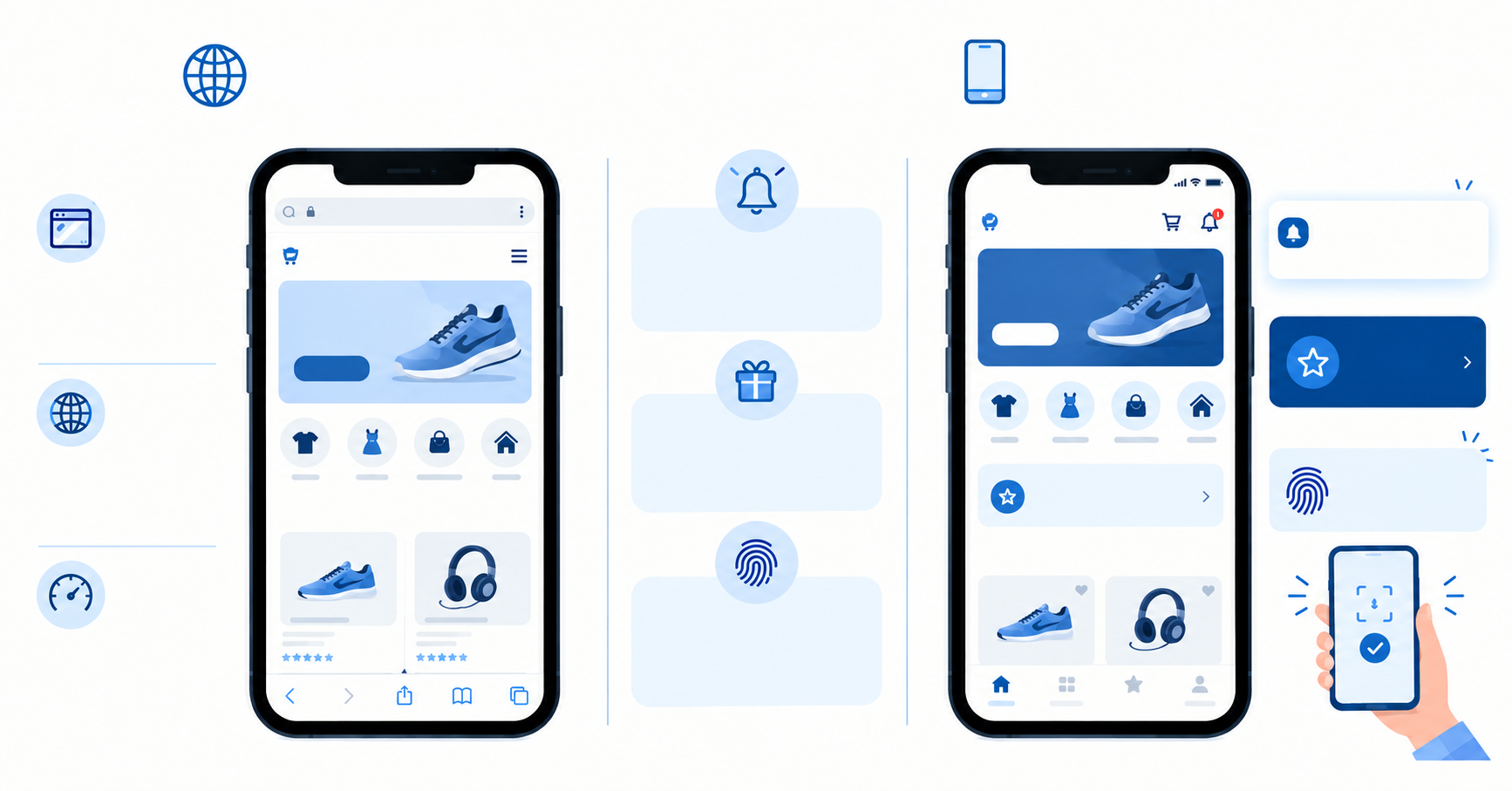
Non-technical founders frequently assume “mobile-friendly” means the desktop layout resizes when viewed on a phone. It does not. True mobile responsiveness means every interaction, form, data table, and navigation element is purposefully designed and tested at 375 pixels — not retrofitted under pressure after the first round of user complaints.
The SEO Penalty You Did Not Plan For
Google uses mobile-first indexing, meaning it crawls and ranks your web presence based on the mobile version of your content. A product that fails basic mobile usability tests ranks lower in organic search — compounding user loss with a discovery loss before anyone reaches your sign-up page. This is not a minor inconvenience; it is a compounding revenue problem that grows quietly over time.
How to Build Mobile-In, Not Mobile-After
Mobile responsiveness must be specified in your functional scope document before development begins. Design mobile-first — building the smallest viewport first and scaling up to desktop, not the reverse. Every sprint’s acceptance criteria should explicitly require mobile testing on real devices before any feature is marked complete. Treating mobile as post-launch polish consistently adds weeks of remediation and technical debt that is expensive to unwind cleanly.
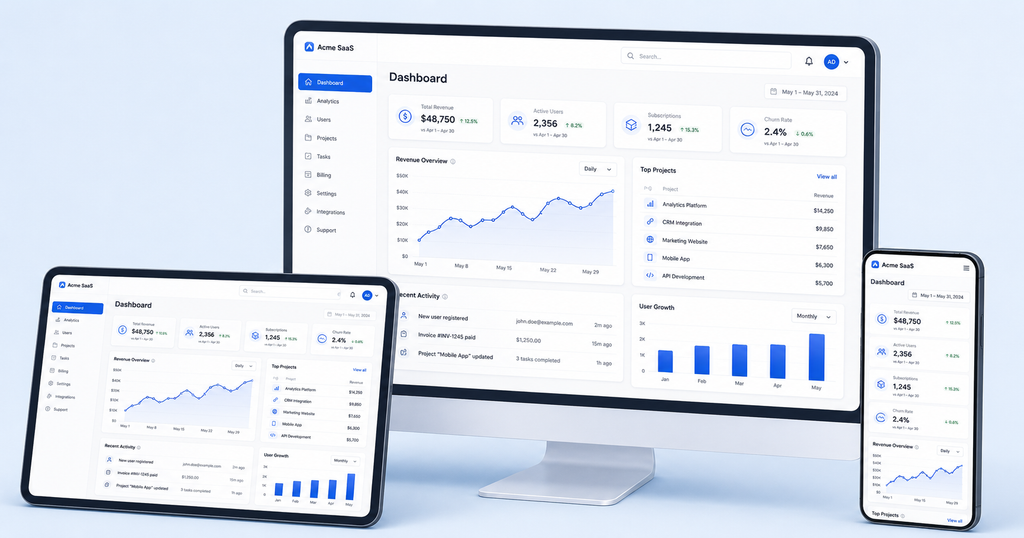
Mistake 5: Neglecting Customer Onboarding UX
You have built a genuinely good product. Users sign up during your beta. And then most of them never return for a second session.
This is the onboarding problem — and it strikes after the product is built, precisely when most founders believe the difficult work is behind them.
Research across SaaS platforms consistently finds that 75% of users abandon a product within the first week if onboarding does not deliver a clear quick win — a moment where the product’s value becomes immediately tangible (industry benchmark, multiple sources including Userpilot and Loyalty.cx, 2024). Good features cannot compensate for a broken path to them.
Onboarding UX refers to the end-to-end experience a new user has from sign-up to the completion of their first meaningful action inside your product — what product designers call the “aha moment.” If the journey to that moment is confusing, slow, or incomplete, users churn before they ever reach the value your product delivers.
What Good Onboarding Actually Looks Like
Wyzowl’s customer onboarding research found that 86% of users say they would be more loyal to a business that invests in onboarding content that welcomes and educates them after sign-up (Wyzowl, 2020). Effective onboarding is not a tooltip tour layered on top of a complex UI. It is a purposefully designed sequence that reduces setup friction, guides users to their first core action within minutes of registration, surfaces the product’s primary value before asking anyone to configure anything, and introduces advanced features progressively — only after the user is already engaged and returning.
When to Design Onboarding
Onboarding must be designed before development begins — in parallel with your core product flows — not added as a final polish step before launch. It requires collaboration between product design, engineering, and customer success simultaneously. And it should be validated with real users during beta testing, not assumed to function based on internal team consensus.
For a closer look at how onboarding design differs between internal tools and commercial SaaS products, our guide on turning an internal tool into a SaaS product covers the critical distinctions founders often miss during this transition.
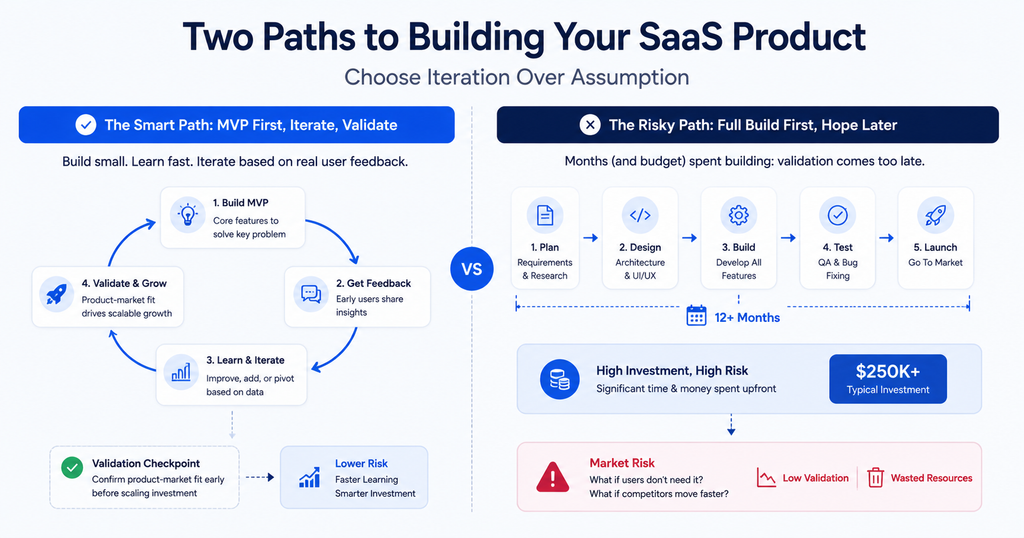
Mistake 6: Skipping the MVP and Building a Full Product
Closely related to over-engineering but distinct in its consequences: many non-technical founders feel uncomfortable launching anything they consider “incomplete,” and so delay launch until the product contains every feature they envisioned at the outset.
The result is a six-to-twelve-month build cycle, a significant budget commitment, and a market that may have shifted — or may simply not want what was built in the format it was built. This is not a hypothetical risk; it is the default outcome when founders build without validating assumptions incrementally.
What an MVP Is — and Is Not
A minimum viable product is not a broken or stripped-down version of your final vision. It is the smallest version of your product that delivers real, measurable value to a real user — and is refined enough for that user to pay for or actively choose to use. It tests your core market assumption before you invest in building everything else.
Skipping the MVP stage eliminates the feedback loop that should be shaping your entire product roadmap. Without it, you build based on assumptions. With it, you build based on evidence. In our experience at TechVedhas, clients who validate with an MVP first consistently arrive at their full build with a sharper feature roadmap, a clearer understanding of what users actually need, and far less waste in their second phase of development — because they are building the right things, not guessing at them.
Mistake 7: Treating Security and Compliance as Post-Launch Problems
Security is almost universally deprioritized by non-technical founders in early build stages because it is invisible to users and feels abstract compared to features. This is a structural mistake with lasting consequences.
Building security into a SaaS product after the fact is architecturally expensive — comparable to installing a load-bearing structural wall in a completed building. Data encryption, access control architecture, audit logging, and authentication flows are decisions that belong in the design phase, not the remediation queue after a breach notification or a failed compliance audit.
The Business Risk Extends Far Beyond the Technical
If your SaaS targets enterprise buyers, healthcare organizations, or financial services companies, you will be asked for SOC 2 Type II compliance, HIPAA alignment, or GDPR documentation before a contract is executed. A product built without these considerations requires a dedicated security remediation engagement — potentially months of engineering effort — that delays your enterprise sales pipeline by quarters rather than weeks. More than once, we have seen a founder lose a significant enterprise deal at the contract stage because their product could not pass a security questionnaire that would have been straightforward to address at build time.
The Minimum Security Standards to Build In From Day One
At a minimum, every commercial SaaS product should implement the following from its first development sprint: HTTPS enforced across all endpoints, data encrypted at rest and in transit using current standards, role-based access control with least-privilege principles, secure authentication via OAuth 2.0 or SAML, and comprehensive audit logging of all data access events. These are not advanced enterprise requirements — they are the baseline for any SaaS product that expects to sell to businesses that take data seriously.
FAQ: saas product development mistakes — Answers to Real Founder Questions
What is the most common saas product development mistake non-technical founders make?
Over-engineering before validation is the most common and costly pattern. Founders build extensive feature sets before confirming users will pay for the core value proposition — spending months and significant budget on a product that needs fundamental rework after early user feedback reveals a different workflow is needed.
How do I scope a SaaS project properly if I am not technical?
Start by writing user stories — plain-language descriptions of what each type of user needs to do in the system and why. Then work with a business analyst or technical architect to translate those into a functional specification. The critical output is a document that explicitly defines what is in scope and what is out of scope before development begins, so there is a shared reference point for every decision that follows.
Is it risky to hire a freelance developer for SaaS development?
The risk is not in freelancing itself — it is in hiring purely on price without evaluating code quality, communication practices, and verifiable SaaS delivery experience. A seasoned freelance developer with a track record of shipping maintainable SaaS products can be an excellent choice. The cheapest option almost always introduces compounding technical debt that costs more to resolve than the initial savings.
When should onboarding UX be designed during a SaaS build?
Onboarding should be designed before development begins, in parallel with your core product user flows — not added as a final step before launch. It requires input from product design, engineering, and customer success simultaneously, and must be validated with real users during beta testing rather than assumed to work based on internal review.
Does mobile responsiveness matter for a B2B SaaS product?
Yes, even for B2B SaaS. Decision-makers, field teams, and executives regularly access tools on mobile devices. Google’s mobile-first indexing also means a non-responsive product ranks lower in search results — reducing organic discovery before users ever reach your sign-up page. Mobile must be a designed-in requirement from sprint one, not a retrofit after complaints arrive.
What does a SaaS MVP typically cost, and how does that compare to a full build?
Industry benchmarks place SaaS MVP development in three tiers based on complexity: a simple MVP focused on a single core workflow typically ranges from 15,000 to 50,000; a standard MVP with integrations, payment processing, and multi-tenant architecture runs 50,000 to 100,000; and a complex MVP involving AI/ML, healthcare compliance, or advanced scalability can reach $100,000 or more. A full-featured SaaS build compounds these costs significantly. Starting with an MVP lets you validate market fit before committing to the full budget — which is the principal reason investors and experienced product builders recommend the staged approach. Use our project estimation tool to scope your specific build.
How much does it cost to retrofit security and compliance into an existing SaaS product?
It is substantially more expensive than building it in from the start. Based on data published by SOC 2 compliance vendors including Vanta, Drata, and Scrut.io, achieving SOC 2 Type II compliance for a small-to-midsize SaaS company runs 30,000 to 100,000 all-in for the first year — covering audit fees, tooling, and internal engineering time. For a product not built with security controls in mind, the remediation engineering required before you can even begin that audit process adds further cost and delay. Building HTTPS enforcement, role-based access control, encrypted data storage, and audit logging in from the first sprint costs a fraction of that — and keeps your enterprise sales pipeline clear.
Can a SaaS product fail even if the original idea is strong?
Yes. CB Insights data shows that 42% of failed startups name “no market need” as a primary cause — but a close analysis of these failures reveals many had a sound core idea executed without sufficient validation or process discipline. A strong idea built with flawed execution consistently loses to a comparable idea built with incremental validation and a disciplined development process.
Build Your SaaS on the Right Foundation
The mistakes covered in this guide are not edge cases — they are the default trajectory for non-technical founders who enter development without a disciplined process and a vetted technical team. Every one of them is avoidable. None require hindsight to catch; they require the right questions asked before the build begins.
Before you sign a development contract or plan your first sprint, it is worth having an experienced team review your product brief, identify which of these risk patterns already exist in your plan, and pressure-test your assumptions before they become expensive to unwind.
TechVedhas works with non-technical founders to scope, architect, and build commercial SaaS products — from MVP validation through full-scale deployment.
to review your product plan with our team, or get a project estimate to understand what a properly scoped build actually costs.